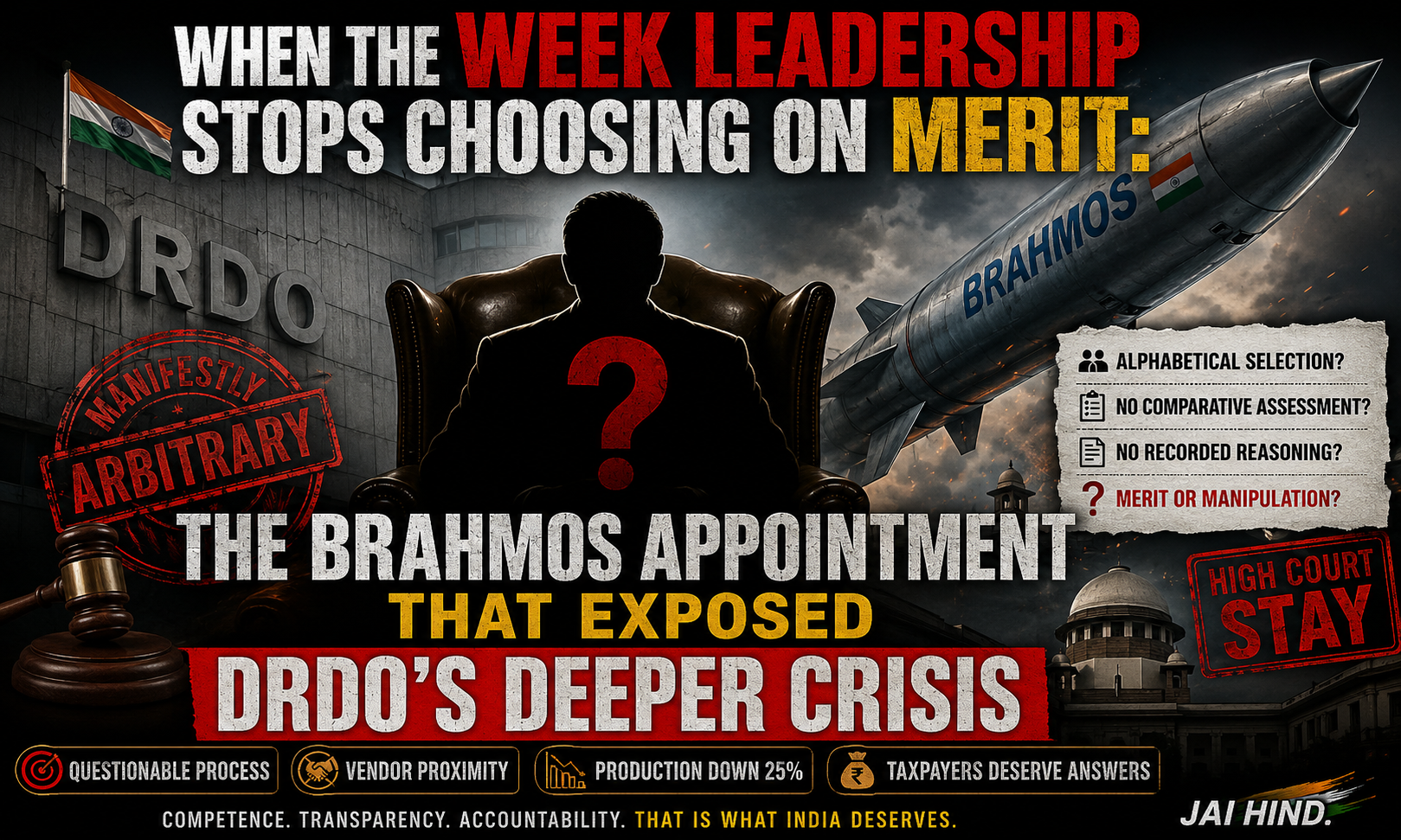
A tribunal called the selection “manifestly arbitrary.” The High Court has stayed that finding for now. But the questions raised by the appointment go far beyond one individual — they strike at the credibility of decision-making inside India’s strategic defence establishment.
There are moments when an institutional decision becomes bigger than the individual who receives the appointment.
The appointment of JR Joshi as DG, BrahMos is one such moment.
This is not merely a dispute between two scientists. It is a test of whether India’s strategic institutions still understand the difference between discretion and arbitrariness, authority and accountability, eligibility and merit.
And the most uncomfortable fact is not an allegation made by a critic.
It is what the CAT Hyderabad Bench, itself recorded in its judgment of December 29, 2025.
The Tribunal — a bench of Dr. Lata Baswaraj Patne and Varun Kul Kaumudi — quashed the appointment and directed the MOD and DRDO to reconsider the candidature of Distinguished Scientist Dr. Sivasubramaniam within four weeks, with an interim in-charge arrangement to be made until then. More significantly, the Tribunal concluded that there was “manifest arbitrariness” in the decision-making process.
That finding deserves to be examined — not buried beneath bureaucratic silence.
THE ALPHABETICAL ORDER QUESTION
Three scientists were shortlisted for the post
According to the Tribunal record, the three candidates were awarded identical scores — reportedly 80 marks each — while the Selection Committee forwarded the names to the appointing authority in alphabetical order.
The Tribunal specifically noted that no rule had been shown to justify arranging the recommended names alphabetically.
Stop and think about that.
Alphabetical order may be perfectly reasonable for a telephone directory.
But when the Government of India is choosing the head of a strategically critical organization associated with one of the country’s most important missile programmes, the obvious question is:
Where is the comparative assessment?
Where is the documented reasoning?
Where is the distinction between one equally-scored candidate and another?
Where is the record demonstrating why one scientist was considered more suitable than the others?
A government appointment to a strategic scientific position cannot be reduced to a mathematical exercise in alphabetical arrangement.
It means the questions remain alive.
A HIGH COURT STAY IS NOT A CLEAN CHIT
This distinction is essential.
On January 7, 2026, a Division Bench of the Telangana High Court — Chief Justice Aparesh Kumar Singh and Justice G.M. Mohiuddin — granted an interim stay suspending the operation of the CAT’s December 29 order, on petitions filed by both Dr. Joshi and the Union of India. That allowed Dr. Joshi to continue in the post while the legal challenge proceeds.
That is an interim judicial development.
It is not a judicial declaration that every
It tells senior scientists that years of service and peer recognition may be secondary to internal equations.
And most dangerously, it creates the perception that the system can decide first and justify later.
They are pro-DRDO questions.
The danger is not one weak appointment.
The danger is an ecosystem in which people learn that compliance is safer than competence, silence is safer than dissent, and proximity to power is more valuable than technical achievement.
That is how institutions hollow themselves out.
Not overnight.
Not through one scandal.
But through hundreds of small decisions in which the wrong incentive is rewarded.
If the decision was fully justified, publish the reasoning.
If the comparative assessment exists, show that the process was rigorous.
inquiry and due process.
That is how institutions regain credibility.
Not through silence.
Not through intimidation.
Not through selective leaks.
Not through unverified claims presented as fact.
Through evidence;
Some facts that there is no comparison between Dr. Sivasubramaniam and Dr JR Joshi because the DG BrahMos post needs the missile core expertise as they compared Project Director with Project Manager Technical awards with paper awards.
Senior most with junior most
Actual they focused corruption expertise, proximity with vendors, and derailing capacity of projects, bluffing expertise and for most loyalty with super corrupt lobby of ex DRDO stalwarts.
Justifying above
Asked feedback from PD Kusha and LRSAM, Joshi inducted all his Kusha and LRSAM vendors, if any oppose, he did random mass transfer, termination, two employed died with heart attack, about derailing capacity BrahMos production is down 25% after Joshi appointment, pls checked from records.
Best joke of bluffing, she the DRDO tweet regarding production in Lucknow and revenue generation.
There are no full facilities established in Lucknow, what they are doing they are only collecting the main part and war head part from Pilani, Hyderabad and Nasik and fixing the bolts in Lucknow and claiming by billing with GST.
Dr. Joshi, if Honorable Yogi ji gets this info maybe he will send Bulldozer at your door step.
Next if 100 number BrahMos earning revenue nearly 1100 Cr then how many will earn as mentioned 5200 Cr in tweet pls check the balance sheet for confirming the claims.
Regarding loyalty EX DG (BrahMos), Mishra informed to some responsible Philipe person one day before selection that JR Joshi is next DG and myself congratulations to Dr Kamat by what’s up same time one day before selection, his decision in advance so anyone imagine how weakest Chairman was run the DRDO.
Next biggest news that smart DG HR playing efforts to promote himself and Joshi in DS post. As both are in seniority list 31 and 40
Rest senior and competent scientist will get “Baba ji ka Thullu’’
Why because they deserve it, they never raise their voices against this rotten system.
It is a very biter truth of current DRDO.
BRAHMOS DESERVES BETTER
BrahMos deserves leadership selected through competence, credibility, transparency and strategic judgement.
DRDO deserves an HR system that strengthens — not weakens — the scientific establishment.
And India’s taxpayers deserve to know that every rupee spent on strategic defence infrastructure is backed by documentation, engineering discipline and accountability.
The High Court has stayed the operative consequences of that judgment, and the matter continues through the judicial process.
And if something went wrong —
find it, fix it, and hold the responsible people accountable — through due process, not presumption.
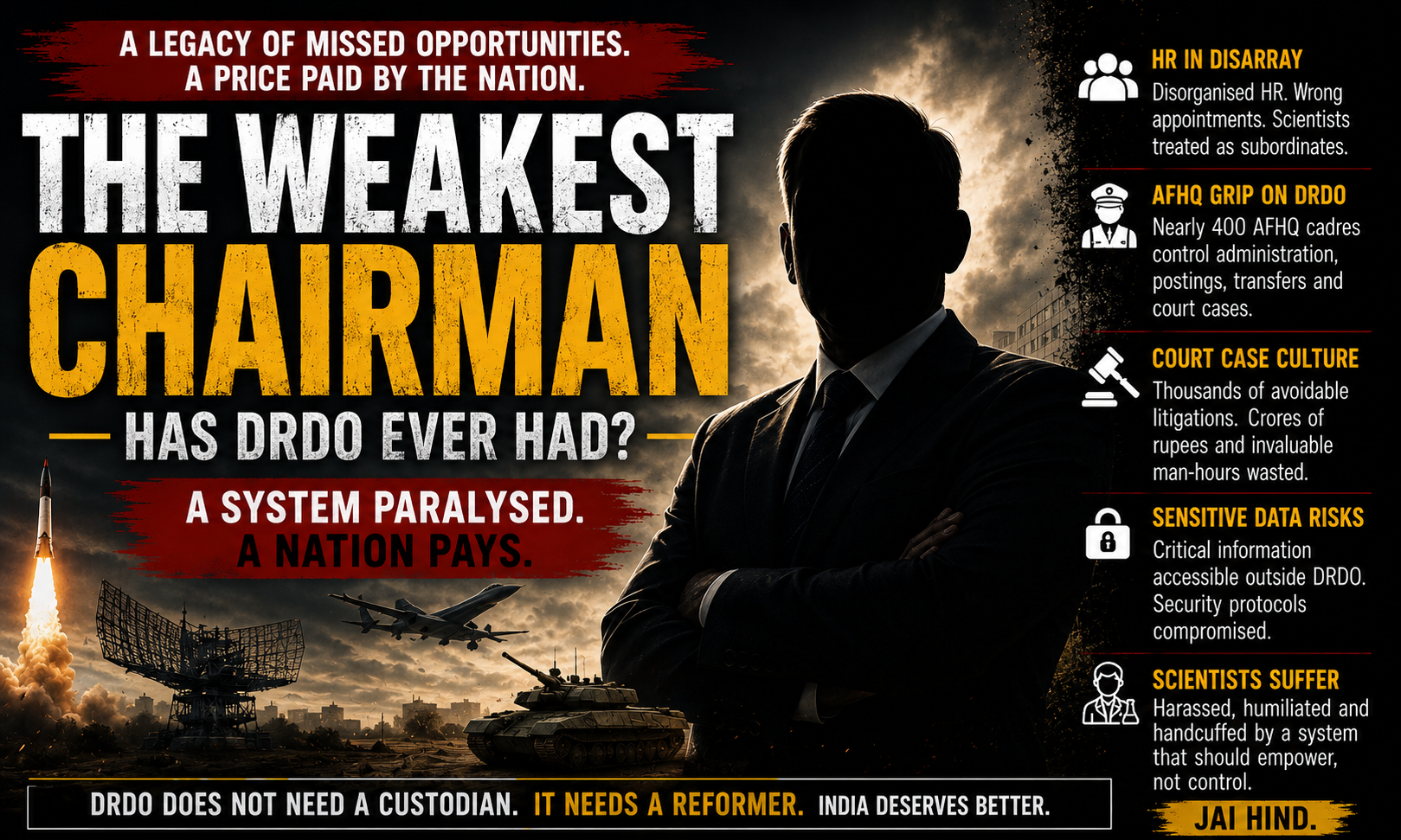
Unfortunately, if we looked the DRDO Chief legacy since Arunachalam till date Dr Sameer V Kamat was the weakest chief ever seen by DRDO. He received the crown on the juncture. when Dr G. Satheesh Reddy was unprecedentedly stepped down with unvisible reason for sake of national interest or……
Dr. Kamat treated this prestigious position with great casualness; the proof of this lies in the work he undertook throughout his entire tenure—including two extensions—and the outcomes of those efforts, which are clearly visible in the current state of the DRDO.
There is a difference between occupying a chair and wielding the authority that comes with it. There is a still wider difference between administering an institution and leading one. The tenure of Dr. Samir V. Kamat as Chairman of the Defence Research and Development Organisation demands a hard, unsentimental reckoning — not because DRDO deserves to be diminished, but because DRDO is too important to be allowed to drift.
For decades, DRDO has shouldered one of the most consequential mandates in the Indian national-security establishment: building the technologies on which this country’s strategic autonomy actually depends. From missiles to radars, electronic warfare to aerospace, naval systems to unmanned platforms, its scientists have proven again and again that India possesses the intellectual firepower to solve extraordinarily hard defence problems. But brilliance in the laboratory cannot indefinitely paper over rot in the corridor. And it is in the corridor — not the lab — that the Kamat years raise their sharpest questions.
A MOMENT THAT DEMANDED COURAGE
Kamat took charge in August 2022, inheriting an organisation already under fire for delays, cost overruns and chronic mismanagement. This was not a caretaker’s job. It was a mandate for institutional courage — a call to confront a system choking on procedure, competing fiefdoms and decades of accumulated inertia.
Instead, the question that came to define his chairmanship was blunt and uncomfortable: where was the transformation?
The government’s own high-powered committee, led by K. Vijay Raghavan, was convened to find out. Its verdict was not kind. It found that nearly 60 per cent of project delays traced back to internal failures — including the absence of critical technologies at decisive stages — with the remainder split between shifting service requirements and plain bureaucratic red tape. That finding should have triggered an institutional earthquake. Instead, reform became just one more battlefield inside an organisation already exhausted by them.
Kamat’s tenure did not end with his original term. He was extended — not once, but twice. That fact alone raises the stakes of any honest assessment, because an extension is not a formality. It is a grant of additional trust: more time, more authority, more room to act.
After years at the helm, what measurable transformation did DRDO get in return?
Not speeches. Not committees. Not another round of presentations. Transformation. Did decisions start moving faster? Did accountability get sharper? Did delays actually fall? Did the administrative layers shrink? Did scientists win back the freedom to do science instead of fighting paperwork? Did HR become transparent, litigation shrink, headquarters get leaner, the whole machine get more agile? Did the VijayRaghavan recommendations ever reach the laboratory floor — or did they die somewhere on the way? These are not rhetorical flourishes. They are the only questions that should decide a Chairman’s legacy.
THE REFORM THAT EXPOSED THE SYSTEM
The VijayRaghavan committee was not convened because DRDO was thought to be functioning well. It was convened because the structural rot had become impossible to explain away. Its recommendations touched organisational design, project management, HR, recruitment, industry participation, academic collaboration, accountability and the functioning of DRDO headquarters itself — a genuinely comprehensive blueprint.
And yet implementation stalled. By October 2024, reporting indicated that the major restructuring simply had not happened on the ground, despite round after round of meetings — with resistance from senior officials cited as a central reason for the paralysis.
That is the real story here. Not whether a committee wrote a good report. Whether the leadership had the spine to force it through. A report sitting in a file is not reform. A meeting is not reform. A slide deck is not reform. Reform begins the day entrenched interests lose their power to block it — and by that measure, DRDO under Kamat never got there.
THE HR MACHINE THAT EATS SCIENTISTS ALIVE WHY ARE THE WEAKEST CHAIRMEN SELECTED TO LEAD DG HR?
If any single function deserves a merciless institutional audit, it is Human Resources. In a scientific organisation, HR is not administrative plumbing — it is the entire climate in which scientists either flourish or wither. Transfers, postings, promotions, disciplinary proceedings, service disputes, court cases: these are not side issues. They are the terrain on which scientific productivity is won or lost.
A scientist fighting a transfer order for 5Years is not perfecting a seeker. A scientist contesting a disciplinary file is not refining a radar array. A scientist litigating a promotion is not solving a propulsion problem. He is fighting the system that was supposed to be fighting for him.
The bureaucracy has stopped serving science. Science has started serving the bureaucracy.
That inversion is not an inconvenience — it is dangerous, and it happened on someone’s watch.
THE AFHQ QUESTION NOBODY WANTS TO ASK OUT LOUD
The role and growing footprint of administrative cadres tied to Armed Forces Headquarters inside DRDO deserves to be examined in the open — not through whispers and allegations, but through records. The question is simple: has the administrative machinery propping up DRDO grown disproportionately powerful compared to the scientific establishment it exists to serve?
If the answer is no, the numbers should prove it in five minutes. If the answer is yes, the government owes the country an explanation. How many personnel, against how many sanctioned posts? What functions do they actually perform, and where do those functions duplicate DRDO’s own establishment machinery? What does it cost annually? Who controls transfers, postings, discipline, litigation? How many of those decisions end up contested in court, and how many of those cases are still pending years later?
And the question underneath all of it: does this structure make DRDO faster, or does it make DRDO slower? These are not personal attacks on individuals. They are governance questions a serious country asks about a strategic institution — and a serious Chairman answers them, rather than leaving them to outlive his tenure.
WHEN ADMINISTRATION BECOMES POWER
Every large institution needs administration. But administration exists to serve institutional purpose — the moment it becomes indispensable for every routine decision, it starts accumulating power of its own, and that power has a way of becoming self-perpetuating. Files start outranking outcomes. Procedure starts outranking purpose. Hierarchy starts outranking expertise.
And slowly, scientists stop asking what does the country need next? and start asking whom do I need to approach to get this done? That is how institutions decay — not in a single dramatic collapse, but quietly: one unnecessary file, one avoidable dispute, one delayed posting, one dragged-out court case, one stalled procurement, one talented scientist who simply stops trying. Then another. Then another. Until the organisation still has its thousands of employees but has lost its momentum entirely.
Here weakest chairmen selected The weakest DG HR and DOP, But they are functioning with absolute power as a GOD for the DRDO entire paternity.
THE COURT-CASE INDUSTRY
Litigation deserves its own uncompromising audit. When routine service matters routinely end up in court, the problem is rarely that employees are litigious by nature — it is usually that the administration itself is failing to resolve disputes before they escalate. Every significant case should be able to answer five questions: Why did the dispute start? Who made the original call? Could it have been settled internally? How much public money did it cost? How many scientific man-hours did it burn?
Because every court case involving a scientist carries a hidden bill — legal fees, administrative overhead, hearings, officers pulled off real work to draft responses — and somewhere in a laboratory, a scientist whose attention has been dragged away from the problem he was hired to solve. That cost never shows up on a balance sheet. National security pays it anyway.
THE SENSITIVE-DATA QUESTION THAT CANNOT BE WAVED AWAY
There are also unresolved questions surrounding the movement, custody and accessibility of sensitive DRDO information — questions that must be treated with total seriousness, not because every allegation is automatically true, but because national-security information cannot be governed by informal arrangements, assumptions, or institutional ambiguity.
If sensitive material moved outside authorised channels at any point, there must be a clean, documented answer: who authorised it, why, under what classification, who received it, where it was stored, who had access, what audit trail exists, and whether the transfer complied with security regulations. If the record is clean, it should be trivial to show that. A security investigation is not a weapon to be aimed at individuals — it is a mechanism that exists to protect the Republic, and it should be used as one. This was created by AFHq Cader, The Nation wants answer for it.
THE SCIENTISTS WERE NEVER THE PROBLEM
This distinction matters enormously, and it would be dishonest to blur it. DRDO’s scientists have delivered real strategic capability — in missiles, radar, aerospace, electronic warfare, naval systems, and more. The talent has never been in question. What is in question is whether the institution around that talent is capable of converting it into capability on time. That is an entirely different problem, and it is the one that actually needs fixing.
A country can have world-class scientists and a second-rate R&D management system at the same time. It can run brilliant laboratories out of a dysfunctional headquarters. It can post successful trials on top of chronically delayed programmes. It can spend enormous budgets and still deliver poor execution. Real DRDO reform, then, cannot be about stacking up more laboratories, more committees, more sanctioned posts. It has to be about building accountability for outcomes — the one thing that has been conspicuously missing.
THE CHAIRMAN’S TRUE TEST
A Chairman should be judged by what he leaves behind, not by what he presided over. If his successor inherits the same files, the same delays, the same bottlenecks, the same litigation, the same confusion, the same resistance to reform, and the same crushing dependency on layers of bureaucracy — then what, precisely, was transformed? That is the only test that matters. Leadership is not the ability to occupy the top floor of DRDO Bhawan. It is the ability to change what happens on the ground floor of a laboratory two thousand kilometres away.
THE MOST DANGEROUS WORD IN GOVERNMENT: “ONGOING”
Government has a peculiar vocabulary for standing still while appearing to move. Reform is always “under consideration.” Restructuring is perpetually “ongoing.” The file is eternally “under process.” The committee is forever “examining.” Years pass. People retire. Committees are reconstituted. Chairmen change. And somehow the reform itself never actually finishes — it simply remains, indefinitely, “ongoing.”
This is precisely why DRDO needs reform with teeth: not intentions, not promises, but deadlines, owners, metrics, and consequences. If a project slips, someone explains why. If a reform stalls, someone owns the stall. If a layer of administration is unnecessary, it gets cut — not studied again. If a scientist is worn down by an avoidable process, someone is held responsible. If sensitive information is mishandled, the investigation is uncompromising, full stop. That is how serious institutions actually behave. DRDO has not yet behaved that way.
WAS KAMAT THE WEAKEST CHAIRMAN?
History will settle that — but history needs evidence, not slogans. Calling any Chairman “the weakest” is a serious charge and should never be thrown around as one. It is equally dangerous, though, to shield senior leadership from scrutiny simply because the institution they run happens to be strategically vital. DRDO deserves scrutiny precisely because it is strategically vital — not despite it.
The Kamat years should be put through an independent, evidence-based performance audit: the organisation as it stood on the day he arrived, measured against the organisation as it stands today, on project delivery, cost escalation, HR reform, administrative efficiency, litigation, scientific manpower utilisation, technology transfer, industry participation, private-sector collaboration, procurement efficiency, security governance, and the actual implementation of the VijayRaghavan recommendations. Then let the numbers do the talking. If the record holds up, defend it. If it doesn’t, fix it. If it’s mixed, learn from it. But do not bury it in another file marked “ongoing.”
DRDO DOES NOT NEED A CUSTODIAN
It needs a reformer — someone who understands that scientific institutions cannot be run like conventional government offices, someone prepared to confront institutional inertia head-on and ask the uncomfortable questions instead of managing around them. Someone who will shield scientists from unnecessary administrative interference while demanding uncompromising scientific accountability in return. Someone who understands that autonomy without accountability curdles into complacency, and accountability without autonomy hardens into bureaucracy.
The next Chairman must be neither a bureaucrat who controls scientists nor a scientist who shields other scientists from being held to account. He must be an institution builder — because DRDO has had administrators. What it has not had, for far too long, is one.
The greatest danger to DRDO was never criticism. It is complacency. A country with ambitions of becoming a genuine global defence power cannot afford an R&D organisation that spends more energy managing itself than inventing the technologies of tomorrow. India needs hypersonics. It needs autonomous systems, advanced radar, electronic warfare, secure communications, propulsion, AI-enabled defence platforms, indigenous semiconductors, next-generation materials — technologies that do not exist yet, anywhere, and must be built here first.
None of that arrives at the speed the country needs while the institution charged with building it remains trapped in its own administrative inertia. So the real question was never simply “who was the weakest Chairman?” The real question, the one that outlasts any single tenure, is:
WHO WILL HAVE THE COURAGE TO FIX DRDO?
Because DRDO does not belong to a chairman. It does not belong to an administrative cadre, or a laboratory director, or any one scientist. DRDO belongs to India. And India’s strategic future is too important to be held hostage by institutional inertia — by anyone, for any length of time.
Hope MOD, PMO will take fast necessary action for the sake of National interest.
There is a particular kind of silence that settles over an institution when it stops being managed and starts merely being administered. That silence has now hung over DRDO for months. An organisation tasked with the country’s missile systems, its aeronautical programmes, its strategic technology base, has been running without a dedicated chief since the start of June — and the closest thing to an explanation the public has received is a bureaucratic holding pattern.
It is observing by all national mind peoples that how serios GOI looking DRDO fate.
This is not a minor administrative gap. It is a signal.
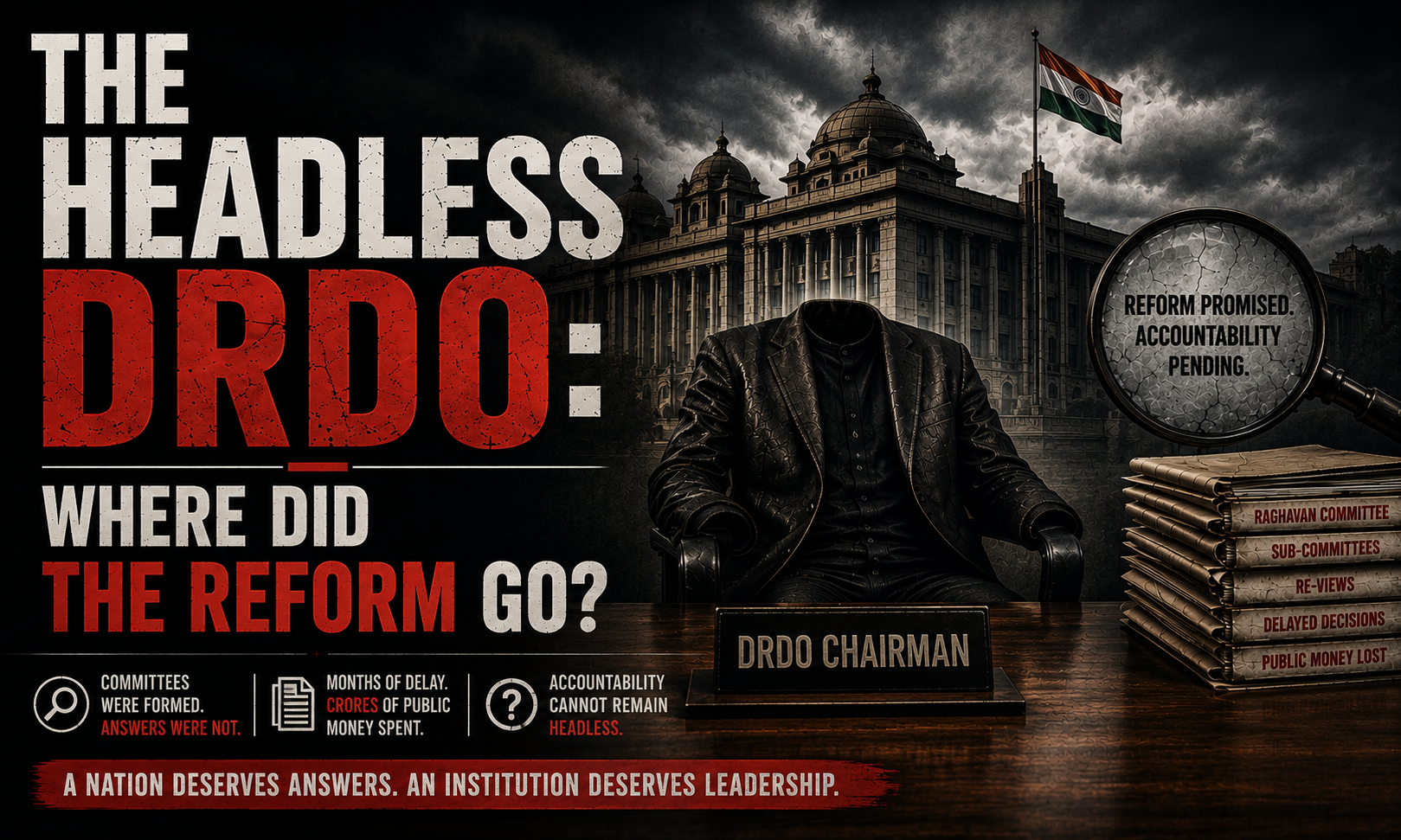
In Jan 2024, the MOD (Ministry of Defence), acting under the direction of the PMO, constituted the Raghavan Committee to overhaul DRDO. The mandate was serious: an organisation with a well-documented record of missed timelines needed structural reform, not another internal review.
What followed instead was a familiar bureaucratic reflex. Subcommittees were formed to study the committee’s findings. Those subcommittees spawned further subcommittees. Officer Scientist and Distinguished Scientist-level personnel — among the most senior technical talent in the country — were pulled into cycles of review, re-review, and internal consultation that consumed months and, by extension, crores of public money.
Where did it go? That is not a rhetorical question. It is one the Ministry of Defence and the PMO owe the country a direct answer to. If the recommendations were implemented, where is the documentation of that implementation? If they were shelved, on whose authority, and why was the public never told?
If public want to see the effort of senior DRDO scientists with respect of Raghavan Committee, it can be only possible to see the dustbin of DRDO, MOD and PMO.
Silence is not an acceptable substitute for accountability on a reform effort of this scale.
The facts here are not in dispute. Dr. Samir V. Kamat’s tenure as DRDO Chairman ended with his retirement on 31 May 2026 with two year unfruitful extension. In his place, the Defence Secretary was handed additional charge — a stopgap measure explicitly described as temporary, pending a “regular” appointment.
The Ministry interviewed five shortlisted candidates for the post on 3 July 2026. That was over six weeks ago. As of this writing, DRDO remains without a permanent chairman.
An organisation responsible for the country’s strategic technology base has now gone more than two and a half months without a dedicated head, through a selection process the government itself initiated and has still not concluded. If this is efficiency, the Ministry should explain what inefficiency would look like. If there is a legitimate reason for the delay, the public — and the scientists working under this uncertainty — deserve to hear it stated plainly, not left to infer it from silence.
Beyond the vacancy itself, a pattern has been alleged by scientists and observers within and around the organization — one that the Ministry has never publicly addressed:
Why have promotions and appointments within DRDO’s leadership repeatedly drawn allegations of being steered toward a particular network, rather than decided strictly on domain expertise and merit?
Why has a senior appointment reportedly moved a person with a missile-technology background into a post overseeing aeronautical systems — a shift that, on its face, invites the question of whether technical fit was the deciding factor?
Currently the blessed lobby manipulating the promotions and appointments without justifying like DG MSS no field of missile technology and who is man of missile become DG Aero what a joke but it is only possible in DRDO because 56% MSC chemistry is responsible to manipulating this, and his other qualification and experiences at the time of joining can verified from office of The AFHq, CO, A1B.
What is the status of the police complaint reportedly pending with Uttarakhand Police over the printing of a national flag upside down on an official publication? A pending complaint is a matter of public record, not a private matter — the public is entitled to know its status.
How many honest scientists have raised concerns internally, only to find their careers stalled rather than their concerns investigated? And how many court cases now exist as a result? Only way to see the great achievements, please go through the agencies reports silently.
None of this is cynicism for its own sake. It is a demand for the basic mechanics of accountable governance: that a reform committee’s findings be published and acted on, not buried; that a leadership vacancy at a strategic institution be filled with urgency, not left to drift; and that allegations of favoritism and credential fraud, once raised, be either formally investigated and closed, or shown to be baseless — not simply left to hang over the institution indefinitely.
DRDO does not need another committee. It needs an answer to the ones it has already commissioned. JAI HIND.
Appeal to clean DRDO of corrupt and anti-national officials