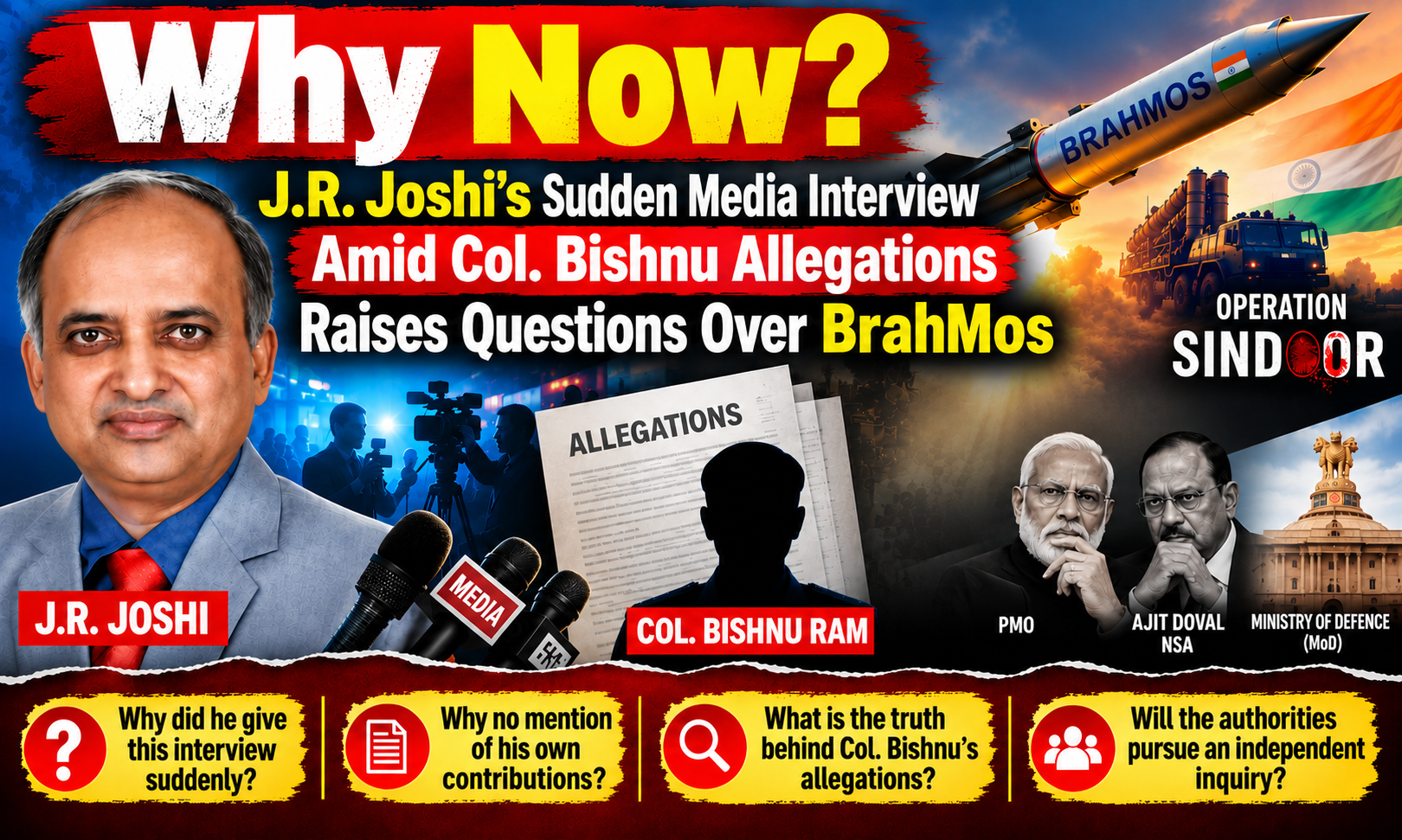
Why did J.R. Joshi, reportedly with the assistance of journalists trusted by BrahMos, suddenly choose to give an interview making sweeping claims while leveraging the significance of Operation Sindoor—a mission witnessed by the entire nation and the world?
Why “matter under investigation” is showing some intresting facts of removal of Chairmen and a member alongwith alleged involvement of JR Joshi’s old aides like Ex BDL Director Finance Mr. Nukka Shrivastava??? it is alleged that their companies like Vishra Defence and another company of Ex empolyee of BrahMos Mr. Rajat Verma (connected with Gp Capt Malay Srivastava) has some linkage into it??
While the government and the public have duly acknowledged BrahMos’s contributions, J.R. Joshi conspicuously failed to mention any of his own contributions in that interview.
Furthermore, the issues raised concerning production costs pertain to a period before Joshi joined the organisation in 2024.
A detailed account of Joshi’s actions following his arrival in 2024 was submitted by his colleague, Col. B
ishnu Ram, to Additional Secretary Mr. Amit Negi, the Prime Minister’s Office (PMO), and National Security Adviser (NSA) Ajit Doval on September 29, 2026.
Recognising the gravity of the allegations, the officials forwarded the matter to the Ministry of Defence (MoD) for investigation.
However, amid concerns over the apparent institutional overlap between the MoD and DRDO, instead of constituting an independent inquiry committee, the matter was reportedly referred back to BrahMos itself.
In the interview conducted on October 22, the significance and achievements of BrahMos were extensively highlighted. Yet Joshi once again refrained from mentioning any of his own achievements—raising legitimate questions about the purpose and timing of the interview.
On October 23, Group Captain Srivastava, described as a key lieutenant of J.R. Joshi, reportedly brought Col. Bishnu Ram to BrahMos and, in Joshi’s presence, pressured him into signing an undertaking acknowledging that he had not written that letter while signature on the letter is correct.
The sequence of events raises serious concerns about the handling of the matter and whether the process is intended to establish the facts or simply to bring the controversy to a quiet conclusion.
If these developments are substantiated, they would warrant serious scrutiny. The apparent attempt to resolve the matter internally, rather than through an independent investigation, risks undermining confidence in the process and raises questions about institutional accountability.
If these documents and allegations eventually come into the public domain, how will the Defence Secretary and Mr. Amit Negi answer to the nation?
The nation deserves transparency, accountability, and an impartial investigation—particularly when documentary evidence is reportedly available to support the allegations.
The central question remains: Will the authorities pursue the facts independently, or will this matter be allowed to disappear behind closed doors?
Defence PSU gives tender for anti-tank missile part to commodore ex-chief’s family firm
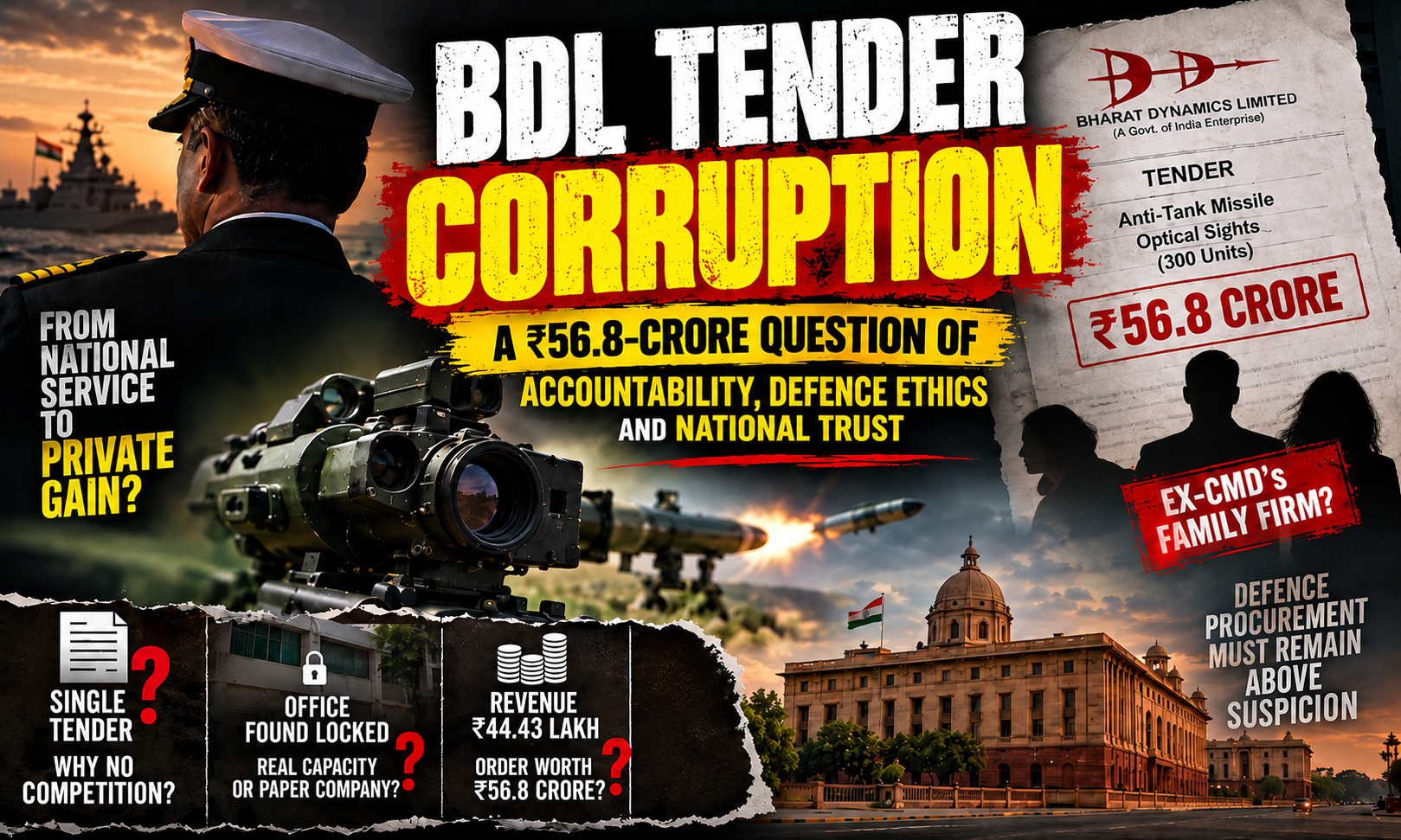
Bharat Dynamics Limited’s single-tender procurement of anti-tank missile optical sights has raised serious questions about procurement integrity, potential conflicts of interest, and the standards of accountability expected from those entrusted with India’s defence institutions.
The ₹56.8-Crore Tender Scam That Demands Answers
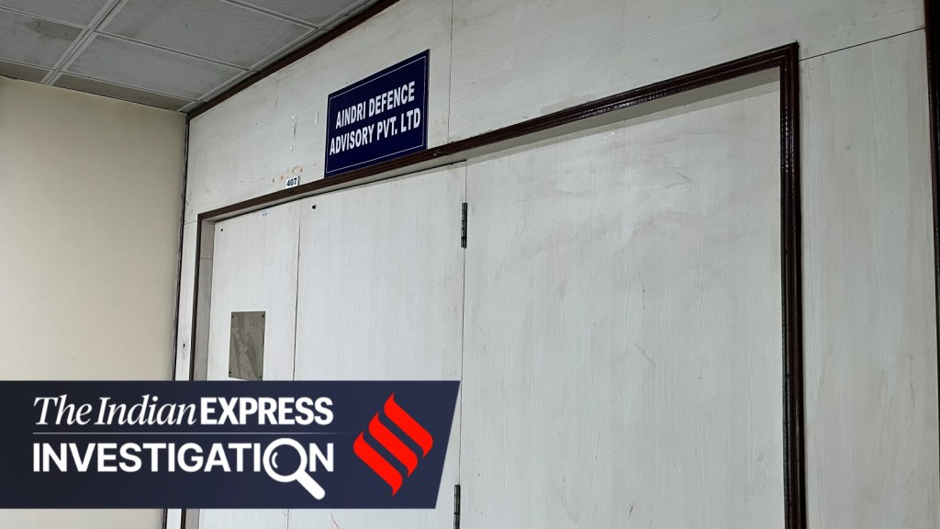
Bharat Dynamics Limited (BDL), a major public-sector defence enterprise under the Ministry of Defence, is at the centre of a procurement controversy following its decision to issue a single tender for 300 optical sights used in anti-tank guided missile systems to Aindri Defence Advisory Private Limited Hydrabad.
According to an investigation published by The Indian Express, the company quoted ₹56.8 crore for the procurement, and its bid had cleared the technical evaluation stage, while financial evaluation was reportedly underway at the time of publication.
The controversy is not simply about a procurement worth crores of rupees. It concerns the circumstances under which a non-competitive procurement route was adopted, the relationship between the selected company and BDL’s EX-CMD Commodore Sidharth Mishra, and the adequacy of safeguards designed to protect public resources from potential conflicts of interest.
A Former Navy Commodore and the Burden of Public Trust
One of the most consequential aspects of this case is the professional background of CommodoreSiddharth Mishra, BDL’s former Chairman and Managing Director.
Mishra served in the Indian Navy’s electrical branch for more than three decades, retiring in 2016 as a Commodore. He subsequently served at Electronics Corporation of India Limited(ECIL) before becoming BDL’s Chairman and Managing Director in 2019. His tenure at BDL ended in March 2023.
In May 2024, Mishra and his wife, Shambhavi Mishra, incorporated Aindri Defence Advisory Private Limited, initially holding equal shares. According to company records cited in the investigation, Mishra ceased to be a director and shareholder in January 2025, when he was appointed Member (Technical) at the National Company Law Tribunal(NCLT) in Kolkata. His wife subsequently held a 95 percent stake in the company while the remaining 5% was held by Kaushiki Nandan Vatsyayana, identified as Siddharth Mishra’s elder brother.”
Currently as per NCLT he is not associated at present.
However, the subsequent award of a single tender to a company founded by a former head of the procuring defence PSU raises legitimate questions that deserve rigorous, independent scrutiny.
Military service is a position of honour, but honour must be reflected in conduct, accountability and the decisions made after retirement.
The Single-Tender Route: Where Is the Full Explanation?
A single tender is a non-competitive procurement mechanism under which only one vendor is invited to bid. Such a route can be permissible under specified circumstances, including genuine urgency or the existence of a sole capable supplier.
According to the investigation, BDL justified its decision by citing urgency. The tender documentation reportedly included certification that the demand was urgent and that the additional expenditure associated with not using an advertised tender was justified. It also stated that the nature of the urgency and the reasons the requirement could not have been anticipated had been placed on record.
That gap is central to the controversy.
Why was a competitive procurement process not adopted? What specific operational requirement made the single-tender route necessary? Were alternative qualified suppliers assessed? What safeguards were applied to eliminate actual or perceived conflicts of interest? Was the urgency independently reviewed and adequately documented?
A Significant Departure from Previous Procurement Practice
The reported procurement history adds another dimension to the matter.
According to comparable purchases of optical sights in 2024 and 2025 followed competitive processes restricted to public-sector enterprises. India Optel Limited(IOL), a defence public-sector undertaking, won both tenders.
The 2026 procurement, by contrast, was directed exclusively to Aindri Defence Advisory through a single-tender process, potentially allowing a private company to secure an order of this scale for the first time in the three-year period examined by the investigation.
The public interest demands an explanation of the technical, operational and commercial rationale behind this decision.
Questions About Infrastructure and Commercial Capacity
The investigation also reported findings from a physical verification of Aindri Defence Advisory’s listed premises in Hyderabad.
the company’s office at the National Small Industries Corporation campus in Kushaiguda was found locked during the newspaper’s visit. An employee of another organisation reportedly said that people opened the office only occasionally. The investigation also reported that the residential address previously associated with the company was vacant at the time of the visit.
Company records cited in the report showed that Aindri’s 2024–25 revenue was ₹44.43 lakh, with a profit of ₹2.89 lakh. Its balance sheet listed no property, manufacturing plant or other assets.
These findings warrant careful interpretation. A consultancy company may operate without owning a manufacturing plant, and the absence of visible assets does not establish that a business lacks the capacity to deliver a specialised product.
The reported tender concerns 300 optical sights, with sample-validation requirements and technical support for maintenance, repair and overhaul for at least 15 years. Such obligations raise practical questions about manufacturing arrangements, access to qualified technical personnel, quality assurance, long-term servicing capability, supply-chain resilience and accountability for product failures.
The competent authorities should establish whether the selected supplier possesses the necessary capabilities directly or through properly evaluated manufacturing and technical partners.
The controversy warrants clear answers to several questions:
Justification for urgency: What specific circumstances necessitated a single tender, and why could the requirement not be met through an advertised competitive process?
Conflict-of-interest safeguards: What declarations, disclosures and independent reviews were undertaken to assess potential or perceived conflicts arising from the former BDL chief’s association with the selected company?
Supplier capability: What due diligence established the supplier’s ability to meet the technical, manufacturing, quality-assurance and long-term support requirements of the contract?
Commercial reasonableness: How was the quoted amount of ₹56.8 crore assessed against technical specifications, comparable procurements, cost benchmarks and value-for-money requirements?
Procurement oversight: Were the applicable procurement rules followed in full, and is the decision supported by a complete, auditable record?
Public accountability: Will BDL and the Ministry of Defence provide an appropriate explanation of the procurement decision without compromising legitimate operational confidentiality?
These questions should be addressed through established oversight mechanisms and evidence-based examination, not speculation or political rhetoric.
The BDL–Aindri tender controversy presents a serious test of institutional transparency and public accountability. A ₹56.8-crore bid, a non-competitive procurement route, the corporate links to a former BDL chief and reported questions concerning the supplier’s visible infrastructure together create circumstances that merit close scrutiny.
India’s defence ecosystem is built on the sacrifices of its soldiers, the expertise of its engineers, the work of its scientists and the trust of its citizens. That trust cannot be taken for granted. It must be earned through transparent decisions, rigorous technical evaluation and unwavering adherence to ethical standards.
For a country investing heavily in indigenous defence manufacturing, the credibility of its procurement institutions is itself a strategic asset. Public-sector defence enterprises must demonstrate that their decisions serve national capability, and the responsible use of taxpayers’ money.
Source and attribution: This article is based on reporting by The Indian Express concerning Bharat Dynamics Limited, Aindri Defence Advisory Private Limited and the optical-sight procurement. The allegations and questions discussed above should be assessed against official tender documents, company filings and responses from the concerned authorities. The views expressed in the analysis are intended to promote transparency, ethical governance and accountability in defence procurement.
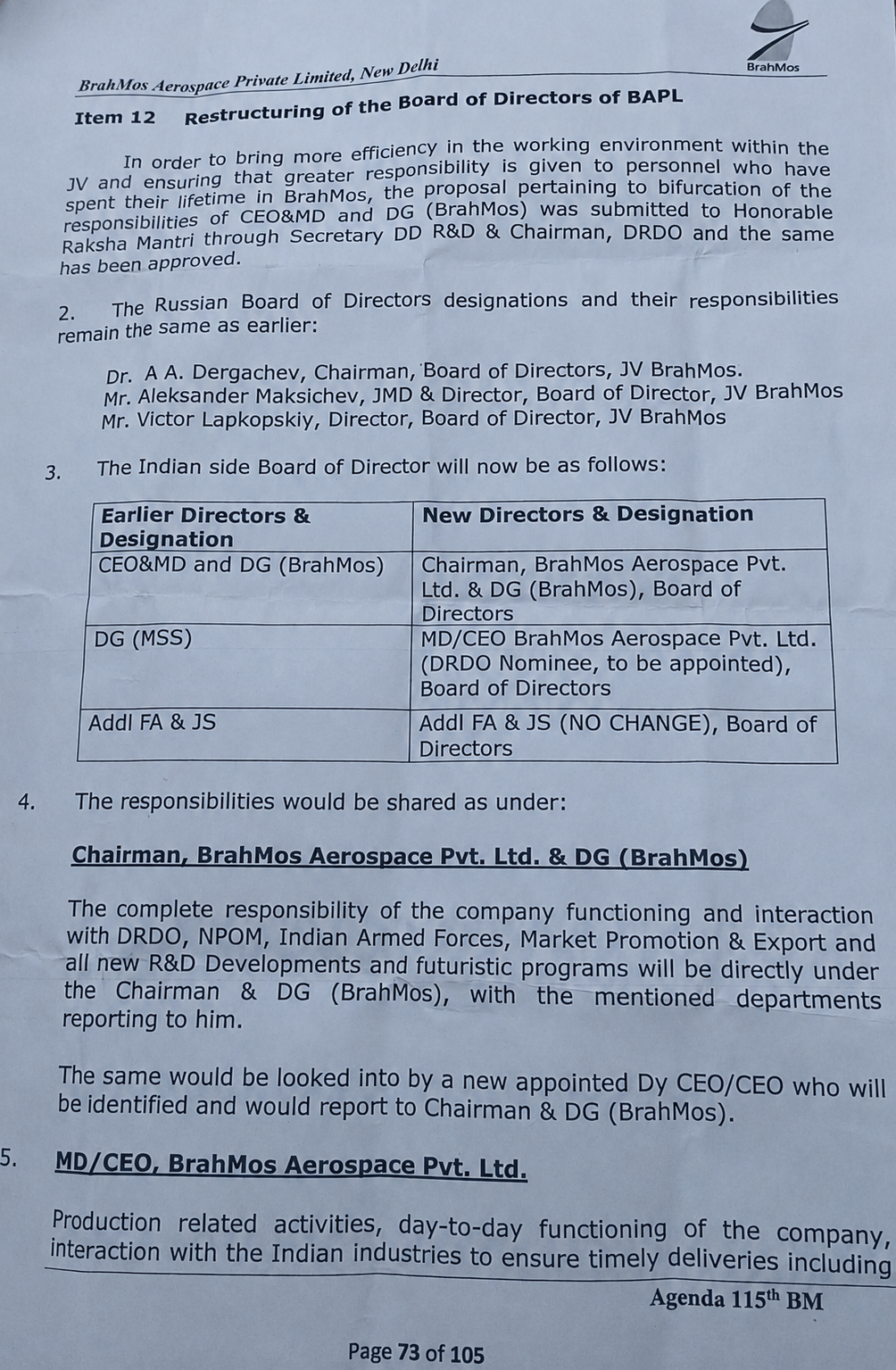
BrahMos Aerospace Private Limited is presently being operated like a private or arbitrarily run business, disregarding its vision, mission, and national security interests. As I raised in my recent information blog wherein I placed proofs of Board of Directors meeting agenda to remove DG MSS from Board.
News has just emerged that BDL has appointed Dr. Jagannath Nayak as a Government Nominee on its Board of Directors. This appointment reflects the Government’s policy to ensure the missile-related production units can access the infrastructure and expertise of the DRDO missile complex and continue to receive strategic guidance from the missile complex scientific community through DG (MSS).
Meanwhile, recently by removing the DG (MSS) from the Board of Directors at BrahMos, what exactly is J.R. Joshi trying to prove? J R Joshi has actually hit the very basic premises of genesis of Brahmos from its foundation itself. The Brahmos was raised with his strong R&D pillars as DRDO from Indian side and NPOM from Russian side which has created so many versions of Brahmos over last 25 years. For the same purpose of having DRDO missile complex by its side, visionaries like Dr. Kalam and Dr. A S Pillai has kept DG MSS in Board of Directors. Now by removing DG MSS, does J R Joshi want to prove that he is having bigger vision than of Dr. Kalam or Dr. Pillai, or he just doesn’t bother for. Or he is having an only objection to derail Brahmos program in coming years??
Is he genuinely committed to making BrahMos more productive and strengthening its strategic capabilities, or is he steering the organisation towards institutional decline? Such actions raise serious questions about whose interests J.R. Joshi is actually serving and whether those interests align with India’s national interests.
Evidence of ever-increasing corruption during his tenure spanning multiple locations, from Lucknow BrahMos to Hyderabad, Nagpur, Pilani, and the Philippines—will soon come to light. We remain confident that swift and decisive action will be taken regarding the information that has reached the PMO.
We firmly believe that the PMO is closely monitoring the alleged nexus operating within the Ministry of Defence and BrahMos, involving certain DRDO corporate directors. The gravity of these concerns demands transparency, accountability, and an impartial investigation to safeguard the integrity of India’s defence establishment and its strategic missile programmes.
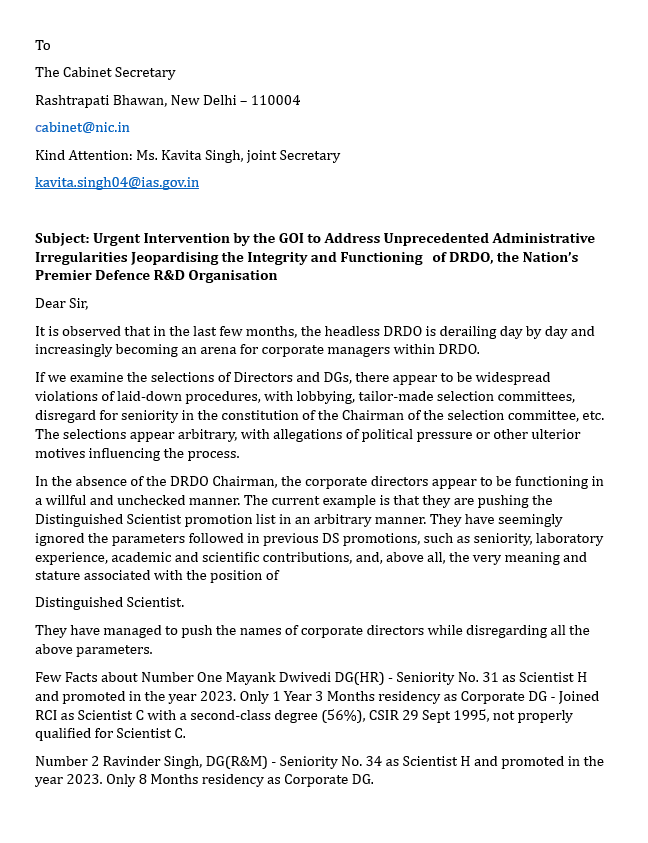
The corruption in DRDO was informed to the Cabinet Secretary on 15th Sept 2026 regarding Urgent Intervention by the GOI to Address Unprecedented Administrative Irregularities Jeopardising the Integrity and Functioning of DRDO, the Nation’s Premier Defence R&D Organisation.
It is observed that in the last few months, the headless DRDO is derailing day by day and increasingly becoming an arena for corporate managers within DRDO.
If we examine the selections of Directors and DGs, there appear to be widespread violations of laid-down procedures, with lobbying, tailor-made selection committees, disregard for seniority in the constitution of the Chairman of the selection committee, etc. The selections appear arbitrary, with allegations of political pressure or other ulterior motives influencing the process.
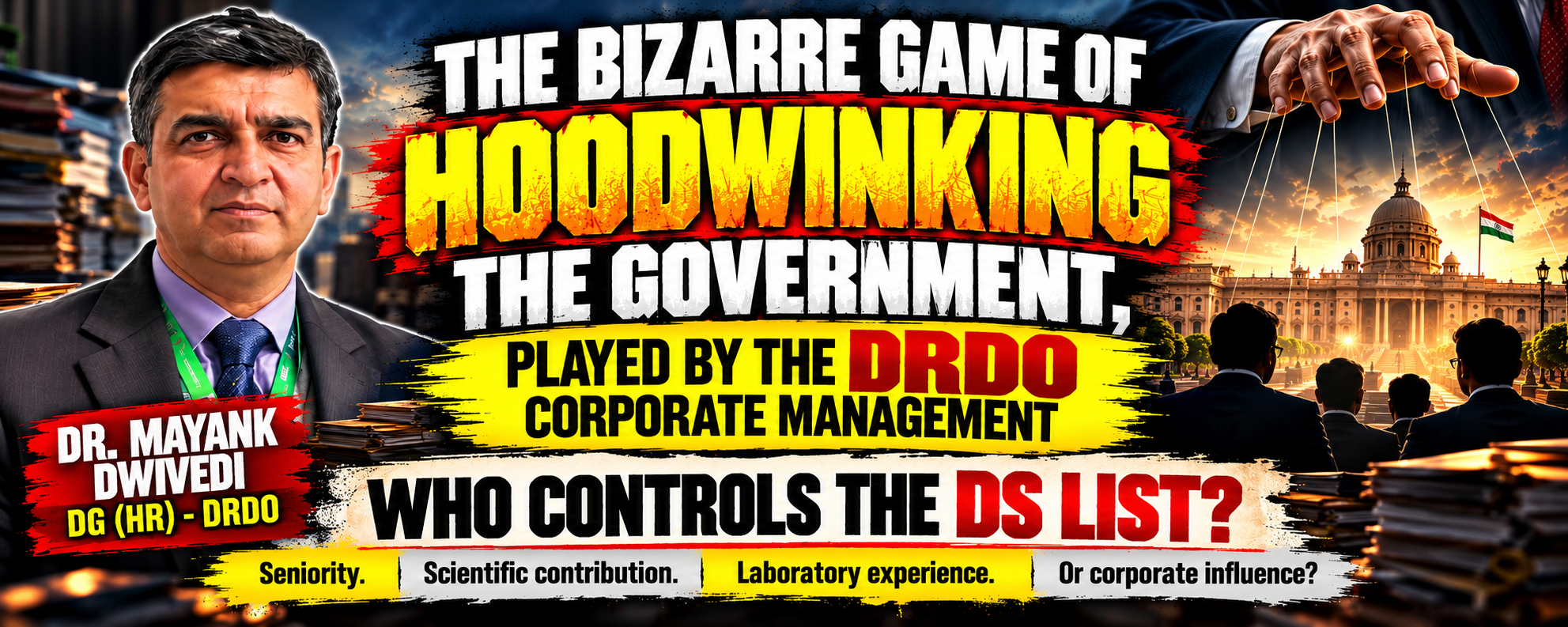
In the absence of the DRDO Chairman, the corporate directors appear to be functioning in a willful and unchecked manner. The current example is that they are pushing the Distinguished Scientist promotion list in an arbitrary manner. They have seemingly ignored the parameters followed in previous DS promotions, such as seniority, laboratory experience, academic and scientific contributions, and, above all, the very meaning and stature associated with the position of Distinguished Scientist.
They have managed to push the names of corporate directors while disregarding all the above parameters.
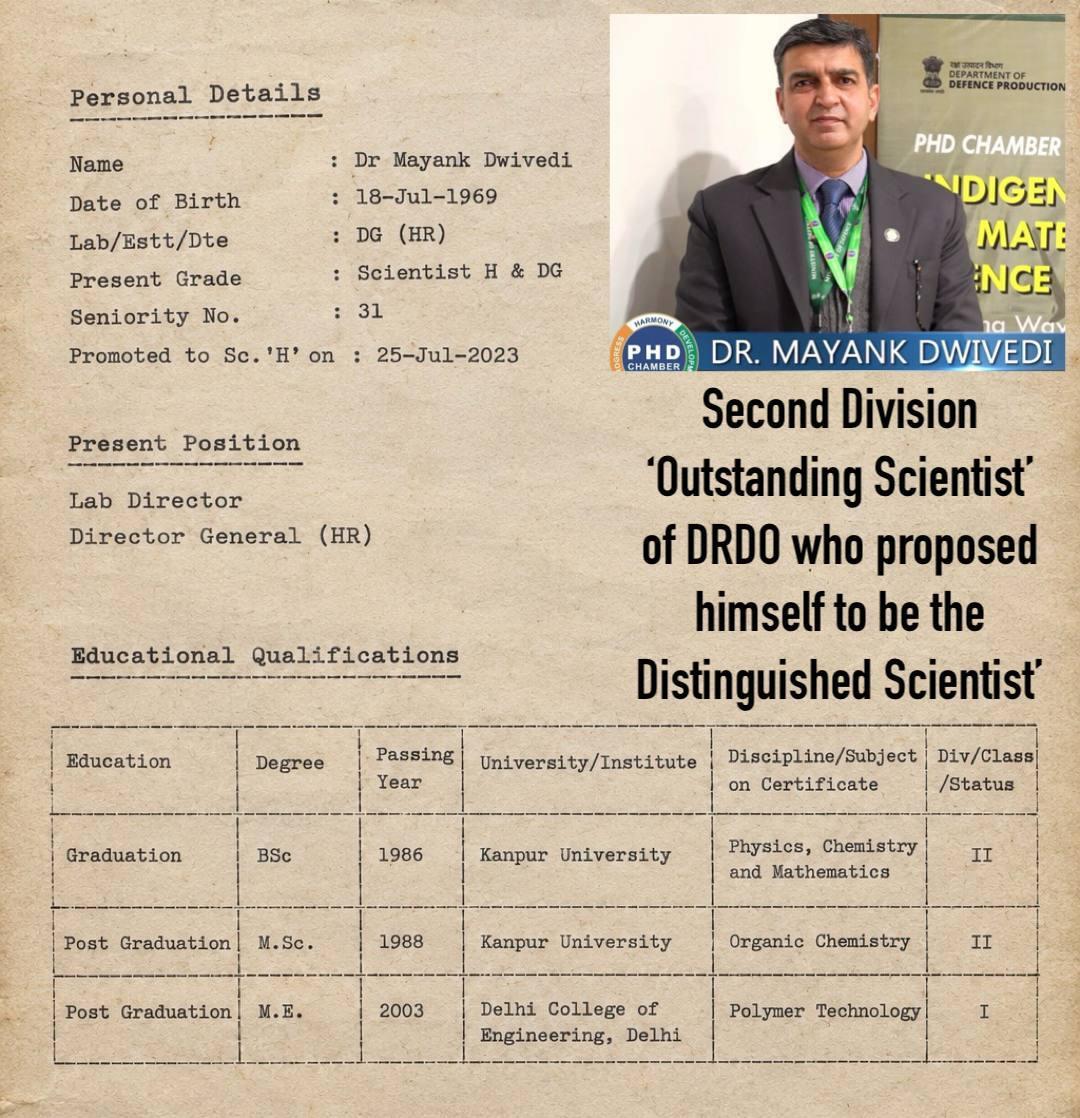
Few Facts about Number One, Mayank Dwivedi, DG(HR) – Seniority No. 31 as Scientist H and promoted in the year 2023. Only 1 Year 3 Months residency as Corporate DG – Joined RCI as Scientist C with a second-class degree (56%), CSIR 29 Sept 1995, not properly qualified for Scientist C.
Number 2, Ravinder Singh, DG(R&M) – Seniority No. 34 as Scientist H and promoted in the year 2023. Only 8 Months residency as Corporate DG.
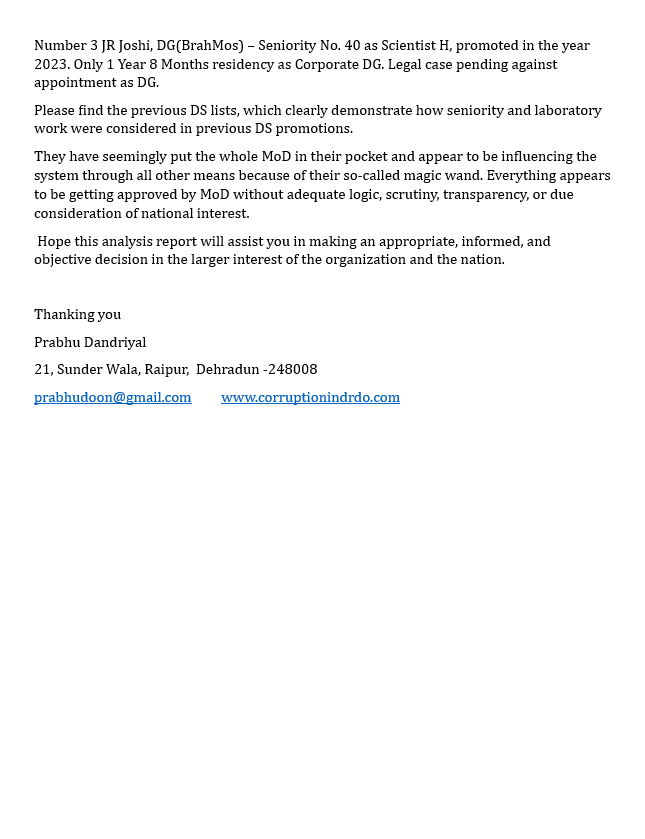
Number 3, JR Joshi, DG(BrahMos) – Seniority No. 40 as Scientist H, promoted in the year 2023. Only 1 Year 8 Months residency as Corporate DG. Legal case pending against appointment as DG.
Please find the previous DS lists, which clearly demonstrate how seniority and laboratory work were considered in previous DS promotions.
They have seemingly put the whole MoD in their pocket and appear to be influencing the system through all other means because of their so-called magic wand. Everything appears to be getting approved by MoD without adequate logic, scrutiny, transparency, or due consideration of national interest.
Hope this analysis report will assist you in making an appropriate, informed, and objective decision in the larger interest of the organization and the nation.
The Cabinet Secretary took the above seriously and directed MoD for deeper inquiry and to find the facts. Now, with the help of JR Joshi, Mayank Diwedi, Ravindra Singh, and J Nayak nexus, the entire MoD is in the pocket. Now MoD passes the Cabinet direction to DRDO, DG HR Mayank Diwedi, and this is an absolutely amusing move by the Ministry of Defense to send the complaint to the accused.
DG (HR) DRDO Mayank Diwedi
Once again forwarded this directive to the RAC Director—who reports to him—for further action, R.P. Pandey. The RAC Director was appointed just a few months ago through Mayank’s machinations; the attached document clearly exposes the absurd arguments he uses to assist Mayank and reveals the extent of the manipulation taking place within DRDO. Pandey argues that the ‘Distinguished Scientist’ (DS) designation should be awarded to DG-level officials—who are merely seeking the perks associated with the rank—rather than to the genuine scientists actually working in the laboratories who are truly deserving candidates for the position as they have proper academic qualifications, research experiences, and proper recognition in scientific fertility in India and abroad in their related field.
We asked Mr. R.P. Pandey: can he give a comparison of the qualification, achievements, and residency period of all 40 scientists who are above in seniority up to J.R. Joshi?
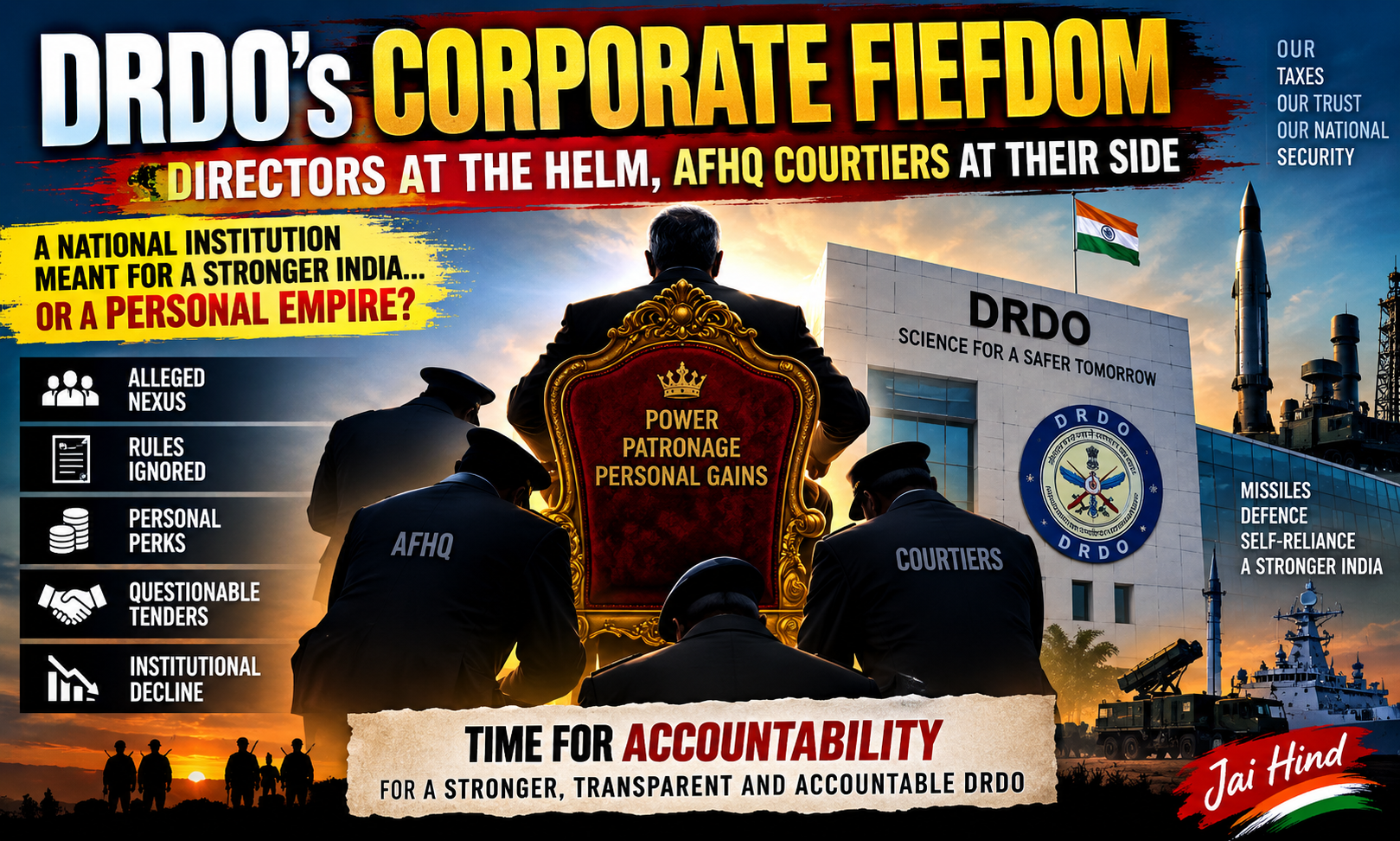
Nowadays, DRDO’s Corporate Directors are running the organization like their own personal fiefdom, with AFHQ cadre personal acting as their courtiers.
DRDO is rapidly heading towards a downward spiral; the organization’s Corporate Director shows no regard for the institution and is blatantly flouting rules to engineer new arrangements that secure personal perks and safeguard their own future.
The current nexus of DRDO’s Corporate Directors is with the help of the Additional Financial Advisor, who, for unseen reasons or vested interests, also appears to support these Corporate Directors. The DG BrahMos agenda is an open example, where the Additional Financial Advisor attended the Board meeting and supported the DG BrahMos for an unprecedented proposal, which, as alleged, formed part of an anti-institutional agenda involving the removal of DG MSS from the BrahMos Board.
As Additional Financial Advisor, he was aware that Mr. Nanda Company opposed the proposal and resigned because it was against the laid-down provisions of the Company Act.
• The same Distinguished Scientist promotion case is also the same: its own rules are being ignored, disregarding the DRDO’s laid-down rules, because no one is taking responsibility for running the organization properly.
This happening is also giving a new thought to DRDO Chairmanship aspirants: if they want to become DRDO Secretary, they should follow the DG BrahMos’ steps — you have to not approach the Minister, but make happy the Minister’s son and OSD, especially political OSDs, etc.
It is not a secret thing; only observe the tenders, works allotted by the DG BrahMos since he got the post.
Each order, whether Lucknow BrahMos, from constructions to till date — who got the order, then sublet to whom — everything, from pin to missile parts, each order was rigged and is still going in the same manner.
This is up to GOI that it can be verified thoroughly by calling records and other available means, with the help of a dedicated IB officers. Only if the DG BrahMos is focused upon, that will prove how many new vendors were created by the DG, what their backgrounds and experiences are, and, specially, how much production was actually completed during his tenure. And the best part is, it is observed that since last one year, the Russian part is not certified even for one single missile till date.
Hope it is enough to open the eyes of MoD.
Rest still waiting for Honorable Prime Minister’s blessing for DRDO.
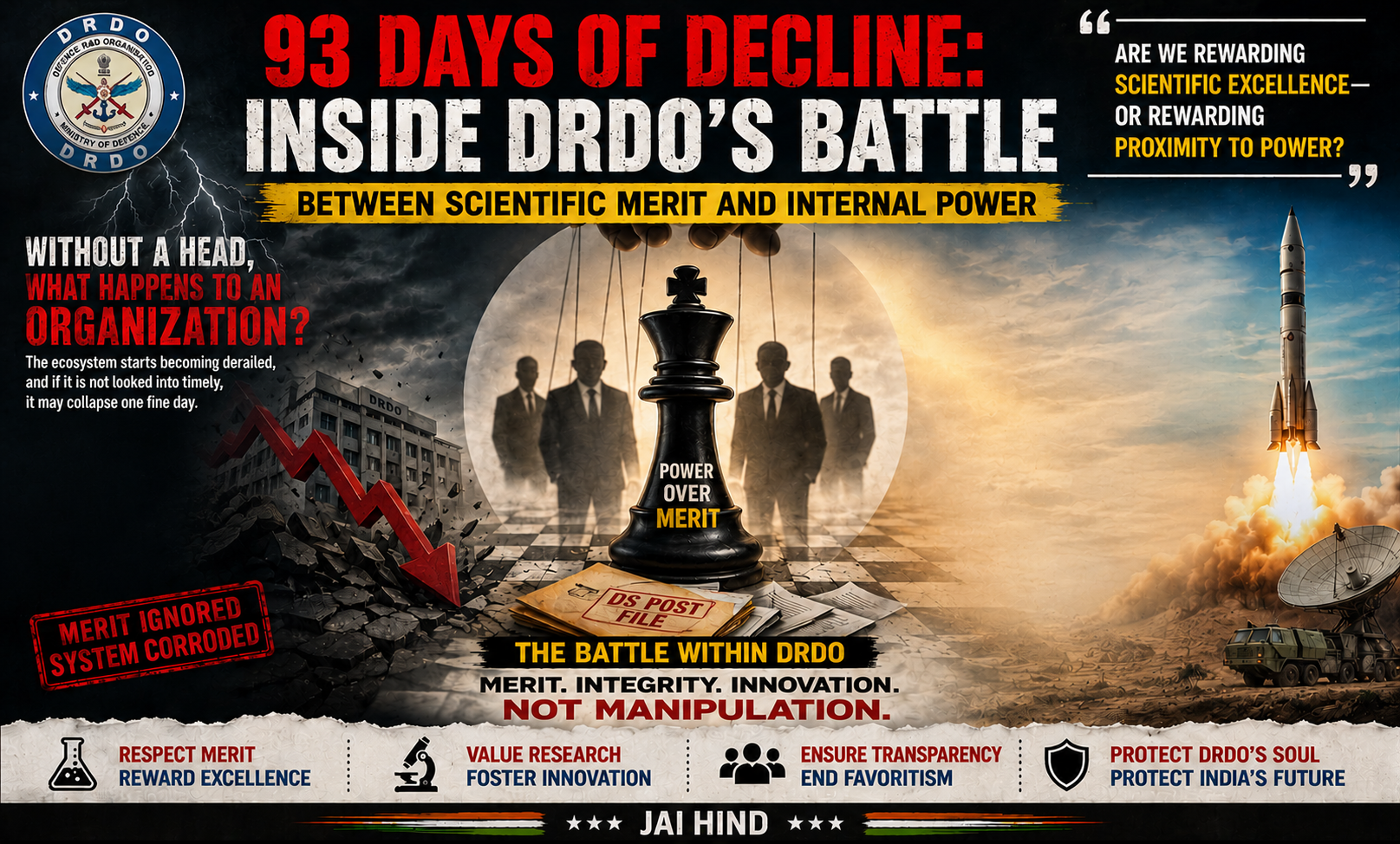
The ecosystem starts becoming derailed, and if it is not looked into timely, it may collapse one fine day.
Since the last 93 days, DRDO has been nose-diving day by day.
Every day, an incompetent group of corporate DGs is making their own rules and raising files for their own benefits.
When they see an opportunity for a DS post, they direct it to the Director, RAC, Mr. RP Pandey, who was planted by DG HR. How did he manage to ensure that the 8th-ranked seniority officer, Parteek Kishor, became the Chairman of the selection committee for Director RAC and selected Pande from his own cluster while avoiding Atul Dev, who was waiting in the queue for Director RAC.
The whole DRDO knows about these manipulations. This happened because the entire match-fixing was done by the same manipulation-oriented group.
This parachuted RAC Director raised a file for four DS posts and, interestingly, without knowing the meaning of DS (Distinguished Scientist)—an elite researcher who is widely recognized for major career achievements, leadership, and groundbreaking discoveries in their academic or industrial field.
Out of four:
1. Mayank Diwedi, DG HR MSc, 56% in Organic Chemistry, with no criteria matching the above definition. No major international papers, and even the experience certificates were reportedly not verified at the time of his mysterious selection as Scientist C in RCI.
31 number in the DS seniority list.
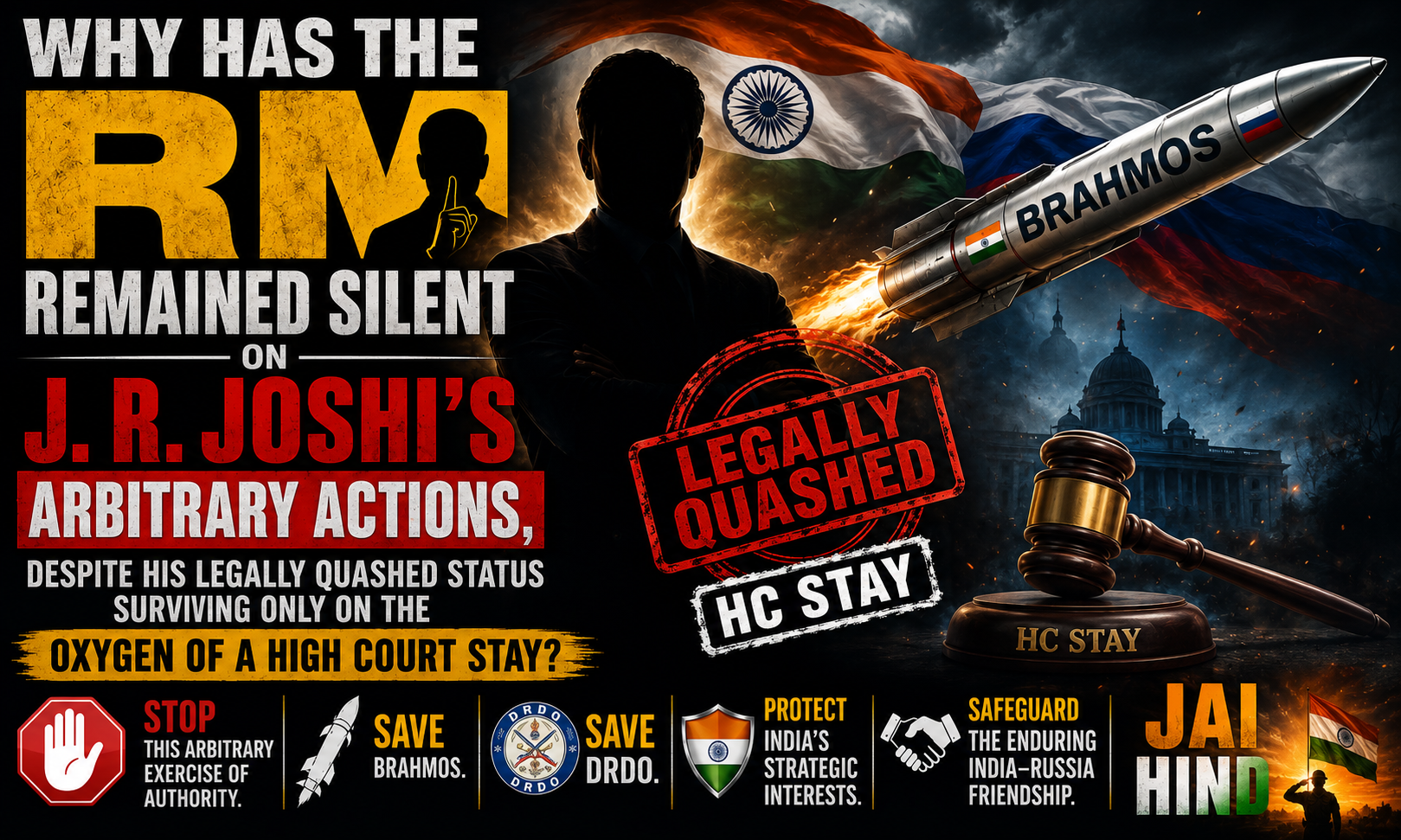
2. J. R. Joshi, DG BrahMos His selection is also entangled in a legal case and is serving under a High Court stay. His claims of being a “best scientist” have already been nullified by the CAT, and his plea was quashed. His other qualities also do not appear to fit the definition of a Distinguished Scientist.
40 number in the DS seniority list.
3. Ravindra Singh, DG (R&M) He is a DRDO Facebook guy.
Why is it that if you search for any DRDO scientist, their name is associated with IITs, universities, research papers, conferences, etc.? This man has Facebook posts or DRDO Twitter posts, with several occasions involving political presence. So, you can imagine his frog-like growth in DRDO.
34 number in the DS seniority list.
4th name is a senior scientist from the list of first 8 names in the seniority list, apparently only to justify that their corporate group has left 25% for the real scientists while they are willing to get the remaining “butter” with the help of bureaucrats and political allies. Sitting in Delhi, they can easily bluff them by portraying achievements that actually came from various DRDO Labs.
The GOI constituted the Raghavan Committee to restructure DRDO and make it more productive. Unfortunately, even before the committee’s recommendations could be implemented, a group of corporate-minded DGs and directors appears to be building strongholds within DRDO, enabling them to run the organization in their own way.
Hope DS List will be recommended from MoD, ACC in the basis of Scientific Contribution and achievements.
The time has come for the responsible authorities to look beyond files, designations, and internal networks and ask the most important question:
Are we rewarding scientific excellence—or rewarding proximity to power?
DRDO cannot afford to lose its scientific soul.
India needs a DRDO where merit speaks louder than influence, science speaks louder than politics, and national interest stands above every individual interest.
It is observed from the inputs received through the website that these developments raise serious questions that the nation must examine with utmost vigilance. As patriotic citizens, can we blindly accept a situation where an individual, seemingly intoxicated by power and displaying an increasingly authoritarian and dictatorial attitude, is allowed to jeopardize BrahMos—a strategic symbol of the close and enduring ties between India and Russia?
The issue is no longer merely an internal administrative matter. When actions surrounding an institution of strategic significance such as BrahMos raise concerns about institutional integrity, accountability, transparency and national interest, silence itself becomes a matter of serious public concern.
It is therefore a humble yet urgent appeal to the nation, the Hon’ble Prime Minister and the Hon’ble Raksha Mantri: intervene before the situation deteriorates further.
Stop this arbitrary exercise of authority. Save BrahMos. Save DRDO. Protect India’s strategic interests. And safeguard the enduring India–Russia friendship.
The nation deserves answers. The armed forces deserve institutions governed by integrity, accountability and due process, not personal authority or unchecked influence.
Current Status
Following the exposure of the alleged actions of J. R. Joshi and the concerns surrounding the matter, the 31st meeting has reportedly been rescheduled to 1700 hrs on 1 September 2026.
The rescheduling makes the matter even more significant and warrants close scrutiny by all concerned authorities.
Input received by website:
“Latest developments
Board Meeting rescheduled on 01 Sept at 1700 hrs
J R Joshi is still confident that Board will pass the resolution as per his conspiracy theory.
Yesterday he went to HQs DRDO and met DG HR, Chairman, Addl FA and DG MSS to eye wash about the report.
Justice prevails as none of his favourite corrupted Scientists F like Dr. Abhisek Kumar PD Lucknow, were not promoted to G
His rival group got promotions including earlier Dy CEO Dr. S K Joshi whom he managed to transfer to DIBER after confrontation using Dr Kamath’s influence.
Dr J R Joshi is urgently going to Lucknow tomorrow. don’t know whether Jogi ji called him or not.’’
At this critical juncture, the question remains:
How long can the nation remain silent when the credibility of a strategically vital institution and a relationship of immense national importance may be at stake?
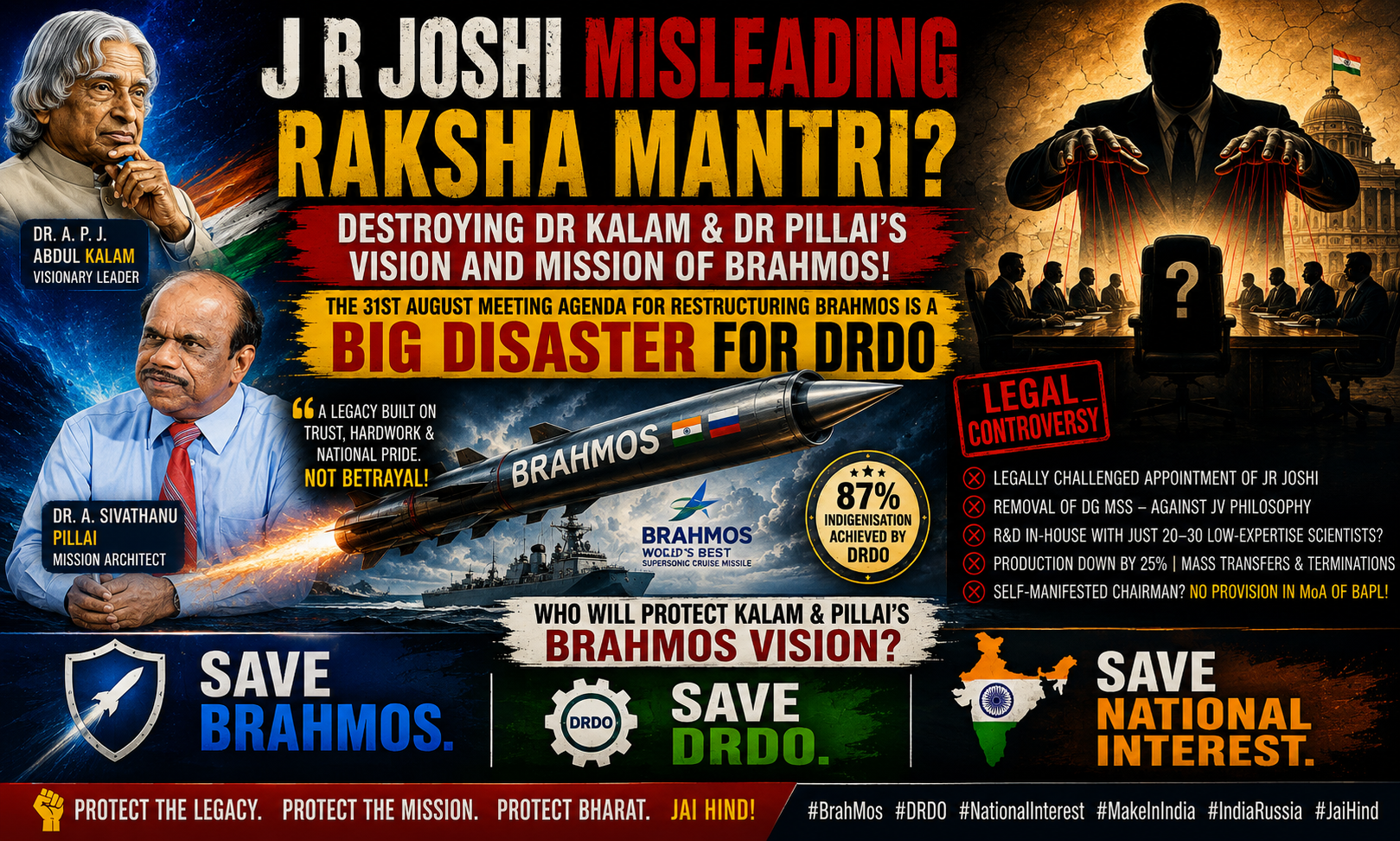
The agenda proposed for the 31st August meeting on the restructuring of BrahMos raises serious questions and, if approved in its present form, could prove to be a major setback for DRDO and the institutional architecture that has supported BrahMos since its inception.
How?
The whole world knows that on 12th February 1998, under the visionary leadership of Dr. A. P. J. Abdul Kalam, a Joint Venture was formed as a partnership between India’s DRDO and Russia’s Military Industrial Corporation, NPO Mashinostroyenia (NPOM).
The first successful flight of BrahMos was launched on 12th June 2001. Since then, BrahMos Aerospace Pvt. Ltd. has developed and produced multiple variants and has also entered the international defence-export arena.
There is numerous success stories associated with BrahMos, including its outstanding operational performance and the significant role attributed to the system during Operation Sindoor.
Unfortunately, according to the concerns and allegations raised in this matter, a former Chairman of DRDO made a controversial decision amid what has been described as an influential internal lobby and selected J. R. Joshi as DG BrahMos.
Most significantly, it has been alleged that J. R. Joshi was the junior-most among 7 eligible candidates. The selection was challenged before the CAT, and the Tribunal reportedly rejected the justification offered for the selection, including the explanation that the decision had been made on the basis of alphabetical order. Such an explanation has understandably raised serious questions, particularly when it concerns a premier national defence institution. The appointment was consequently quashed by the Hon’ble CAT.
Here, one important allegation requires serious examination: it has been claimed that information regarding the proposed appointment of J. R. Joshi was communicated to a particular individual one day before the selection interview and that this matter was duly brought to the attention of the Chairman, DRDO.
If established, such a sequence of events would raise serious questions regarding the transparency and credibility of the selection process and the confidence of the internal network involved. It is further understood that a stay was obtained from the Telangana High Court. Following extensive arguments, including submissions involving the ASG, the matter reportedly remains pending, with the verdict reserved since 8th July 2026.
The central question now is: what happens to the institutional ecosystem that has developed under J. R. Joshi if the High Court ultimately vacates the stay?
There are also serious concerns being raised regarding BrahMos production, with claims that production has already declined to approximately 25%. already because of continues inductions of non-skilled/low-skilled scientists with great profile could be Eco Intel from IB will justify.
Similar concerns have also been raised regarding continuing transfers and terminations involving individuals who are allegedly not aligned with the existing internal influential lobby. These allegations deserve transparent examination rather than being dismissed without inquiry.
Now comes the most consequential point. The proposed agenda appears to have been placed for approval through the present DRDO leadership. The concern is whether the complete institutional, technical and governance history of the BrahMos Joint Venture has been adequately considered.
Why should the DG MSS be removed from the Board?
Why has the DG MSS historically been associated with the Board/directorship structure of the Joint Venture?
The reason is fundamental: the DG MSS ecosystem is responsible for major missile R&D capabilities. The achievements of India’s missile programmes have been built upon the collective contribution of multiple missile-complex laboratories and their associated R&D infrastructure.
Now the agenda puts which shows that approve by RM through temporary DG DRDO, who don’t know the complete JV MoU, removal of DG MSS from the Board why DG MSS heading board directorship of JV because responsible for R&D and because of this India achieved 87% indignation of various and all missile complex labs under DG MSS have the credit.
Now our genius JR Joshi, current CEO ad MD BrahMos wants that BrahMos R&D will be in house at BAPL with just 20-30 low expertise scientists as you know what expertise are them.
However, the same indignation by DRDO since 2001 to till date Under DG MSS achieved 87% has contribution of more than 300 scientists in last 26 years of the history of BrahMos.
what will Joshi achieve with these small chunks and without R&D infrastructure, the help of DRDO missile complex laboratories and DGMSS Who is the Director General all missile complex laboratory cluster in Hydrabad. Can our dear Defence Secretary know this points basically they ignoring the vision of Dr. Kalam and misleading the RM.
Against this background, the proposal that BrahMos R&D should effectively be brought in-house with a limited team of approximately 20–30 scientists raises a fundamental technical question: can such a small group replicate the depth, infrastructure, laboratories, specialist manpower and institutional knowledge available across the established missile R&D ecosystem?
This is the point that must be examined carefully. From 2001 to the present, the established missile R&D structure under DG MSS and associated laboratories has contributed substantially to India’s missile-development achievements. What additional capability would be created by fragmenting this established ecosystem and attempting to recreate R&D capacity inside BrahMos with a comparatively small scientific team?
Can our Defence Secretary and the Raksha Mantri be fully apprised of these technical and institutional implications before any restructuring decision is taken? If not, there is a real risk that the original vision of Dr. Kalam and the founding leadership of BrahMos could be diluted through administrative restructuring rather than strengthened through scientific and technological integration.