Tag Archives: government

‘Akash missile system can’t be trusted during war’: Degraded by govt defence agencies, loopholes in strategic weapon system threaten national security

Yatish Yadav Dec 02, 2019 18:22:43 IST

Other squadrons reported frequent unserviceability of mobile surface-to-air Akash Missile system and long duration downtime, which means that the missiles are dysfunctional and may not be cocked and loaded against enemy in contingency

Several government agencies, including missile manufacturer Bharat Dynamics Limited, Bharat Electronics Limited, did not tell the truth to the government about malfunctioning Akash Missile system and poor quality of spare parts provided by the private vendors

CAG was perhaps far-sighted, when in a 2017 report, the national auditor observed that Akash Missiles cannot be trusted in situation of a war

On 3 June, 2018, Akash Missile’s Transportation and Loading Vehicle (TLV), parked at an Air Force Squadron, was jolted after a sudden burst of tube followed by shearing off wheel bolts due to impact. The incident shocked Air Force headquarters. The Air Force officials wanted not only wanted the routine analysis of the incident, but also an in-depth discussion with Defence Research and Development Laboratory (DRDL), a multi-disciplinary Missile System laboratory under the Defence Research and Development Organisation (DRDO) to unearth issues hampering the functioning of the strategic weapon system.

More than a month later, another squadron reported cracks on air intake caps of dummy missiles. An investigation by Firstpost revealed that the incidents were followed by other squadrons reporting frequent unserviceability of mobile surface-to-air Akash Missile system and long duration downtime, which means that the missiles are dysfunctional and may not be cocked and loaded against enemy in contingency. This incident forced Guided Weapon Maintenance Department of Air Force on 5 September 2018 to raise the issue, where they clearly stated that the “Squadrons have been reporting frequent unserviceability of Missiles and it has been noticed that time taken to resolve these failures is considerably high due to delay in analysis of failures.”

The sheer inertia of government defence enterprise involved in Akash Missile production and maintenance reached to such an alarming level that at least three squadrons of Akash in February 2019 reported that missile system remained down or simply broken and sometimes even out of order during 90 percent of the time since their date of commissioning. These squadrons were commissioned between 2013-2015 to counter Chinese aggression.

Multiple government agencies, including Missile manufacturer Bharat Dynamics Limited (BDL) which comes under the Ministry of Defence, Bharat Electronics Limited (BEL) which is responsible for radars and maintenance and the DRDO, did not tell the truth to the government about malfunctioning Akash Missile system and poor quality of spare parts provided by the private vendors.

The malfunction of Integrated Air Compressor and Storage Facility (IACSF) revealed another shocker and the Air Force mentioned it on record that the IACSFs of Akash Missile System units are unserviceable due to wobbling and vibration, pneumatic leakage, breaking of mounting pads and bolts. A missile had failed to take off during combined guided weapon firing exercise known as ‘CROSSBOW-18’ and a team of Missile System Quality Assurance Agency (MSQAA), BDL and DRDL was constituted to investigate the failure.

MSQAA is an independent inspection Agency under the administrative and functional control of Director General Aeronautical Quality Assurance, which comes under the Department of Defence Production of Defence Ministry. The incidents of leakage from fuel tanks and leakage in pressurised Missile containers were taken so lightly that the Air Force, responsible to secure the nation from aerial threats, was forced to direct to the DRDL, BEL and BDL that present configuration of certain systems of Akash Missile will not be acceptable for future squadrons, which are under the process of procurement. The Air Force, BDL, BEL and DRDL are yet to respond to a questionnaire sent by Firstpost on 24 November.

Details expose criminal act by government defence enterprises

If there is an emergent situation, several Akash sqaudron may not be able to launch counter offensive because deficiencies in many of the system including hydraulic oil leakage and container pressure leakage, which is pending since 2017. The complaints received from Air Force headquarters, Eastern Air Command and other Akash field units reveals there is no back-to-back agreement with vendors for equipment under warranty, making it difficult to repair the faults. Documents reviewed by Firstpost showed that almost all squadrons have expressed that they are unable to get proper feedback from BEL on repairing the faults in Missile System and on problems plaguing Akash Missiles which Indian agencies are ill-equipped to resolve. Surprisingly the field engineers, who are supposed to rectify the critical snags, are not even aware of any action plan.

Documents further said: “Currently majority of the Akash field engineers are working to pass information about issues without any tangible technical output. The untrained and poorly equipped field engineers are neither aware of any corrective action plan nor they are committed.”

The documents also pointed to massive delay in supply of spares for Missile System, virtually grounding them for for six months to a year. Air Force in a meeting had informed that most of the problems reported in 2017 were pending for over a year now. The documents also pointed at the repairing of Akash trailers which are covered under annual maintenance contract. It said: “Akash Trailers serviceability is poor and some cases spares supplied to Akash Missile units are not configured as per system requirement which is affecting equipment serviceability in case of failure.”

Bharat Dynamics Limited (BDL) the manufacturer of Akash Missile has not been able to resolve three important issues for the last two to three years. BDL, founded in 1970, is a government enterprise under the administrative control of the Ministry of Defence. It is learnt that BDL was told in high level meeting convened last year to come out with solid plan after conducting an investigation and study of faults in Akash Missile System within a month on long delays of critical faults. Even the investigation to unearth and address the issues was delayed.’


The Air Force has refused to pay for new maintenance contract for certain Akash Missile squadrons as the old ones expired in September 2019. They argued that missile systems in several squadrons were left idle for more than a year. Instead, it had asked for extension of warranty for certain squadrons which have been dysfunctional for 17 to 15 months in the last two years. Air Force asserted since system was down and faults were neither rectified nor replaced, it violated the maintenance contract. Air Force is learnt to have said that “during the warranty period, the seller shall either replace or rectify the failed goods free of charge within 30 days of notification of such defects. As per article of the contract, warranty of the equipment would be extended by such duration from time the buyer has reported such unserviceabilities till the time seller has restored the status of the buyer’s satisfaction.”

Red tapeism in government defence enterprises hurt national security

Firstpost investigation also revealed gross inefficiency of government defence agencies BEL, BDL and DRDL to address the problem in Akash Missile System. Documents reveal that meetings after meetings were convened on the issues but the government defence enterprises couldn’t satisfactorily answer the questions raised by Air Force. These government defence enterprises have been passing the buck. They also cheated Air Force by providing substandard and fake spares.

A meeting earlier this year chaired by Air Vice Marshal Bhanoji Rao pointed at severe negligence in handling Akash Missile System which may have serious ramifications in contingency. Documents revealed that certain spares, especially those of sub-vendors (procured by BEL) were being received at Akash Missile System units without ‘Quality Assurance’ certification and on a few instances it came to light that these spares were old and fake. In a letter, it was noted: “On few instances it has been noticed that the items were not new/authentic.”

Air Vice Marshal Rao clearly told his team at the Air Force not to accept spares without ‘Quality Assurance’ certification. The meeting also revealed a lack of expertise of government-owned defence enterprises which are acting merely as a supplier of equipment after procuring it from domestic and foreign vendors. It basically means that these government enterprises are acting like a payment facilitators. Their complicity in this entire saga was further exposed when government defence enterprises officials told the senior Air Force officials that sub-vendors (private companies supplying spares) were not willing to share their design documents.

An appalled Air Vice Marshal asked, if the Defence Research and Development Laboratory (DRDL) is the authority then it must have intellectual property rights of all designs related to Akash Missile System. Obviously, the defence agencies representatives were not aware about it since they never took the pain to look into the agreements and promised the Air Force to look into the matter to ascertain whether these rights were with vendors. A promise was made to list all major vendors for unhindered supply of spares to overcome single vendor situation. As far as BEL is concerned documents said: “Almost all squadrons have expressed that they are unable to get proper feedbacks from BEL on progress and plan of action of pending faults.”

The meeting chaired by Air Vice Marshal Rao also discussed high failure rate of one of the systems of Akash Missile, lacunae in analysis of faults and mismatch in software versions used for the this strategic weapon.

Another major loophole, which highlights the non-seriousness of defence agencies, is the contract with the private vendors. The agreements are more favorable to private parties putting Akash Missile System in jeopardy. Documents flagged these concerns further pointing out that all the vendor supplied items are outside their warranty obligations and in certain cases supplied spares are not configured as per system requirements. Some spares for Akash Missiles are not fit and functional and this is affecting the equipment serviceability in case of failure.

It appears that careless handling of most critical weapons has been going on for a long time. The Comptroller and Auditor General of India (CAG) was perhaps far-sighted when in a 2017 report, the national auditor observed that Akash Missiles cannot be trusted in situation of a war. CAG had categorically stated that Akash missile system delivered by BEL were deficient in quality and 30% missiles failed the test.

“Audit found that the Strategic missile system delivered by BEL were deficient in quality. Out of 80 missiles received up to November 2014, 20 missiles were test fired during April-November 2014. Six of these missiles i.e., 30 percent, failed the test. Preliminary failure analysis report revealed that the missiles fell short of the target, had lower than the required velocity, and also there was malfunctioning of critical units like Servo Control Unit and Connector. Two missiles had failed to take off because the booster nozzle had failed. These deficiencies posed an operational risk during hostilities. Two missiles had failed to take off because the booster nozzle had failed. These deficiencies posed an operational risk during hostilities.” CAG report had said.

Firstpost investigation showed that after the CAG report, the squabbling between government defence enterprises had come to light. Eight critical snags in Akash Missile Systems were reported after the CAG report which were pending for three-seven months. CAG had recommended that Ministry of Defence needs to ensure better synchronisation of the various activities and agencies involved in such strategically important projects to ensure their timely completion and quality of Strategic Missiles also needs improvement so as to bring down failure rate.

Notwithstanding, many snags were not rectified citing lack of spares. The Air Force anguished over lackadaisical attitude of BEL and BDL has firmly directed them to resolve all internal issues immediately and ensure that no Missile is kept unserviceable due to their internal problems.

BEL Senior Officers Conversations Regarding Corruption in Prestigious Air Force IACCS Project

www.corruptionindrdo.com,  however, cannot independently verify the authenticity of audio. Received from anonymous source. 

www.corruptionindrdo.com  has forwarded government agencies for further investigation.

Here is a conversation between Mr. D.K. Chatterjee and Mr. M.M. Pandey wherein Mr. Pandey is exposing the BEL corruption Modus Operandi  observed in ordering of civil contracts in IACCS.  

Mr. D.K. Chatterjee an IIT Kanpur Graduate of 1983 batch had worked in many indigenously developed products related to communications and radars. He is presently in the R&D group in-charge of the Radar Data processing. He is an engineer of par excellence in his field and through his in-house research and development he has saved a huge amount of foreign exchange for the country.

He has been targeted by the BEL management and his career has been stalled since he does not fit into the BEL model of going for foreign ToTs and with big corporate / private vendors to provide the defence forces equipment at very high cost and ensure kickbacks leading to corruption where persons at highest level BEL are involved. In the IACCS project the biggest challenge was to integrate the legacy Radars of Indian Air force and Army with the IACCS system since the output protocol of these old Radars was not compatible with input requirement for IACCS system.

Mr. D.K. Chatterjee and Mr. M.M. Pandey wherein Mr. Pandey is discussing the discrepancies which have been observed in ordering of civil contracts in IACCS. In turn Mr. Chatterjee tells about his experience wherein as a part of IACCS project he had worked on creating the interface (Radar Data Processing hardware and software) between the old legacy Radars and IACCS system. He was forced to use hardware which were pre-defined and at a very high cost.

As per him even with the high cost of hardware (since the software was written in-house) the cost of one system came to just about Rs 25 lacs. After the systems were proven he was unceremoniously removed from the project and the systems were subsequently outsourced and bought at a huge cost of about Rs 2.5 Crores each. With so many legacy Radars which were integrated to the IACCS the amount of money which has been misappropriated by the top management of BEL would run into hundreds of Crores.

This is again a case where an intelligent IIT graduate Electronics Engineer who did not compromise on corruption and worked for giving the Defence Forces the best at the least cost was harassed and removed from the main stream and made to suffer in his career. This is again in line with what has been brought out in the case of ordering of DDS software where a software worth not more than Rs 20 Crores was being bought at Rs 320 Crores and when one of the Managers in R&D became a whistle blower to stop this from happening he was harassed and bullied to the extent that he was forced to resign.

The Vigilance report which brought out this corruption had also noted that all the original team which worked on software related to IACCS (first phase wherein five nodes were established by BEL) was dismantled and engineers were either transferred out of the Unit or outside the project. Hence the modus operandi is the same in BEL for all persons who stand against corruption. They are harassed, side tracked, given punishment postings or suspended and terminated.   

It can be understood that if one or two persons are targeted but in the project IACCS it is clearly brought out at various stages that persons have been targeted whenever they have spoken about the rampart corruption which is being monitored by the highest level of management in BEL.

If proper investigation is carried out by external government agencies it will clearly come out that in this project from the beginning itself at all stages and in all systems (software, hardware, civil contracts, sub-systems for hardened underground buildings) organized and planned corruption has taken place through a mafia (which may be external to BEL) and with full support from persons sitting at the highest level of BEL.

Some of the conversations of Mr. D.K. Chatterjee are as follows:

• I have talked to Shri Ajay Singh who is involved in the civil works of IACCS. He has also said that there are lots of discrepancies in the civil contracts.

• I was part of IACCS group who interacted with Air Force persons during the initial phase of the project. I was working in Radar Data Processing (RDP) and when we were interfacing with Air Force personnel they also told us that there was something very wrong going on in the project.

• The amount of corruption which is there in the project it does not look that CMD would have any control. If the loot is of the order of Rs 1000 to 2000 Crores, I think a very small part of it would have gone to BEL persons. Persons facilitating this loot in BEL would just get few foreign trips and perhaps some GM promotions. The very fact that Air Force has given BEL the job of civil construction on underground buildings is itself questionable since DRDO already had expertise in this and Air Force could have done this job ( directly through some private vendor) with DRDO help (this shows that the plan was to do all the corruption by just front ending BEL).

• I have also been a part of IACCS project from the very beginning (although I was looking after a very small portion related to RDP) but I also found something strange happening in the project. When I was doing the RDP I was asked by Mr. Anil Pant (the AGM in-charge of IACCS who was indicted by the Vigilance report dated 16th Nov’16 for manipulations in the ordering of DDS software but was subsequently promoted as General Manager) to choose the hardware from a particular vendor (on a single tender basis and at a very high cost from what was available in the market). As per Mr. Pant it was customers requirement to go with a particular vendor (how can customer dictate the vendor).

• Even taking the hardware at a higher cost I was able to make the system in-house at a cost of Rs 25 lacs. The same system they were getting from vendors at almost Rs 2.5 Crores (ten times the in-house cost).

• Although I was doing a very small part of the project the attitude which was there in the

overall project got reflected in this also (as in overall IACCS project they have been going for single tenders for ordering on pre-fixed vendors at much higher costs than available in the market).

• Everyone looked at me as if I have done a very big mistake by developing the system inhouse (maybe because I came on the way of persons making money out of outsourcing the same to pre-fixed vendors). Everyone (including the end user) tried to dissuade me from taking up the in-house development by telling me that the system is required urgently within six months thinking that I will raise my hands due to the impossible time lines set for me for development. Everyone was saying that RDP cannot be made in-house but like a fool I accepted the challenge and when I successfully demonstrated it, I was unceremoniously thrown out of the project.

• It is quite obvious that there is some serious misappropriation going on in the project at the highest level.

It is obvious that since after developing the system at a cost of Rs 25 lacs Mr. D.K. Chatterjee was thrown out of the project the required systems would have been bought at inflated cost (almost ten times) from pre-fixed vendors. This has been the modus operandi in the IACCS project wherein persons who had originally been part of the project and were instrumental in development of software and selection of hardware were unceremoniously removed from the project and a bunch of persons who had nothing to do with the project were placed at the positions where they manipulated the ordering in connivance with the persons at the highest level at BEL for personal gains.

Explosive Purported Conversation Between MM Joshi Ex-GM,NCS,SBU and MM Pandey, GM,Vigilance

An explosive purported conversation between former in-charge of Air Force’s Rs. 7,900 Crore project, MM Joshi and another BEL senior officer MM Pandey recently surfaced and received by the corruptionindrdo.com through anonymous sources. MM Joshi was the officer who signed the IACCS contract on behalf of Bharat Electronics Limited in October 2015 and served as driving force till April 2016 when he was unceremoniously transferred from BEL.

According to sources, Joshi was removed from the position after he refused to endorse large-scale corruption in the project that was being orchestrated through senior officers of defence public sector undertaking.

Another person in purported conversation, MM Pandey (GM), who conducted inquiry in alleged irregularities in IACCS project and exposed the deep-rooted corruption in the project. Pandey has now been suspended by BEL for exposing corruption. The government, which vows to fight corruption has been a mute spectator all along while Pandey is being harassed for doing honest job. MM Joshi who handled the sensitive IACCS project in purported conversation with Pandey has made startling revelation suggesting that alleged loot in contract began immediately after BEL signed the agreement with Indian Air Force and at least two senior officers were instrumental in perpetrating the irregularities. Joshi is also heard in the conversation admitting that it is fit case to be investigated by the Central Bureau of Investigation.

This shocking revelation fly in the face of BEL, which has been trying to cover-up the massive scam and punishing honest officers, who expose the rot. It has been learnt from the reliable sources that Department of Defence Production, has recommended a CBI probe but the file for the last one month is still awaiting recommendation of defence minister.

While this case has been caught in bureaucratic quagmire due to influence exercised by the Babus, BEL officers, the inquiry team which exposed corruption has been suspended. This is a sad reality of a vibrant democracy where corrupts are honored and honest officers are hanged.

This whistleblower website which has been on the forefront of anti-corruption movement for more than a decade has decided to publish excerpts of the purported conversation which makes it amply clear on loot right under the nose of government and investigating agencies.

www.corruptionindrdo.com,  however, cannot independently verify the authenticity of audio. Received from anonymous source. www.corruptionindrdo.com has forwarded government agencies for further investigation.

Here are the excerpts of conversation between MM Joshi (NCS SBU head in BEL when the IACCS project was finalized between BEL and Air Force, Retired in March 2019) and MM Pandey (GM-PS/Delhi who was the Vigilance Inquiry Officer who brought out the corruption in IACCS project) on 9th April 2019  or 10th April 2019 after main stream media reports publish on 9th April 2019 “BEL allegedly violated string of norms to award contracts to German, Finnish firms; ex-CMD, two retired defence officials under scanner”

Mr. M.M. Joshi can be heard saying:

_ I was very careful in signing any document order/contract of IACCS without seeing that everyone has signed since I knew that all of these cases would be opened by Vigilance one day  

_This report is beyond the report which was made by M.M. Pandey and contains details of procurement of “A” class items. Mr. Nataraj Krishnappa (who is Director-Oother Units) and Mr. Joydeep Majumdar (who is the present GM-NCS) will finally be caught for what they have being doing (which brings out that he had knowledge of the wrong which was to happen in the project from the time the project was taken up).

_ One of the Directors of BEL is saying that there is some person in DRDO who has leaked the report to press  

_ What has been brought out in the second news article is point to point and ever thing which has been written is the truth and today’s report is very explosive and related to Material Procurement  

– This report will directly indict Mr. Nataraj and Mr. Majumdar. They should get a lesson and they should get the return for whatever wrong they have done. They were the people behind my transfer out of NCS in fact Mr. Majumdar had started manipulations even before he took over as SBU head. Also Mr. Nataraj is the person who manipulated the selection of D (OU) and saw that my application for that post gets rejected so that he could be selected. He was also responsible for my transfer out of NCS SBU and bringing in Mr. Joydeep Majumdar in my place

_ All these should be handed over to CBI/CAG or they should take suo moto cognizance of the corruption done by these people.

_ All the companies to which order has been given are shell companies  

_ I will wait for that day when these two are punished for what they have been doing.  

………………………………………………………………………………

DRDO’s Assessment Phobia always in Extreme in May June

Website received so many calls and letters related to assessment most of that the Directors are not giving due credentials of their work.

I could not understand that after so many years of service and experience they don’t what to accept the assessment game of DRDO, although inside they all accepts the DRDO assessment culture but in front of family and friends not want to show the biggest rotten culture of DRDO.

What is the base of DRDO assessments; simply there are three types of candidates in every year in all categories.

  1. Who are the beloved of Directors, DG’s or have good connections of VIP like politicians, bureaucracy, judiciary etc or any outside important board member but this type of situation is very less but it worked because when RAC forced to external member to clear incompetents so that time he bargain for his man,  you can these example in every labs of DRDO the competency is not a necessity of these type of creatures and Director make sure that any  situation this candidates should clear in any cost. That’s why defer system was created. Examples are such candidates are enjoying post of DG and Directors in so many place who gave their 100% more than their own family to their respective bosses DRDO fraternity very well knows such candidates. Unfortunately today’s DRDO standing on these kinds of candidates. The greatest irony of these that after retirement they made arrangements to suck the blood of DRDO till whole life. And DRDO management always running files to arrange such equations for them.
  2. In this category very few candidates falls that is non controversial in these cases Director’s not interested if they are getting promotions or not getting, if not getting then he went and ask the boss most common answer is I have tried by best due to shortage of available posts   I could not able help you but I will make sure that next time you will get.
  3. Third category scientists are specials in most cases they are the real competent and Lab Directors and his courtiers never want that theses type will grow, because both felt illiterate in front of these categories. Directors put their whole efforts to stop them to get promotion. You can verify that the cream of DRDO scientists never get right time promotions, this is clear yard stick to find out actual talent of DRDO. It can be one or two exceptions. The FCS is only created for these types of scientists but FCS benefits are getting by point one categories candidates.
  4. Rest is clear that DRDO assessment is a eye wash and government wasting crores of crores rupees in such melodrama. Where after June 30 lot of candidates start plays Kakei’s role and set for few days in Kope Bhawan.
  5. Why DRDO not able to delivering world class product after corruption the nepotism with assessment business is major cause and the spine of DRDO is suffered with illness.
  6. So friend digest this dilemma of ASSESSMENT fever and take rest and enjoy with your family leave this matter for Dr G Shatish Reddy and he will make differentiate between candidates and scientists
  7. In DRDO almost 7500 scientific manpower is their but every time DRDO asking government we are in shortage of scientists to cope with demand of services why because of out of 7500 scientific manpower only 50% is scientists, out of these 50%, 20% percent scientists are suffering with assessment vaccine and rest is 50% are candidates only.  Regards

Defence industry may see spectacular growth after 2019 General Elections, says L&T’s Jayant Patil

May 16, 2018 12:28 PM IST | Source: Moneycontrol.com

The L&T Whole-Time Director expects capital spending, as part of the defence budget, to increase next year, resulting in higher project orders

Prince Mathews Thomas
@prince0879
Jayant D Patil spearheaded L&T’s foray into the defence industry in 1986, at a time few other private companies saw any promise in the heavily regulated industry. Patil, who joined the infrastructure heavy weight straight after passing out from IIT Mumbai in 1978, developed long-term relationships with the DRDO, and the Navy, among other defence establishments.

The early start is now helping the engineering giant. In 13 years since its debut in the market, L&T has become the largest private defence company in the country, and is bigger than most of the government-owned defence enterprises.

In an exclusive interview with Moneycontrol, Patil – Member of the Board & Whole-Time Director (Defence Business) at L&T – says that defence is one of the fastest growing businesses in the company. To reflect the growing importance of the vertical, the defence business is now an ‘independent company.’ And starting from this financial year, L&T will report the defence segment as a separate entity within its core businesses.

“We have the entire infrastructure in place. We have all the initiatives put in place. We have the R&D centres,” says Patil, adding that L&T is set for a spectacular growth.
For that growth to happen though, the central government will have to increase the proportion of capital spending in the defence budget. Patil is hopeful of that happening after the 2019 General Elections.

Excerpts from an interview:

The government has talked about developing capabilities domesticallyto reduce the dependence on imports. The Make in India campaign also focuses on the defence industry. Have you started seeing the difference?

The focus is there. The government has started putting programs in a competitive basket. Earlier projects would either go to a foreign player, or to a PSU. But now, for instance look at Navy. Earlier, 92 per cent of the warships or submarine contracts by value have been placed with government owned shipyards. As of now, except of old decisions, the government plans to allow private sector to participate in all future shipbuilding programs on competitive basis.

The issue is that things are not changing at the kind of pace what one would have hoped for and the quantum of money being allocated to enable new contracts. The current Budget allocations are just good enough to meet committed liabilities.

Why is that?
One should look at the budget allocation. Till 2014-15, 40 per cent of the defence budget would go into capital spending. Today, that has dropped to 20-25 per cent. And that it because of the huge increase in revenue costs (salary and pension payments).

That is something which the government did out of sheer respect for people who fought for the country. But the fact is that it has come at a huge cost for the future preparedness of Armed Forces. So money has become a constraint and allocations need to be enhanced.

And that has led to the slow pace?
Yes.

Do you think the situation will be better after the General Elections in 2019?
Yes, I believe that the reversal will possibly happen when the new Government comes around after the 2019 General Elections.

What has the present situation meant for L&T’s defence business?
So we have a scenario today where this is a market which shows huge promise. And we keep getting orders as and when a PSU gets a big contract. The public enterprises buy from us because we have developed these products in partnership with Defence Research Organisation (DRDO). So the business continues in “business as usual” state, the growth comes in with us getting few contracts directly from MoD.

But the growth could have been truly spectacular had Make-in-India programs taken off in a big way. We have the entire infrastructure, technologies, products and capabilities already in place. We have all the initiatives proactively in place. We have the R&D centers, design centers, and innovation groups in place. Earlier we used to have one, but now we have four R&D / Basic Design Centers to serve the defence sector.

What is your manufacturing presence?
Today we operate from Powai (Mumbai), Hazira, Baroda, Pune, Coimbatore, Vishakapatnam, Katupalli, New Mumbai and Bengaluru, which is more of an R&D unit, but also has a small production facility for strategic electronics.

Which is your largest segment?
The largest segment today is the artillery and Naval segments. The smallest segment what we are operating today is the space, missiles, communication, which are individually worth about Rs 100-200 crore per year.

What is the total order book now?
I can’t give you that number. But perhaps in another few months I can. From the 2019 financial year, we will be reporting defence business as a separate entity within the L&T core business. So wait for that.

Although we have been operating defence business for three decades, we had created defence as a separate independent company (IC) as an entity, with its own board, in the FY 2018.

A few reports last year said your order book was of about Rs 12-15k crore…Holistic if we look at it, we are bigger than that.

So all the defence businesses will be brought under this IC?
All the defence offerings are under this IC, except for very strategic construction programs.

Could you give an idea of how big your defence business is?
If I look at comparisons, HAL and BEL (Hindustan Aeronautics, which has revenue of about Rs 17,000 crore & Bharat Electronics, which has a revenue of about 10,000 crore, respectively) are larger than us. But we are slightly bigger than the other PSUs. You should remember, we were never allowed to produce until licensing began in 2002 and began getting direct orders from MoD only in 2005. In 2002, we got the first license. It’s just been 16 years now.

L&T forayed into defence even before that, with partnerships with DRDO and other defence establishments. How has the early start worked for you?

Across the segments, we have built capabilities that are unmatched. Be it warships, submarines or weapon systems, today our portfolio and offerings are ahead of competition. No other company has a portfolio range and depth as that of L&T. We don’t produce weapons as yet. But we make weapon launching systems and fire controls across the range. We can offer complete solution for an anti-submarine warfare, air-defence, land attack, or anti-ship warfare role to a warship. So, there is no domain in weapon programmes which L&T doesn’t touch.

And because we have in-house capability, we have forged partnerships where we also bring in unique value. As a result, L&T has 250 MoUs and just 4 joint ventures (equity based) while we have preferred to engage in non-equity JVs / partnerships through joint development and joint production mode. ​

Would you consider hiving off the defence business as a separate entity?

No, it is and will stay as a part of core of Larsen & Toubro.

But would you eventually list the business?
I don’t see that, not at least for the next decade or two. As for now, we are better off being part of the L&T core.

Is the defence biz growing faster than the other parts in the L&T core?

Percentage growth wise, I would say it’s among the better growing ones. But the fact is that the scale today is smaller than many other construction & hydrocarbon businesses. So if I look at the entire portfolio of L&T, defence, smart world, power transmission and water are businesses growing faster than others in percentage terms.
First Published on May 16, 2018 12:22 pm
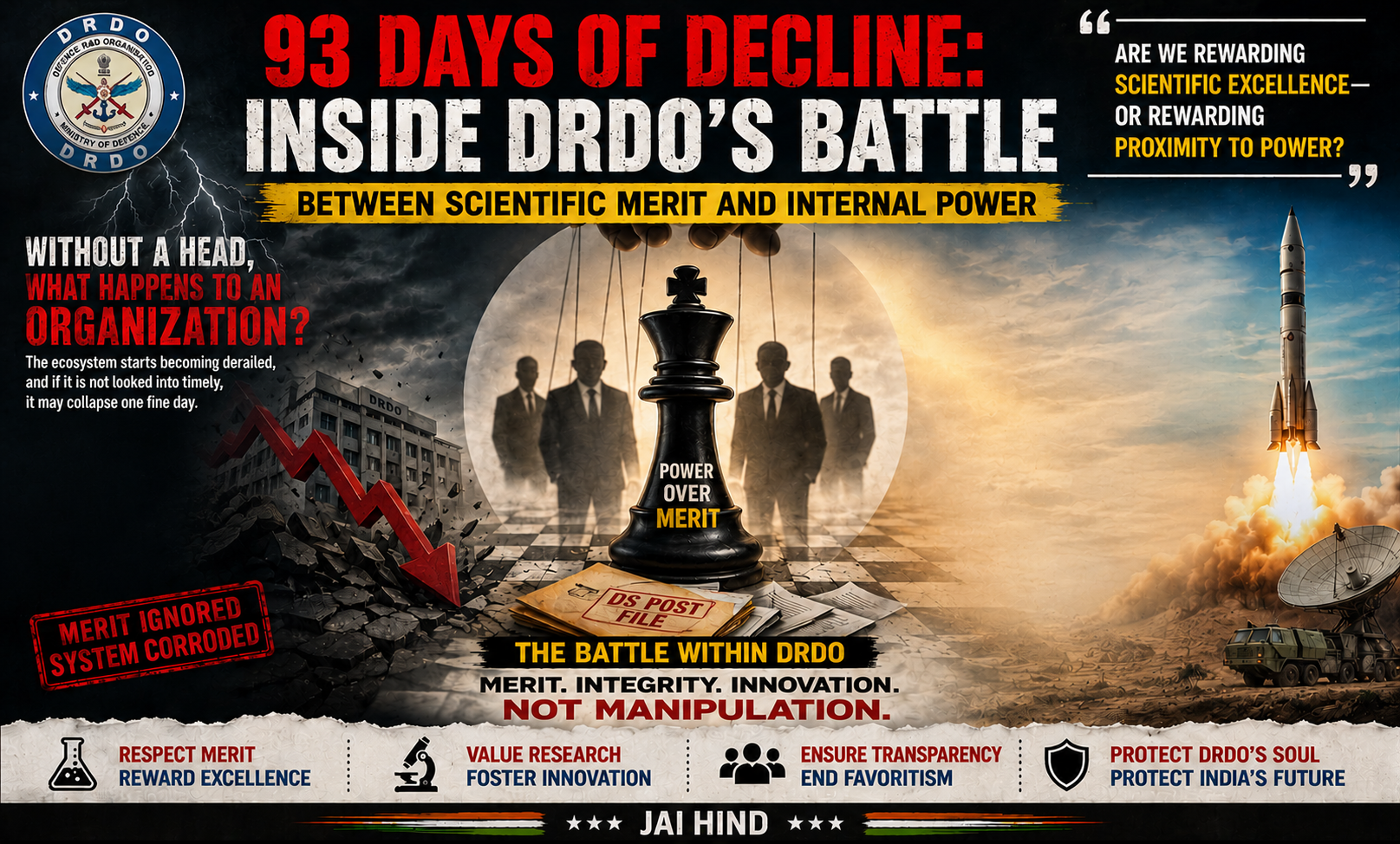
DRDO chief not appointed even after three months

Abhinandan Mishra,  Sunday Guardian: August 18, 2018


‘Selecting a new DRDO chief has become like walking on a landmine’.

The post of the chief of Defence Research & Development Organisation (DRDO) has been vacant for nearly three months now, courtesy the apparent pressure tactics being employed by various quarters—both from inside the government and outside it. A few posts had fallen vacant in the last week of May after the incumbent DRDO chief Selvin Christopher retired following a three-year long tenure which included a year long extension. The post of SA to RM (Scientific Advisor to Raksha Mantri), which was held by G. Satheesh Reddy for three years, including a year-long extension till 4 June 2018, is vacant too. DRDO chairman is also the Secretary of Defence, Research and Development.

Since the retirement of Christopher, Sanjay Mitra, a 1982 batch IAS of West Bengal cadre, is the Defence Secretary, and he is also holding the additional charge of the post of Secretary, Department of Defence Research & Development and Chairman, DRDO for a period of three months, beginning 29 May.

Official sources said that this was for the first time that the DRDO was staying headless for this long. They attributed this situation to various stakeholders who are involved in the functioning of the organisation. The DRDO has an annual budget of Rs 20,000 crore; it spends the same on the upkeep of over 50 laboratories across India.

“The post of the DRDO chief is a very coveted one and apart from merit, other factors like political interference, regional interference, import lobby and foreign vendors play a crucial role in the whole exercise. The government is not giving a very good message by displaying indecisiveness. Ideally, the next chief should have been identified and notified even before the term of the incumbent ended,” a former top official who worked with the organisation for more than three decades, said.

According to officials, selecting a new DRDO chief had become like walking on a landmine in recent times. “So many names are floating in the media; many of them are being planted by their adversaries, many by the claimants themselves. There is not a single name whose candidature will not generate controversy unlike at the time of appointment of Abdul Kalam or V.K. Aatre or V.S. Arunachalam, all of whom were well-known scientists. Earlier, the DRDO was headed by scientists who were really reputed, but now the situation has changed,” a scientist, posted with one of the DRDO laboratories, said.

Sources said that the government had come close to appointing a new chief when Selvin Christopher’s term was about to end, but at the very last moment, there was a “negative intelligence report” on the one who had been shortlisted and the whole process was abandoned.

“Prime Minister Narendra Modi had repeatedly expressed his concerns and apprehensions about the working of the DRDO. However, these concerns cannot be taken care of if the DRDO chief is appointed not because of merit, but due to his proximity to a particular minister or to a region,” the official said. In a not-so-covert hint that the organisation could be externally influenced, V.K. Aatre, who succeeded Kalam as DRDO chief, had once said that there were three non-state actors that influenced the working of DRDO: foreign vendors, mass media and the import lobby.

“If one traces back the history of the DRDO, one would come across names like Dr V.S. Arunachalam who had absolute freedom to walk into the office of successive PMs. He was close to Indira Gandhi and was able to secure a lot of money and autonomy for the organisation. Before him, we had people like Dr Daulat Singh Kothari, Professor S. Bhagavantam, Dr B.D. Nagchaudhuri, Prof M.G.K. Menon and Dr Raja Ramanna, who were scientists of international repute and were known for their work across the globe. Now it is not the same,” a senior official of the organisation said.

According to officials, the 2015 bifurcation of the post of the DRDO Chairman, Secretary of Defence, R&D and the SA to RM, which were earlier headed by the same individual, had led to two competing power centers within the organisation.

“This should not have been done as this has affected the value of the chair of the DRDO chief. Do you expect the SA to RM to give importance to the DRDO chief? Now every proposal that is brought by the DRDO is vetted by the SA to RM. There was a lot of friction between Selvin and Reddy because both of them thought they were more senior to the other,” an official of the organisation explained.

Former officials recalled how someone like Kalam, decorated with the , led the DRDO in the past. “He was the brain behind Pokhran-II; he was someone who stood shoulder to shoulder with the late Atal Bihari Vajpayee, a stalwart Prime Minister. We are missing a man like him. He needed no recommendation or political approach to become the chief of DRDO. People like Kalam had assumed a huge stature much before they had joined the DRDO,” an officer recalled.

As S Christopher completes term, DRDO to remain headless for 3 months

By Manu Pubby, ET Bureau|Updated: May 29, 2018

Christopher was in May last year given a one-year extension. His extended term ended today.

NEW DELHI: The Defence Research And Development Organisation (DRDO) could stay headless for as many as three months with the government failing to find a replacement for incumbent Selvin Christopher who retired on Monday. Efforts till late to grant him another extension in service could have delayed the appointment of a successor, with a search committee looking at probable names to recommend to the cabinet appointments committee.
Defence Secretary Sanjay Mitra will hold additional charge of the organisation till the government approves a scientist to take over the top position, an official notification said.

The past few weeks has seen jostling for the post. DRDO has an annual budget of `17,861 crore. Outgoing chief Christopher who was already on a year’s extension of service beyond the prescribed age but had been hoping for yet another extension.

This search committee list is expected to include the three senior most scientists of DRDO, besides the first woman to have made it to the post of director-general in the organisation. Sources said that those in the fray include missile scientists G Satheesh Reddy, the scientific advisor to the defence minister and the head of the Brahmos missile project, Sudhir Mishra.

While Mishra and Reddy come from the missile scientist community that has traditionally ‘ruled’ DRDO, also in contention is Pravin K Mehta, who heads the Armament cluster of the research organisation from Pune. A surprise entrant to the selection shortlist could also be DG Jillelamudi Manjula who heads the Electronics & Communication Systems vertical at DRDO.
As reported by ET, several top level appointments are pending at the defence ministry. The crucial posting to Northern Army Commander is still to be announced

DRDO has much to answer for its poor performance

India has been unable to increase its self-reliance capability despite taking several steps.

By Dinesh Kumar | Chandigarh | 21 January, 2018 – Sunday Gaurdian
On paper the Defence Research and Development Organisation (DRDO) comes across as formidable. It is currently engaged in about 70 projects that include making almost every major conventional weapon system and platform that major military powers are already manufacturing. From rifles and machine guns to tanks, fighter aircraft, airborne warning and control system, aircraft carrier and a wide array of missiles—surface-to-air, surface-to-surface and sub surface. In reality, the DRDO has much to answer for its performance.

The DRDO, entrusted with developing weapon systems for India’s defence requirement, is critical for ensuring a high degree of self-reliance. Its huge establishment comprises a partnership with over 40 academic institutions, 15 national science and technology agencies, 50 public sector undertakings including the nine defence public sector units, the 40 ordnance factories and the over 250 private sector industries. By 2008, an estimated 1,500 small and medium enterprises were engaged in supplying about 20% to 25% of defence components to defence firms.

Notwithstanding, however, India’s self-reliance continues to hover at 30% to 35% despite a series of measures taken by the government that has resulted in India continuing to remain overly import dependent for its defence requirements. India has been unable to increase its self-reliance capability from the current 30% to 35% despite a series of measures it has taken in the last two-and-a-half decades in particular. Much of even the existing self-reliance capability is based on licence manufacture and transfer of technology by foreign state-owned or private companies. What is more, the government itself has expressed doubts about the country’s capability to even develop core technologies in reports prepared by the parliamentary standing committee on defence.

The harsh reality is that India’s state-owned defence industry has been unable to even develop a rifle, let alone a tank or an aircraft engine. The DRDO has consistently been shifting the timeline for all projects, ranging from rifles to aircraft. Furthermore, the DRDO has been unable to successfully complete a single major project except for a few missile systems and the nuclear powered submarine, although the latter has several shortcomings in capability. The procurement process continues to be time consuming and the private industry remains mired in bureaucratic processes. Most of the private industry’s involvement currently is low scale and focused on making sub systems. It is yet to graduate to making complete weapon systems or highly sophisticated technologies as is the case with major defence companies in the US and Europe.

India’s mission to increase self-dependency for defence equipment to 70% remains a dream. In 1992, following the breakup of the Soviet Union, which had been India’s main source of weapons supply, catering to 70% of the country’s defence requirements, a defence ministry “Self Reliance Review Committee” conceived “a ten-year plan for Self-Reliance in Defence Systems”, which, starting from 1995, was aimed at increasing India’s self-reliance index to 70% by 2005. The defence ministry has now shifted its deadline to attain about 70% self-reliance by over two decades to 2027. But as of now, this seems unlikely in the next ten years.

Efforts of successive governments have failed despite two unprecedented decisions that were specifically aimed at facilitating the self-reliance process—(a) opening of the military-industrial complex to Indian private sector participation up to hundred per cent, and (b) opening up to foreign direct investment (FDI) permissible up to 26%, which was subsequently increased to 49% in 2014 and 100% in 2016.

The present government’s latest emphasis on “Make in India” is undoubtedly noble, but seemingly idealistic. It remains to be seen whether “Make in India” will translate into “Made in India” or remain “Assemble in India”, without intellectual property rights and design control. Perhaps there is wisdom in the advice of David Gross, a Nobel Laureate in Physics, who during a visit to India in January 2016 advised that in order to “Make in India”, the country should focus on first “Discover in India”, followed immediately by “Invent in India”, before it embarks on “Make in India”. But this seems unlikely, considering India’s inflexible, irrational and outdated bureaucracy and the fact that India overall has been spending a paltry 0.9% of its GDP on research and development, compared to 2.1% by China, 2.7% by the United States and 4.4% by South Korea.

India’s record of producing and exporting weapon systems is extremely modest. For example, India’s defence exports averaged a meagre US$88 million a year between 2006-07 and 2008-09, which marginally rose to $174 million in 2013-14 and $330 million in 2016. At a cursory level, the list of countries that have been importing Indian defence equipment is impressive, as it also includes the United States, United Kingdom and Russia. But a study of the equipment reveals that it is very rudimentary—flight control panels, forging equipment and electronic assemblies to the US, transmitting tubes to the UK and, to Russia, some spares and services for the Russian origin MiG-29 and Sukhoi-30 fighter aircraft. None of these are critical technologies or anywhere close to a complete weapon system or a weapon platform.

In contrast, even while China is a major importer of defence hardware, it is at the same time also self-sufficient in certain key military technologies along with being a major weapons exporter. It was the fifth largest exporter of defence equipment to developing countries between 2000 and 2007, the third largest global supplier between 2010 and 2014 following an arms export increase by 143% and ranked fourth between 2008 and 2015 in arms transfer agreements with developing nations. China’s defence exports to developing countries averaged over $3 billion annually between 2011 and 2014, more specifically $2.5 billion in 2007, $2.2 billion in 2008, $3 billion in 2009, $1.9 billion in 2010, $3.2 billion in 2011, $3.4 billion in 2012, $4.2 billion in 2013 and $3.2 billion in 2014 and $ 6 billion in 2015.

India’s state-owned military industrial complex is characterised by flaws at several levels. Internal criticism against the military-industrial complex range from the way the DRDO is conceptualised and structured, its tendency to over reach, technological limitations and incapability; coordination problems with, and changing specifications by, the users, the myriad responsibilities of the head of the DRDO, the continuing limited involvement of the private sector and the predominant role of generalist bureaucrats with no expertise in defence. Moreover, the bureaucratisation of Indian science has created a scientific-work environment with features comprising caution, rules, reviews, screenings, scrutinies, committees, controls, centralisation, delays, doubts, indecision, inaction, suspicion, friction, and less communication.

Until India increases its self-dependence for its defence requirements, India’s import bill is only expected to rise, making it a foreign-made Indian armed force. But such overdependence has come at a high price for the country and the armed forces, which for the last two-and-a-half decades has been battling depleting force levels and antiquity of weapon systems.

The author is a defence analyst

ToT holders of controversial DRDO bio toilet forms nexus in the name of Association

ToT holders of controversial DRDO bio toilet forms nexus in the name of Association. Till date these toilets are purchased by either central government or state governments at a huge cost. Dr Lokendra Singh who was once director of DRDE and so called inventor of bio digester technology after shifted alliance to  Bio Toilets ToT holders association as its chairman. Interesting point to be noted here is these toilets being installed by these ToT holders needs inspection and certification by DRDE Gwalior of which Dr Loknedra Singh was director and his earlier team members currently working at senior levels in DRDE are the certifying officials. As chairman of such association whose sole buyer is Govt. and  his earlier team members worked under him at DRDE  as certifying officials even layman can understand who are the people being benefited from such criminal nexus at the expense of tax payer money.

SC cancels engineering degrees given by deemed universities through correspondence course

Amit Anand Choudhary | TIMESOFINDIA.COM | Updated: Nov 3, 2017, 16:26 IST
HIGHLIGHTS
The apex court restrained educational institutions from providing courses in subjects like engineering, in the distance education mode
With its ruling, the SC affirmed the findings of the Punjab and Haryana high court on the issue
Also with its ruling, the SC set aside a verdict by the Odisha high court, which allowed technical education by correspondence
NEW DELHI: Engineering degrees of hundreds of students who pursued education through correspondence course from four deemed Universities — JRN Rajasthan Vidyapeeth, Institute of Advanced Studies in Education in Rajasthan, Allahabad Agricultural Institute and Vinayaka Mission Research Foundation in Tamil Nadu from year 2001 on wards have been quashed by the Supreme Court.
A bench of Justices AK Goel and UU Lalit, however, allowed students of 2001-05 batch to get their degree by appearing in the examination to be conducted by AICTE but it cancelled the degrees of students of subsequent batches as the deemed university had not got approval from authorities for the course.
“As regards students who were admitted after the academic sessions 2001-2005, their degrees in engineering awarded by the concerned deemed to be universities through distance education mode stand recalled and be treated as cancelled. All benefits secured by such candidates shall stand withdrawn. However, the entire amount paid by such students to the concerned deemed to be universities towards tuition fees and other expenditure shall be returned by the concerned deemed to be universities,” the bench said.
The apex court also restrained deemed universities from offering correspondence courses without getting approval from AICTE. “We restrain all “deemed to be universities” to carry on any courses in distance education mode from the academic session 2018- 2019 onwards unless and until it is permissible to conduct such courses in distance education mode and specific permissions are granted by the concerned statutory/regulatory authorities in respect of each of those courses and unless the off-campus centres/study centres are individually inspected and found adequate by the concerned statutory authorities. The approvals have to be course specific,” the bench said.
The court also directed CBI inquiry to catch the government officials who had allowed deemed universities to offer the distance learning courses which was not allowed. The court asked the government to constitute a high-level committee to examine the functioning of deemed universities.
We direct the CBI to carry out thorough investigation into the conduct of the concerned officials who dealt with the matters and went about the granting permissions against the policy statement, as indicated in Para 49 above and into the conduct of institutions who abused their position to advance their commercial interest illegally.
“The Union of India may constitute a three members Committee comprising of eminent persons who have held high positions in the field of education, investigation, administration or law at national level within one month. The Committee may examine the issues indicated above and suggest a road map for strengthening and setting up of oversight and regulatory mechanism in the relevant field of higher education and allied issues within six months. The Committee may also suggest oversight mechanism to regulate the Deemed to be Universities. The Union of India may examine the said report and take such action as may be considered appropriate within one month thereafter and file an affidavit in this Court of the action taken on or before August 31, 2018” it said.