Tag Archives: Bharat Dynamics Limited

Bharat Dynamics Limited(BDL) Tender Controversy: A ₹56.8-Crore Question of Accountability, Defence Ethics and National Trust

Defence PSU gives tender for anti-tank missile part to commodore ex-chief’s family firm
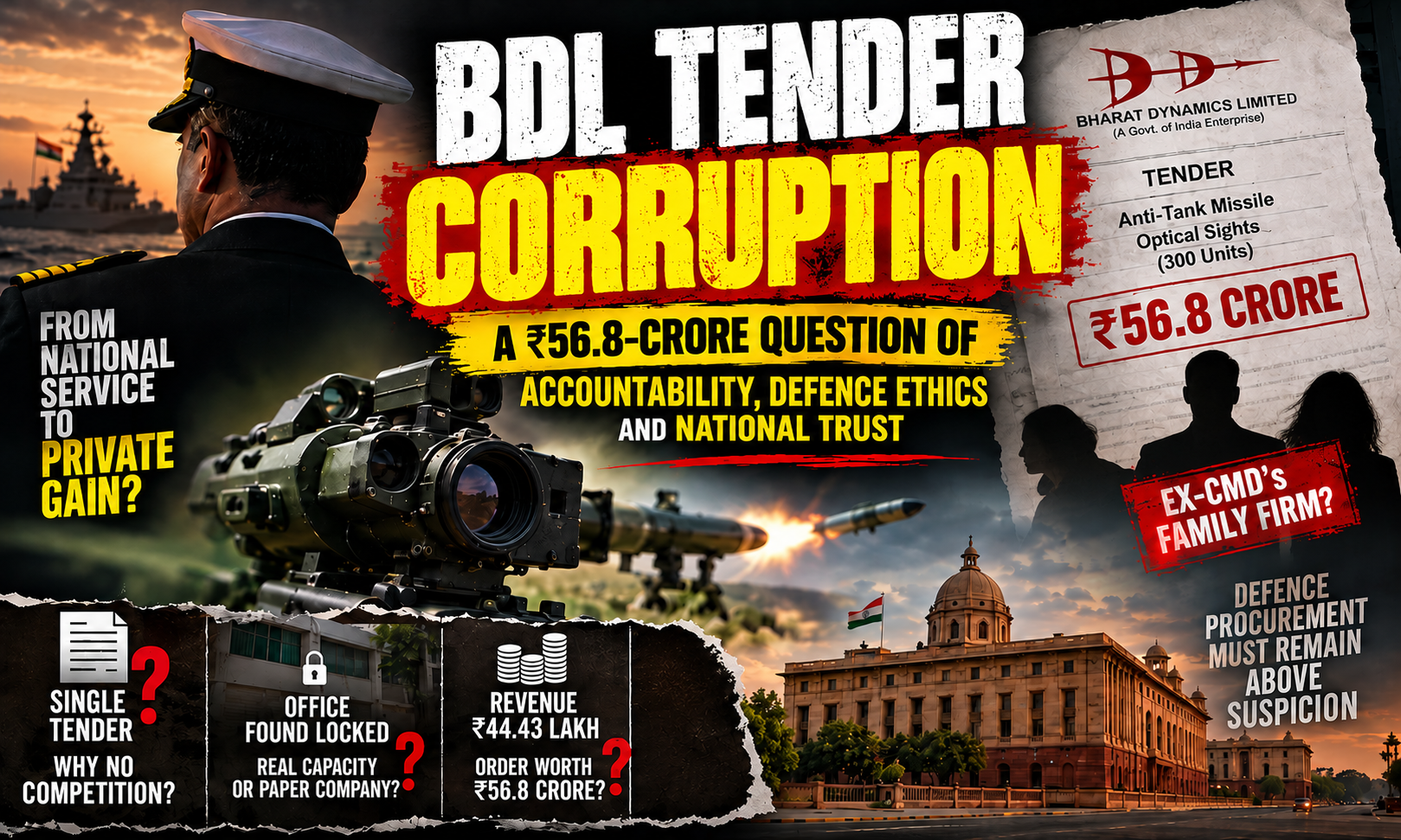
Bharat Dynamics Limited’s single-tender procurement of anti-tank missile optical sights has raised serious questions about procurement integrity, potential conflicts of interest, and the standards of accountability expected from those entrusted with India’s defence institutions.

The ₹56.8-Crore Tender Scam That Demands Answers

Bharat Dynamics Limited (BDL), a major public-sector defence enterprise under the Ministry of Defence, is at the centre of a procurement controversy following its decision to issue a single tender for 300 optical sights used in anti-tank guided missile systems to Aindri Defence Advisory Private Limited Hydrabad.

According to an investigation published by The Indian Express, the company quoted ₹56.8 crore for the procurement, and its bid had cleared the technical evaluation stage, while financial evaluation was reportedly underway at the time of publication.
The controversy is not simply about a procurement worth crores of rupees. It concerns the circumstances under which a non-competitive procurement route was adopted, the relationship between the selected company and BDL’s EX-CMD Commodore Sidharth Mishra, and the adequacy of safeguards designed to protect public resources from potential conflicts of interest.

A Former Navy Commodore and the Burden of Public Trust

One of the most consequential aspects of this case is the professional background of Commodore Siddharth Mishra, BDL’s former Chairman and Managing Director.

Mishra served in the Indian Navy’s electrical branch for more than three decades, retiring in 2016 as a Commodore. He subsequently served at Electronics Corporation of India Limited(ECIL) before becoming BDL’s Chairman and Managing Director in 2019. His tenure at BDL ended in March 2023.

In May 2024, Mishra and his wife, Shambhavi Mishra, incorporated Aindri Defence Advisory Private Limited, initially holding equal shares. According to company records cited in the investigation, Mishra ceased to be a director and shareholder in January 2025, when he was appointed Member (Technical) at the National Company Law Tribunal(NCLT) in Kolkata. His wife subsequently held a 95 percent stake in the company while the remaining 5% was held by Kaushiki Nandan Vatsyayana, identified as Siddharth Mishra’s elder brother.”

Currently as per NCLT he is not associated at present.

However, the subsequent award of a single tender to a company founded by a former head of the procuring defence PSU raises legitimate questions that deserve rigorous, independent scrutiny.

Military service is a position of honour, but honour must be reflected in conduct, accountability and the decisions made after retirement.

The Single-Tender Route: Where Is the Full Explanation?

A single tender is a non-competitive procurement mechanism under which only one vendor is invited to bid. Such a route can be permissible under specified circumstances, including genuine urgency or the existence of a sole capable supplier.

According to the investigation, BDL justified its decision by citing urgency. The tender documentation reportedly included certification that the demand was urgent and that the additional expenditure associated with not using an advertised tender was justified. It also stated that the nature of the urgency and the reasons the requirement could not have been anticipated had been placed on record.

That gap is central to the controversy.

Why was a competitive procurement process not adopted? What specific operational requirement made the single-tender route necessary? Were alternative qualified suppliers assessed? What safeguards were applied to eliminate actual or perceived conflicts of interest? Was the urgency independently reviewed and adequately documented?

A Significant Departure from Previous Procurement Practice

The reported procurement history adds another dimension to the matter.

According to comparable purchases of optical sights in 2024 and 2025 followed competitive processes restricted to public-sector enterprises. India Optel Limited(IOL), a defence public-sector undertaking, won both tenders.

The 2026 procurement, by contrast, was directed exclusively to Aindri Defence Advisory through a single-tender process, potentially allowing a private company to secure an order of this scale for the first time in the three-year period examined by the investigation.

The public interest demands an explanation of the technical, operational and commercial rationale behind this decision.

Questions About Infrastructure and Commercial Capacity

The investigation also reported findings from a physical verification of Aindri Defence Advisory’s listed premises in Hyderabad.

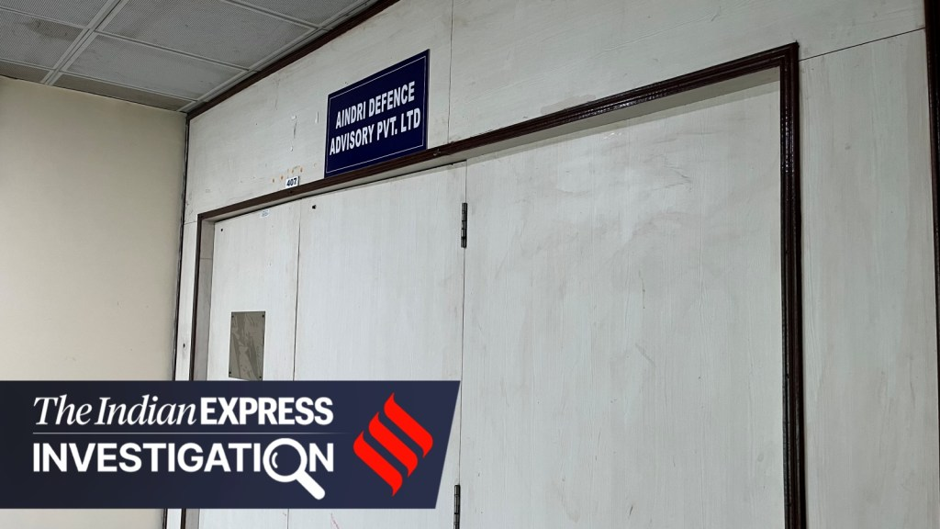
the company’s office at the National Small Industries Corporation campus in Kushaiguda was found locked during the newspaper’s visit. An employee of another organisation reportedly said that people opened the office only occasionally. The investigation also reported that the residential address previously associated with the company was vacant at the time of the visit.

Company records cited in the report showed that Aindri’s 2024–25 revenue was ₹44.43 lakh, with a profit of ₹2.89 lakh. Its balance sheet listed no property, manufacturing plant or other assets.

These findings warrant careful interpretation. A consultancy company may operate without owning a manufacturing plant, and the absence of visible assets does not establish that a business lacks the capacity to deliver a specialised product.

The reported tender concerns 300 optical sights, with sample-validation requirements and technical support for maintenance, repair and overhaul for at least 15 years. Such obligations raise practical questions about manufacturing arrangements, access to qualified technical personnel, quality assurance, long-term servicing capability, supply-chain resilience and accountability for product failures.

The competent authorities should establish whether the selected supplier possesses the necessary capabilities directly or through properly evaluated manufacturing and technical partners.

The controversy warrants clear answers to several questions:

  1. Justification for urgency: What specific circumstances necessitated a single tender, and why could the requirement not be met through an advertised competitive process?
  2. Conflict-of-interest safeguards: What declarations, disclosures and independent reviews were undertaken to assess potential or perceived conflicts arising from the former BDL chief’s association with the selected company?
  3. Supplier capability: What due diligence established the supplier’s ability to meet the technical, manufacturing, quality-assurance and long-term support requirements of the contract?
  4. Commercial reasonableness: How was the quoted amount of ₹56.8 crore assessed against technical specifications, comparable procurements, cost benchmarks and value-for-money requirements?
  5. Procurement oversight: Were the applicable procurement rules followed in full, and is the decision supported by a complete, auditable record?
  6. Public accountability: Will BDL and the Ministry of Defence provide an appropriate explanation of the procurement decision without compromising legitimate operational confidentiality?

These questions should be addressed through established oversight mechanisms and evidence-based examination, not speculation or political rhetoric.

The BDL–Aindri tender controversy presents a serious test of institutional transparency and public accountability. A ₹56.8-crore bid, a non-competitive procurement route, the corporate links to a former BDL chief and reported questions concerning the supplier’s visible infrastructure together create circumstances that merit close scrutiny.

India’s defence ecosystem is built on the sacrifices of its soldiers, the expertise of its engineers, the work of its scientists and the trust of its citizens. That trust cannot be taken for granted. It must be earned through transparent decisions, rigorous technical evaluation and unwavering adherence to ethical standards.

For a country investing heavily in indigenous defence manufacturing, the credibility of its procurement institutions is itself a strategic asset. Public-sector defence enterprises must demonstrate that their decisions serve national capability, and the responsible use of taxpayers’ money.

Source and attribution: This article is based on reporting by The Indian Express concerning Bharat Dynamics Limited, Aindri Defence Advisory Private Limited and the optical-sight procurement. The allegations and questions discussed above should be assessed against official tender documents, company filings and responses from the concerned authorities. The views expressed in the analysis are intended to promote transparency, ethical governance and accountability in defence procurement.

JAI HIND!

‘Akash missile system can’t be trusted during war’: Degraded by govt defence agencies, loopholes in strategic weapon system threaten national security

Yatish Yadav Dec 02, 2019 18:22:43 IST

Other squadrons reported frequent unserviceability of mobile surface-to-air Akash Missile system and long duration downtime, which means that the missiles are dysfunctional and may not be cocked and loaded against enemy in contingency

Several government agencies, including missile manufacturer Bharat Dynamics Limited, Bharat Electronics Limited, did not tell the truth to the government about malfunctioning Akash Missile system and poor quality of spare parts provided by the private vendors

CAG was perhaps far-sighted, when in a 2017 report, the national auditor observed that Akash Missiles cannot be trusted in situation of a war

On 3 June, 2018, Akash Missile’s Transportation and Loading Vehicle (TLV), parked at an Air Force Squadron, was jolted after a sudden burst of tube followed by shearing off wheel bolts due to impact. The incident shocked Air Force headquarters. The Air Force officials wanted not only wanted the routine analysis of the incident, but also an in-depth discussion with Defence Research and Development Laboratory (DRDL), a multi-disciplinary Missile System laboratory under the Defence Research and Development Organisation (DRDO) to unearth issues hampering the functioning of the strategic weapon system.

More than a month later, another squadron reported cracks on air intake caps of dummy missiles. An investigation by Firstpost revealed that the incidents were followed by other squadrons reporting frequent unserviceability of mobile surface-to-air Akash Missile system and long duration downtime, which means that the missiles are dysfunctional and may not be cocked and loaded against enemy in contingency. This incident forced Guided Weapon Maintenance Department of Air Force on 5 September 2018 to raise the issue, where they clearly stated that the “Squadrons have been reporting frequent unserviceability of Missiles and it has been noticed that time taken to resolve these failures is considerably high due to delay in analysis of failures.”

The sheer inertia of government defence enterprise involved in Akash Missile production and maintenance reached to such an alarming level that at least three squadrons of Akash in February 2019 reported that missile system remained down or simply broken and sometimes even out of order during 90 percent of the time since their date of commissioning. These squadrons were commissioned between 2013-2015 to counter Chinese aggression.

Multiple government agencies, including Missile manufacturer Bharat Dynamics Limited (BDL) which comes under the Ministry of Defence, Bharat Electronics Limited (BEL) which is responsible for radars and maintenance and the DRDO, did not tell the truth to the government about malfunctioning Akash Missile system and poor quality of spare parts provided by the private vendors.

The malfunction of Integrated Air Compressor and Storage Facility (IACSF) revealed another shocker and the Air Force mentioned it on record that the IACSFs of Akash Missile System units are unserviceable due to wobbling and vibration, pneumatic leakage, breaking of mounting pads and bolts. A missile had failed to take off during combined guided weapon firing exercise known as ‘CROSSBOW-18’ and a team of Missile System Quality Assurance Agency (MSQAA), BDL and DRDL was constituted to investigate the failure.

MSQAA is an independent inspection Agency under the administrative and functional control of Director General Aeronautical Quality Assurance, which comes under the Department of Defence Production of Defence Ministry. The incidents of leakage from fuel tanks and leakage in pressurised Missile containers were taken so lightly that the Air Force, responsible to secure the nation from aerial threats, was forced to direct to the DRDL, BEL and BDL that present configuration of certain systems of Akash Missile will not be acceptable for future squadrons, which are under the process of procurement. The Air Force, BDL, BEL and DRDL are yet to respond to a questionnaire sent by Firstpost on 24 November.

Details expose criminal act by government defence enterprises

If there is an emergent situation, several Akash sqaudron may not be able to launch counter offensive because deficiencies in many of the system including hydraulic oil leakage and container pressure leakage, which is pending since 2017. The complaints received from Air Force headquarters, Eastern Air Command and other Akash field units reveals there is no back-to-back agreement with vendors for equipment under warranty, making it difficult to repair the faults. Documents reviewed by Firstpost showed that almost all squadrons have expressed that they are unable to get proper feedback from BEL on repairing the faults in Missile System and on problems plaguing Akash Missiles which Indian agencies are ill-equipped to resolve. Surprisingly the field engineers, who are supposed to rectify the critical snags, are not even aware of any action plan.

Documents further said: “Currently majority of the Akash field engineers are working to pass information about issues without any tangible technical output. The untrained and poorly equipped field engineers are neither aware of any corrective action plan nor they are committed.”

The documents also pointed to massive delay in supply of spares for Missile System, virtually grounding them for for six months to a year. Air Force in a meeting had informed that most of the problems reported in 2017 were pending for over a year now. The documents also pointed at the repairing of Akash trailers which are covered under annual maintenance contract. It said: “Akash Trailers serviceability is poor and some cases spares supplied to Akash Missile units are not configured as per system requirement which is affecting equipment serviceability in case of failure.”

Bharat Dynamics Limited (BDL) the manufacturer of Akash Missile has not been able to resolve three important issues for the last two to three years. BDL, founded in 1970, is a government enterprise under the administrative control of the Ministry of Defence. It is learnt that BDL was told in high level meeting convened last year to come out with solid plan after conducting an investigation and study of faults in Akash Missile System within a month on long delays of critical faults. Even the investigation to unearth and address the issues was delayed.’


The Air Force has refused to pay for new maintenance contract for certain Akash Missile squadrons as the old ones expired in September 2019. They argued that missile systems in several squadrons were left idle for more than a year. Instead, it had asked for extension of warranty for certain squadrons which have been dysfunctional for 17 to 15 months in the last two years. Air Force asserted since system was down and faults were neither rectified nor replaced, it violated the maintenance contract. Air Force is learnt to have said that “during the warranty period, the seller shall either replace or rectify the failed goods free of charge within 30 days of notification of such defects. As per article of the contract, warranty of the equipment would be extended by such duration from time the buyer has reported such unserviceabilities till the time seller has restored the status of the buyer’s satisfaction.”

Red tapeism in government defence enterprises hurt national security

Firstpost investigation also revealed gross inefficiency of government defence agencies BEL, BDL and DRDL to address the problem in Akash Missile System. Documents reveal that meetings after meetings were convened on the issues but the government defence enterprises couldn’t satisfactorily answer the questions raised by Air Force. These government defence enterprises have been passing the buck. They also cheated Air Force by providing substandard and fake spares.

A meeting earlier this year chaired by Air Vice Marshal Bhanoji Rao pointed at severe negligence in handling Akash Missile System which may have serious ramifications in contingency. Documents revealed that certain spares, especially those of sub-vendors (procured by BEL) were being received at Akash Missile System units without ‘Quality Assurance’ certification and on a few instances it came to light that these spares were old and fake. In a letter, it was noted: “On few instances it has been noticed that the items were not new/authentic.”

Air Vice Marshal Rao clearly told his team at the Air Force not to accept spares without ‘Quality Assurance’ certification. The meeting also revealed a lack of expertise of government-owned defence enterprises which are acting merely as a supplier of equipment after procuring it from domestic and foreign vendors. It basically means that these government enterprises are acting like a payment facilitators. Their complicity in this entire saga was further exposed when government defence enterprises officials told the senior Air Force officials that sub-vendors (private companies supplying spares) were not willing to share their design documents.

An appalled Air Vice Marshal asked, if the Defence Research and Development Laboratory (DRDL) is the authority then it must have intellectual property rights of all designs related to Akash Missile System. Obviously, the defence agencies representatives were not aware about it since they never took the pain to look into the agreements and promised the Air Force to look into the matter to ascertain whether these rights were with vendors. A promise was made to list all major vendors for unhindered supply of spares to overcome single vendor situation. As far as BEL is concerned documents said: “Almost all squadrons have expressed that they are unable to get proper feedbacks from BEL on progress and plan of action of pending faults.”

The meeting chaired by Air Vice Marshal Rao also discussed high failure rate of one of the systems of Akash Missile, lacunae in analysis of faults and mismatch in software versions used for the this strategic weapon.

Another major loophole, which highlights the non-seriousness of defence agencies, is the contract with the private vendors. The agreements are more favorable to private parties putting Akash Missile System in jeopardy. Documents flagged these concerns further pointing out that all the vendor supplied items are outside their warranty obligations and in certain cases supplied spares are not configured as per system requirements. Some spares for Akash Missiles are not fit and functional and this is affecting the equipment serviceability in case of failure.

It appears that careless handling of most critical weapons has been going on for a long time. The Comptroller and Auditor General of India (CAG) was perhaps far-sighted when in a 2017 report, the national auditor observed that Akash Missiles cannot be trusted in situation of a war. CAG had categorically stated that Akash missile system delivered by BEL were deficient in quality and 30% missiles failed the test.

“Audit found that the Strategic missile system delivered by BEL were deficient in quality. Out of 80 missiles received up to November 2014, 20 missiles were test fired during April-November 2014. Six of these missiles i.e., 30 percent, failed the test. Preliminary failure analysis report revealed that the missiles fell short of the target, had lower than the required velocity, and also there was malfunctioning of critical units like Servo Control Unit and Connector. Two missiles had failed to take off because the booster nozzle had failed. These deficiencies posed an operational risk during hostilities. Two missiles had failed to take off because the booster nozzle had failed. These deficiencies posed an operational risk during hostilities.” CAG report had said.

Firstpost investigation showed that after the CAG report, the squabbling between government defence enterprises had come to light. Eight critical snags in Akash Missile Systems were reported after the CAG report which were pending for three-seven months. CAG had recommended that Ministry of Defence needs to ensure better synchronisation of the various activities and agencies involved in such strategically important projects to ensure their timely completion and quality of Strategic Missiles also needs improvement so as to bring down failure rate.

Notwithstanding, many snags were not rectified citing lack of spares. The Air Force anguished over lackadaisical attitude of BEL and BDL has firmly directed them to resolve all internal issues immediately and ensure that no Missile is kept unserviceable due to their internal problems.

India test-fires medium range nuclear capable Agni-II missile

Times of India, PTI | Feb 20, 2018,
BALASORE: India on Tuesday test-fired its medium range nuclear capable Agni-II missile with a strike range of 2,000km from Abdul Kalam Island off Odisha coast, defence sources said.
The trial of the surface-to-surface missile was conducted from a mobile launcher at the launch complex-4 of the integrated test range (ITR) at around 8.38am, the sources said.
The Intermediate Range Ballistic Missile (IRBM) has already been inducted into the services and Tuesday’s test was carried out by the Army’s strategic forces command (SFC) with logistic support provided by the Defence Research and Development Organisation (DRDO), they said.
The 20-mt-long Agni-II ballistic missile has a launch weight of 17 tonne and can carry a payload of 1,000kg over a distance of 2,000km.
The state-of-the-art missile, already a part of the country’s arsenal for strategic deterrence, was launched as a training exercise by the armed forces, a DRDO scientist said.
Agni-II, a two-stage missile, equipped with advanced high accuracy navigation system and guided by a unique command and control system, was propelled by solid rocket propellant system, he said.
The entire trajectory of the trial was tracked by a battery of sophisticated radars, telemetry observation stations, electro-optic instruments and two naval ships located near the impact point in the down range area of the Bay of Bengal.
Agni-II was developed by the advanced systems laboratory along with other DRDO laboratories and integrated by the Bharat Dynamics Limited, Hyderabad, sources said.
The missile is part of the Agni series of missiles which includes the Agni-I with a 700km range, Agni-III with a 3,000km range, Agni-IV and Agni-V both having long range capabilities.
The first proto type of the Agni-II missile was carried out on April 11, 1999 and last launch was a user’s trial on May 4, 2017.