Tag Archives: defence

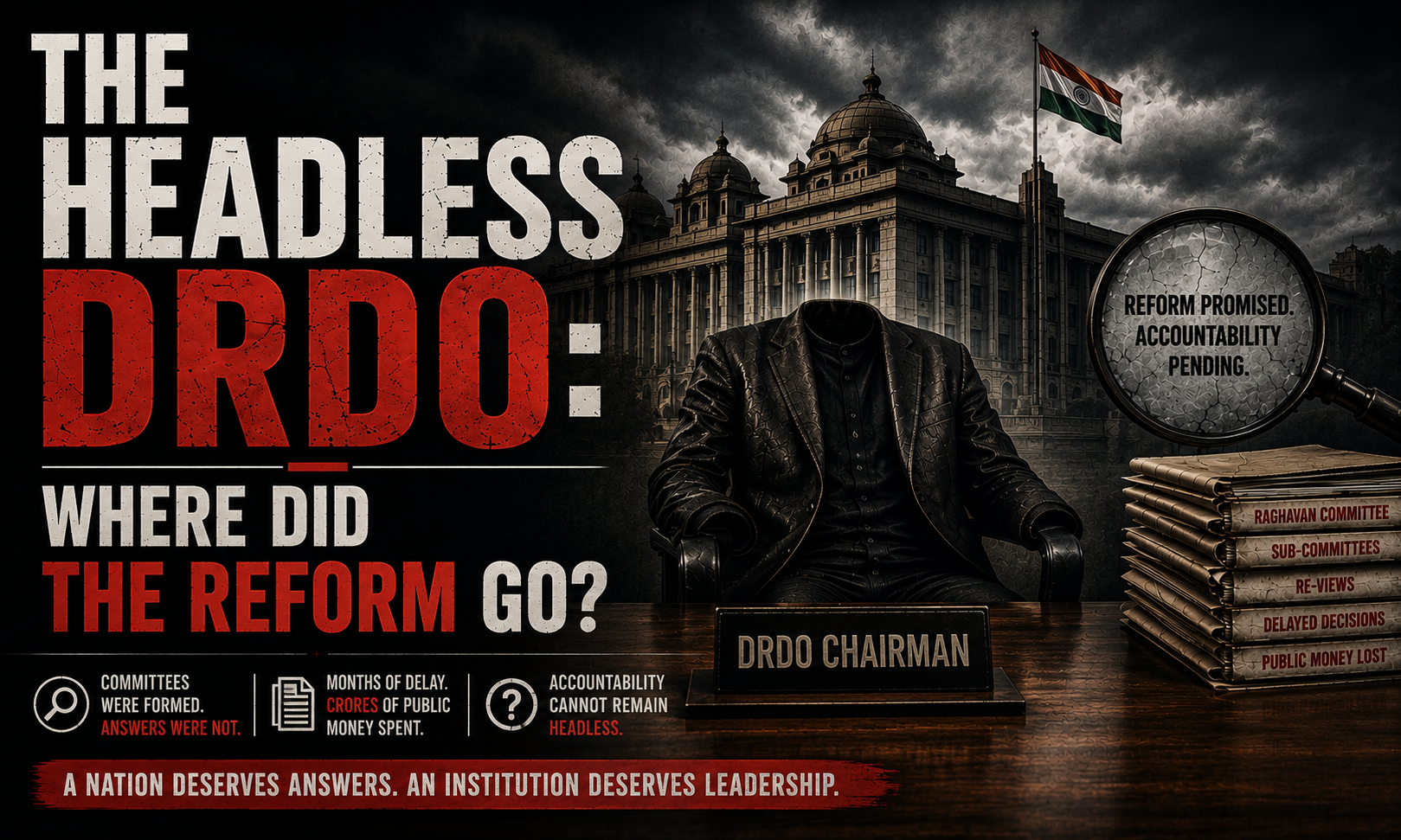
Fight Against Corruption Lobby of DRDO

The appointment of the Director General (DG) of BrahMos became the subject of a prolonged legal dispute after concerns were raised regarding the selection process.

Sivan Subramanyam, the senior-most Distinguished Scientist (DS) in DRDO, challenged the appointment before the Central Administrative Tribunal (CAT), contending that the prescribed selection procedure had not been followed. After examining the matter, the CAT directed the DRDO Secretary to revisit the appointment process and conduct a fresh selection in accordance with the applicable rules and procedures.

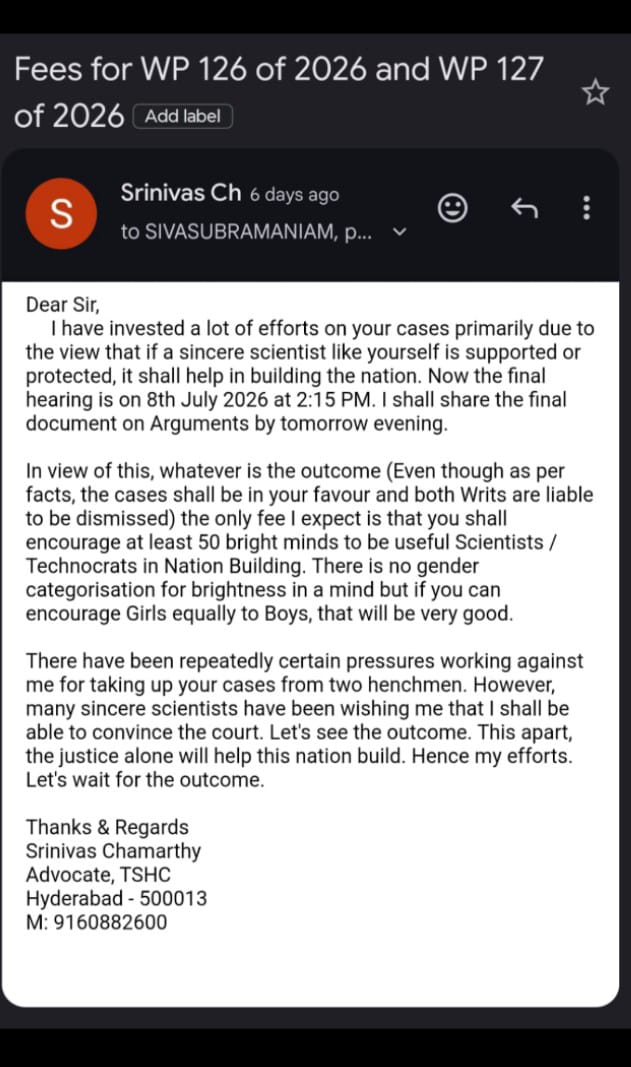
Instead of implementing the Tribunal’s directions, the DRDO Secretary challenged the CAT order before the Hon’ble High Court of Telangana at Hyderabad. After extensive hearings, the final arguments were concluded on 8 July, and the matter now awaits judgment.

Throughout this legal battle, one individual stood firmly for the cause of justice—Advocate Shri Srinivas Chamarthy. Despite the complexity and significance of the case, he rendered his legal services without accepting a single penny in professional fees. His commitment to the rule of law, fairness, and institutional integrity reflects exceptional dedication and selfless service.

This case is not merely about one appointment; it concerns adherence to established procedures, transparency in public institutions, and the principle that every public authority must remain accountable to the rule of law.

‘Akash missile system can’t be trusted during war’: Degraded by govt defence agencies, loopholes in strategic weapon system threaten national security

Yatish Yadav Dec 02, 2019 18:22:43 IST

Other squadrons reported frequent unserviceability of mobile surface-to-air Akash Missile system and long duration downtime, which means that the missiles are dysfunctional and may not be cocked and loaded against enemy in contingency

Several government agencies, including missile manufacturer Bharat Dynamics Limited, Bharat Electronics Limited, did not tell the truth to the government about malfunctioning Akash Missile system and poor quality of spare parts provided by the private vendors

CAG was perhaps far-sighted, when in a 2017 report, the national auditor observed that Akash Missiles cannot be trusted in situation of a war

On 3 June, 2018, Akash Missile’s Transportation and Loading Vehicle (TLV), parked at an Air Force Squadron, was jolted after a sudden burst of tube followed by shearing off wheel bolts due to impact. The incident shocked Air Force headquarters. The Air Force officials wanted not only wanted the routine analysis of the incident, but also an in-depth discussion with Defence Research and Development Laboratory (DRDL), a multi-disciplinary Missile System laboratory under the Defence Research and Development Organisation (DRDO) to unearth issues hampering the functioning of the strategic weapon system.

More than a month later, another squadron reported cracks on air intake caps of dummy missiles. An investigation by Firstpost revealed that the incidents were followed by other squadrons reporting frequent unserviceability of mobile surface-to-air Akash Missile system and long duration downtime, which means that the missiles are dysfunctional and may not be cocked and loaded against enemy in contingency. This incident forced Guided Weapon Maintenance Department of Air Force on 5 September 2018 to raise the issue, where they clearly stated that the “Squadrons have been reporting frequent unserviceability of Missiles and it has been noticed that time taken to resolve these failures is considerably high due to delay in analysis of failures.”

The sheer inertia of government defence enterprise involved in Akash Missile production and maintenance reached to such an alarming level that at least three squadrons of Akash in February 2019 reported that missile system remained down or simply broken and sometimes even out of order during 90 percent of the time since their date of commissioning. These squadrons were commissioned between 2013-2015 to counter Chinese aggression.

Multiple government agencies, including Missile manufacturer Bharat Dynamics Limited (BDL) which comes under the Ministry of Defence, Bharat Electronics Limited (BEL) which is responsible for radars and maintenance and the DRDO, did not tell the truth to the government about malfunctioning Akash Missile system and poor quality of spare parts provided by the private vendors.

The malfunction of Integrated Air Compressor and Storage Facility (IACSF) revealed another shocker and the Air Force mentioned it on record that the IACSFs of Akash Missile System units are unserviceable due to wobbling and vibration, pneumatic leakage, breaking of mounting pads and bolts. A missile had failed to take off during combined guided weapon firing exercise known as ‘CROSSBOW-18’ and a team of Missile System Quality Assurance Agency (MSQAA), BDL and DRDL was constituted to investigate the failure.

MSQAA is an independent inspection Agency under the administrative and functional control of Director General Aeronautical Quality Assurance, which comes under the Department of Defence Production of Defence Ministry. The incidents of leakage from fuel tanks and leakage in pressurised Missile containers were taken so lightly that the Air Force, responsible to secure the nation from aerial threats, was forced to direct to the DRDL, BEL and BDL that present configuration of certain systems of Akash Missile will not be acceptable for future squadrons, which are under the process of procurement. The Air Force, BDL, BEL and DRDL are yet to respond to a questionnaire sent by Firstpost on 24 November.

Details expose criminal act by government defence enterprises

If there is an emergent situation, several Akash sqaudron may not be able to launch counter offensive because deficiencies in many of the system including hydraulic oil leakage and container pressure leakage, which is pending since 2017. The complaints received from Air Force headquarters, Eastern Air Command and other Akash field units reveals there is no back-to-back agreement with vendors for equipment under warranty, making it difficult to repair the faults. Documents reviewed by Firstpost showed that almost all squadrons have expressed that they are unable to get proper feedback from BEL on repairing the faults in Missile System and on problems plaguing Akash Missiles which Indian agencies are ill-equipped to resolve. Surprisingly the field engineers, who are supposed to rectify the critical snags, are not even aware of any action plan.

Documents further said: “Currently majority of the Akash field engineers are working to pass information about issues without any tangible technical output. The untrained and poorly equipped field engineers are neither aware of any corrective action plan nor they are committed.”

The documents also pointed to massive delay in supply of spares for Missile System, virtually grounding them for for six months to a year. Air Force in a meeting had informed that most of the problems reported in 2017 were pending for over a year now. The documents also pointed at the repairing of Akash trailers which are covered under annual maintenance contract. It said: “Akash Trailers serviceability is poor and some cases spares supplied to Akash Missile units are not configured as per system requirement which is affecting equipment serviceability in case of failure.”

Bharat Dynamics Limited (BDL) the manufacturer of Akash Missile has not been able to resolve three important issues for the last two to three years. BDL, founded in 1970, is a government enterprise under the administrative control of the Ministry of Defence. It is learnt that BDL was told in high level meeting convened last year to come out with solid plan after conducting an investigation and study of faults in Akash Missile System within a month on long delays of critical faults. Even the investigation to unearth and address the issues was delayed.’


The Air Force has refused to pay for new maintenance contract for certain Akash Missile squadrons as the old ones expired in September 2019. They argued that missile systems in several squadrons were left idle for more than a year. Instead, it had asked for extension of warranty for certain squadrons which have been dysfunctional for 17 to 15 months in the last two years. Air Force asserted since system was down and faults were neither rectified nor replaced, it violated the maintenance contract. Air Force is learnt to have said that “during the warranty period, the seller shall either replace or rectify the failed goods free of charge within 30 days of notification of such defects. As per article of the contract, warranty of the equipment would be extended by such duration from time the buyer has reported such unserviceabilities till the time seller has restored the status of the buyer’s satisfaction.”

Red tapeism in government defence enterprises hurt national security

Firstpost investigation also revealed gross inefficiency of government defence agencies BEL, BDL and DRDL to address the problem in Akash Missile System. Documents reveal that meetings after meetings were convened on the issues but the government defence enterprises couldn’t satisfactorily answer the questions raised by Air Force. These government defence enterprises have been passing the buck. They also cheated Air Force by providing substandard and fake spares.

A meeting earlier this year chaired by Air Vice Marshal Bhanoji Rao pointed at severe negligence in handling Akash Missile System which may have serious ramifications in contingency. Documents revealed that certain spares, especially those of sub-vendors (procured by BEL) were being received at Akash Missile System units without ‘Quality Assurance’ certification and on a few instances it came to light that these spares were old and fake. In a letter, it was noted: “On few instances it has been noticed that the items were not new/authentic.”

Air Vice Marshal Rao clearly told his team at the Air Force not to accept spares without ‘Quality Assurance’ certification. The meeting also revealed a lack of expertise of government-owned defence enterprises which are acting merely as a supplier of equipment after procuring it from domestic and foreign vendors. It basically means that these government enterprises are acting like a payment facilitators. Their complicity in this entire saga was further exposed when government defence enterprises officials told the senior Air Force officials that sub-vendors (private companies supplying spares) were not willing to share their design documents.

An appalled Air Vice Marshal asked, if the Defence Research and Development Laboratory (DRDL) is the authority then it must have intellectual property rights of all designs related to Akash Missile System. Obviously, the defence agencies representatives were not aware about it since they never took the pain to look into the agreements and promised the Air Force to look into the matter to ascertain whether these rights were with vendors. A promise was made to list all major vendors for unhindered supply of spares to overcome single vendor situation. As far as BEL is concerned documents said: “Almost all squadrons have expressed that they are unable to get proper feedbacks from BEL on progress and plan of action of pending faults.”

The meeting chaired by Air Vice Marshal Rao also discussed high failure rate of one of the systems of Akash Missile, lacunae in analysis of faults and mismatch in software versions used for the this strategic weapon.

Another major loophole, which highlights the non-seriousness of defence agencies, is the contract with the private vendors. The agreements are more favorable to private parties putting Akash Missile System in jeopardy. Documents flagged these concerns further pointing out that all the vendor supplied items are outside their warranty obligations and in certain cases supplied spares are not configured as per system requirements. Some spares for Akash Missiles are not fit and functional and this is affecting the equipment serviceability in case of failure.

It appears that careless handling of most critical weapons has been going on for a long time. The Comptroller and Auditor General of India (CAG) was perhaps far-sighted when in a 2017 report, the national auditor observed that Akash Missiles cannot be trusted in situation of a war. CAG had categorically stated that Akash missile system delivered by BEL were deficient in quality and 30% missiles failed the test.

“Audit found that the Strategic missile system delivered by BEL were deficient in quality. Out of 80 missiles received up to November 2014, 20 missiles were test fired during April-November 2014. Six of these missiles i.e., 30 percent, failed the test. Preliminary failure analysis report revealed that the missiles fell short of the target, had lower than the required velocity, and also there was malfunctioning of critical units like Servo Control Unit and Connector. Two missiles had failed to take off because the booster nozzle had failed. These deficiencies posed an operational risk during hostilities. Two missiles had failed to take off because the booster nozzle had failed. These deficiencies posed an operational risk during hostilities.” CAG report had said.

Firstpost investigation showed that after the CAG report, the squabbling between government defence enterprises had come to light. Eight critical snags in Akash Missile Systems were reported after the CAG report which were pending for three-seven months. CAG had recommended that Ministry of Defence needs to ensure better synchronisation of the various activities and agencies involved in such strategically important projects to ensure their timely completion and quality of Strategic Missiles also needs improvement so as to bring down failure rate.

Notwithstanding, many snags were not rectified citing lack of spares. The Air Force anguished over lackadaisical attitude of BEL and BDL has firmly directed them to resolve all internal issues immediately and ensure that no Missile is kept unserviceable due to their internal problems.

Explosive Purported Conversation Between MM Joshi Ex-GM,NCS,SBU and MM Pandey, GM,Vigilance

An explosive purported conversation between former in-charge of Air Force’s Rs. 7,900 Crore project, MM Joshi and another BEL senior officer MM Pandey recently surfaced and received by the corruptionindrdo.com through anonymous sources. MM Joshi was the officer who signed the IACCS contract on behalf of Bharat Electronics Limited in October 2015 and served as driving force till April 2016 when he was unceremoniously transferred from BEL.

According to sources, Joshi was removed from the position after he refused to endorse large-scale corruption in the project that was being orchestrated through senior officers of defence public sector undertaking.

Another person in purported conversation, MM Pandey (GM), who conducted inquiry in alleged irregularities in IACCS project and exposed the deep-rooted corruption in the project. Pandey has now been suspended by BEL for exposing corruption. The government, which vows to fight corruption has been a mute spectator all along while Pandey is being harassed for doing honest job. MM Joshi who handled the sensitive IACCS project in purported conversation with Pandey has made startling revelation suggesting that alleged loot in contract began immediately after BEL signed the agreement with Indian Air Force and at least two senior officers were instrumental in perpetrating the irregularities. Joshi is also heard in the conversation admitting that it is fit case to be investigated by the Central Bureau of Investigation.

This shocking revelation fly in the face of BEL, which has been trying to cover-up the massive scam and punishing honest officers, who expose the rot. It has been learnt from the reliable sources that Department of Defence Production, has recommended a CBI probe but the file for the last one month is still awaiting recommendation of defence minister.

While this case has been caught in bureaucratic quagmire due to influence exercised by the Babus, BEL officers, the inquiry team which exposed corruption has been suspended. This is a sad reality of a vibrant democracy where corrupts are honored and honest officers are hanged.

This whistleblower website which has been on the forefront of anti-corruption movement for more than a decade has decided to publish excerpts of the purported conversation which makes it amply clear on loot right under the nose of government and investigating agencies.

www.corruptionindrdo.com,  however, cannot independently verify the authenticity of audio. Received from anonymous source. www.corruptionindrdo.com has forwarded government agencies for further investigation.

Here are the excerpts of conversation between MM Joshi (NCS SBU head in BEL when the IACCS project was finalized between BEL and Air Force, Retired in March 2019) and MM Pandey (GM-PS/Delhi who was the Vigilance Inquiry Officer who brought out the corruption in IACCS project) on 9th April 2019  or 10th April 2019 after main stream media reports publish on 9th April 2019 “BEL allegedly violated string of norms to award contracts to German, Finnish firms; ex-CMD, two retired defence officials under scanner”

Mr. M.M. Joshi can be heard saying:

_ I was very careful in signing any document order/contract of IACCS without seeing that everyone has signed since I knew that all of these cases would be opened by Vigilance one day  

_This report is beyond the report which was made by M.M. Pandey and contains details of procurement of “A” class items. Mr. Nataraj Krishnappa (who is Director-Oother Units) and Mr. Joydeep Majumdar (who is the present GM-NCS) will finally be caught for what they have being doing (which brings out that he had knowledge of the wrong which was to happen in the project from the time the project was taken up).

_ One of the Directors of BEL is saying that there is some person in DRDO who has leaked the report to press  

_ What has been brought out in the second news article is point to point and ever thing which has been written is the truth and today’s report is very explosive and related to Material Procurement  

– This report will directly indict Mr. Nataraj and Mr. Majumdar. They should get a lesson and they should get the return for whatever wrong they have done. They were the people behind my transfer out of NCS in fact Mr. Majumdar had started manipulations even before he took over as SBU head. Also Mr. Nataraj is the person who manipulated the selection of D (OU) and saw that my application for that post gets rejected so that he could be selected. He was also responsible for my transfer out of NCS SBU and bringing in Mr. Joydeep Majumdar in my place

_ All these should be handed over to CBI/CAG or they should take suo moto cognizance of the corruption done by these people.

_ All the companies to which order has been given are shell companies  

_ I will wait for that day when these two are punished for what they have been doing.  

………………………………………………………………………………

Many BrahMos staffers have official data on personal devices:ATS FIR

Shisher Arya, TNN: October 12, 2108

Nagpur: Anti-Terrorist Squad (ATS) investigators grilling Nishant Aggarwal have reported that the BrahMos Aerospace systems engineer confessed to having copied data related to the missiles from his senior colleague Alan Abraham’s computer, when he was still undergoing training in the organization.
The First Information Report (FIR) registered by Uttar Pradesh ATS was accessed by TOI. It says Aggarwal told investigators that he had copied the data from the official computer of his colleague around four years ago, without his permission. The person from whose computer the data was downloaded was posted at the Hyderabad facility of BrahMos Aerospace, where Aggarwal was undergoing training. The person has now quit the job and is pursuing a research project in Canada.
Aggarwal had just joined the organization four years ago, and was posted at the facility in Nagpur before arrested three days ago.
The FIR says Aggarwal confessed that he had copied the data without his colleague’s permission. However, he has also named close to a dozen other colleagues, who, he claims, have even more sensitive data stored on their private computers as wel. the designations of these colleagues include his peers andeven seniors.
However, Agagarwal had no answer to how official data, which was supposed to remain a secret, reached his personal devices pertained to mution of war, supersonic BrahMos cruise missiles.
The FIR further says that apart from storing the details in in personal devices, Aggarwal also had links with two Pakistani Intelligence Operatives (PIOs).They were in contact with him through fake Facebook (FB).accounts in the name of Neha Sharma and Pooja Ranjan.Aggarwal did not reveal anything on how did he got in touch with the two persons on Facebook.Their e-mail IDs have been traced to Pakistan, said the ATS.
Meanwhile, it is learnt that among the papers seized by ATS from Nishant’s computers is a user manual of the missiles supplied to the Indian Navy. The manual is, however, supposed to be 10 years old,and a routine document each engineer has for his reference.Much changes have been made to the system since then, said sources.
Sources said it was sometime during 2011 that such information was provided in soft copy to a number of BrahMos Aerospace employees for reference.Even this was supposed to remain in official computers only.After that, software that does not allow data to be copied or altered has been put in place.
Sources say the investigations began after an IAF officer was held on similar charges early this year. It was found that Neha Sharma was a Facebook friend of this officer too. An army officer at Jabalpur too was under scanner.
The FIR mentions that the PIO agents using fake names had been extracting information from top officials of important defence establishments of the country. Their tactics included honey trapping and even blackmailing and bribaery.
IN A NUTSHELL
Colleague from whose computer Aggarwal copied data was posted at Hyderabad, Aggarwal was trainee at that time.Colleague has quit job and is now pursuing research at Canada.
Aggarwal named a dozen other colleagues who have official data on their computers.
ATS FIR says two Pak operatives — Neha Sharma and Pooja Ranjan – had befriended many defence officials.
Honey-trapping, bribery and blackmail were tactics to glean information.

DRDO scientist arrested over spying handled by same Pakistan ISI agent who honey-trapped BSF jawan A N Mishra

Oct 09, 2018 | 12:32 IST | Times Now Digital

DRDO BrahMos lab scientist Nishant Agarwal and BSF jawan Achyutanand Mishra, both arrested for alleged spying on behalf of Pakistan’s ISI, were handled by the same agent- the UP ATS has said.
New Delhi: The Uttar Pradesh ATS, in its report to the Ministry of Home Affairs, has said that the scientist Nishant Agarwal arrested from a Nagpur DRDO lab, could have the same handler as that of the BSF man Achyutanand Mishra, who was allegedly honey-trapped by Pakistan’s Inter-Services Intelligence (ISI). Sources told Times Now news channel, that the modus operandi in the two cases is similar. The revelations, which have been submitted to the Union Home Ministry also strengthen the ATS’ claims that a Pakistan spy-ring is at work in engaging Indian security officials in extracting sensitive data about India’s defence establishments and plans.

Meanwhile, the Nagpur sessions court on Tuesday granted three days transit remand of Agarwal to Uttar Pradesh ATS. He was produced at the sessions court on Tuesday morning. Mishra, a BSF jawan posted in Delhi-NCR was apprehended by UP ATS in September, for allegedly passing on sensitive information to his Pakistani handler, who posed as a woman defence reporter on Facebook. He had reportedly shared details of his unit’s location, photographs of the training facility and other such classified information.
Agarwal, on the other hand, was arrested from the BrahMos facility in DRDO Nagpur. A junior engineer, the police had stumbled upon the case when investigations were underway for the BSF jawan’s activities. He had allegedly shared information with two fake IDs — believed to be handlers — over chat “In the on-going investigation of the arrested BSF constable, two fake IDs in the name of women being operated from Pakistan were spotted. It was discovered that engineer Nishant Agarwal who worked at a defence institution (DRDO’s BrahMos production facility) in Nagpur had chat histories with the two fake IDs,” UP Police said in an official statement released Monday

Defence industry may see spectacular growth after 2019 General Elections, says L&T’s Jayant Patil

May 16, 2018 12:28 PM IST | Source: Moneycontrol.com

The L&T Whole-Time Director expects capital spending, as part of the defence budget, to increase next year, resulting in higher project orders

Prince Mathews Thomas
@prince0879
Jayant D Patil spearheaded L&T’s foray into the defence industry in 1986, at a time few other private companies saw any promise in the heavily regulated industry. Patil, who joined the infrastructure heavy weight straight after passing out from IIT Mumbai in 1978, developed long-term relationships with the DRDO, and the Navy, among other defence establishments.

The early start is now helping the engineering giant. In 13 years since its debut in the market, L&T has become the largest private defence company in the country, and is bigger than most of the government-owned defence enterprises.

In an exclusive interview with Moneycontrol, Patil – Member of the Board & Whole-Time Director (Defence Business) at L&T – says that defence is one of the fastest growing businesses in the company. To reflect the growing importance of the vertical, the defence business is now an ‘independent company.’ And starting from this financial year, L&T will report the defence segment as a separate entity within its core businesses.

“We have the entire infrastructure in place. We have all the initiatives put in place. We have the R&D centres,” says Patil, adding that L&T is set for a spectacular growth.
For that growth to happen though, the central government will have to increase the proportion of capital spending in the defence budget. Patil is hopeful of that happening after the 2019 General Elections.

Excerpts from an interview:

The government has talked about developing capabilities domesticallyto reduce the dependence on imports. The Make in India campaign also focuses on the defence industry. Have you started seeing the difference?

The focus is there. The government has started putting programs in a competitive basket. Earlier projects would either go to a foreign player, or to a PSU. But now, for instance look at Navy. Earlier, 92 per cent of the warships or submarine contracts by value have been placed with government owned shipyards. As of now, except of old decisions, the government plans to allow private sector to participate in all future shipbuilding programs on competitive basis.

The issue is that things are not changing at the kind of pace what one would have hoped for and the quantum of money being allocated to enable new contracts. The current Budget allocations are just good enough to meet committed liabilities.

Why is that?
One should look at the budget allocation. Till 2014-15, 40 per cent of the defence budget would go into capital spending. Today, that has dropped to 20-25 per cent. And that it because of the huge increase in revenue costs (salary and pension payments).

That is something which the government did out of sheer respect for people who fought for the country. But the fact is that it has come at a huge cost for the future preparedness of Armed Forces. So money has become a constraint and allocations need to be enhanced.

And that has led to the slow pace?
Yes.

Do you think the situation will be better after the General Elections in 2019?
Yes, I believe that the reversal will possibly happen when the new Government comes around after the 2019 General Elections.

What has the present situation meant for L&T’s defence business?
So we have a scenario today where this is a market which shows huge promise. And we keep getting orders as and when a PSU gets a big contract. The public enterprises buy from us because we have developed these products in partnership with Defence Research Organisation (DRDO). So the business continues in “business as usual” state, the growth comes in with us getting few contracts directly from MoD.

But the growth could have been truly spectacular had Make-in-India programs taken off in a big way. We have the entire infrastructure, technologies, products and capabilities already in place. We have all the initiatives proactively in place. We have the R&D centers, design centers, and innovation groups in place. Earlier we used to have one, but now we have four R&D / Basic Design Centers to serve the defence sector.

What is your manufacturing presence?
Today we operate from Powai (Mumbai), Hazira, Baroda, Pune, Coimbatore, Vishakapatnam, Katupalli, New Mumbai and Bengaluru, which is more of an R&D unit, but also has a small production facility for strategic electronics.

Which is your largest segment?
The largest segment today is the artillery and Naval segments. The smallest segment what we are operating today is the space, missiles, communication, which are individually worth about Rs 100-200 crore per year.

What is the total order book now?
I can’t give you that number. But perhaps in another few months I can. From the 2019 financial year, we will be reporting defence business as a separate entity within the L&T core business. So wait for that.

Although we have been operating defence business for three decades, we had created defence as a separate independent company (IC) as an entity, with its own board, in the FY 2018.

A few reports last year said your order book was of about Rs 12-15k crore…Holistic if we look at it, we are bigger than that.

So all the defence businesses will be brought under this IC?
All the defence offerings are under this IC, except for very strategic construction programs.

Could you give an idea of how big your defence business is?
If I look at comparisons, HAL and BEL (Hindustan Aeronautics, which has revenue of about Rs 17,000 crore & Bharat Electronics, which has a revenue of about 10,000 crore, respectively) are larger than us. But we are slightly bigger than the other PSUs. You should remember, we were never allowed to produce until licensing began in 2002 and began getting direct orders from MoD only in 2005. In 2002, we got the first license. It’s just been 16 years now.

L&T forayed into defence even before that, with partnerships with DRDO and other defence establishments. How has the early start worked for you?

Across the segments, we have built capabilities that are unmatched. Be it warships, submarines or weapon systems, today our portfolio and offerings are ahead of competition. No other company has a portfolio range and depth as that of L&T. We don’t produce weapons as yet. But we make weapon launching systems and fire controls across the range. We can offer complete solution for an anti-submarine warfare, air-defence, land attack, or anti-ship warfare role to a warship. So, there is no domain in weapon programmes which L&T doesn’t touch.

And because we have in-house capability, we have forged partnerships where we also bring in unique value. As a result, L&T has 250 MoUs and just 4 joint ventures (equity based) while we have preferred to engage in non-equity JVs / partnerships through joint development and joint production mode. ​

Would you consider hiving off the defence business as a separate entity?

No, it is and will stay as a part of core of Larsen & Toubro.

But would you eventually list the business?
I don’t see that, not at least for the next decade or two. As for now, we are better off being part of the L&T core.

Is the defence biz growing faster than the other parts in the L&T core?

Percentage growth wise, I would say it’s among the better growing ones. But the fact is that the scale today is smaller than many other construction & hydrocarbon businesses. So if I look at the entire portfolio of L&T, defence, smart world, power transmission and water are businesses growing faster than others in percentage terms.
First Published on May 16, 2018 12:22 pm
Start with how to make a Rifle

We pay a price when we let other countries set our pace. One day Donald Trump includes India in the list of those “who are robbing America” and threatens to levy high taxes on “thousands and thousands

US and Indian flags (File photo | Reuters)

Published: 05th August 2018 04:00 AM
By T J S George
We pay a price when we let other countries set our pace. One day Donald Trump includes India in the list of those “who are robbing America” and threatens to levy high taxes on “thousands and thousands” of Indian motorcycles imported into America. This was when India cut duty on the glamorous Harley-Davidson from 75 per cent to 50 instead of the 0 per cent Trump wanted. Another day Trump praises India and green-lights the sale of unmanned aerial combat vehicles to India, a deal that was previously denied. These missile-firing drones have a sea variant reputed to be effective in coastal defence. No doubt, they can be decisive in beating back attacks such as the 26/11 terror strike in Mumbai.

Is India expected to cringe when Trump threatens it, and feel elated when Trump flatters it? Our concern should be not that this is a man the world mistrusts because of his unpredictable mood shifts; our concern should be the assumptions that are taken for granted, seemingly by all, in US-India dealings.

The American turnaround on the sale of hi-tech weapons such as the drone is a case in point. This looked like a systemic shift rather than a Trumpian twinkle. Nevertheless, India needs to be cautious for at least three reasons. First, America now recognises India as a full partner in its defence strategies and considers this as an “upgradation” of India. Second, Delhi sought a favourable nod from Washington before moving to buy an anti-missile defence system from Russia. Both these factors are linked to the third: Washington’s eagerness to block China’s growth as a world power.

Barack Obama’s America had formally accepted India as a “major defence partner”. But the partnership gained muscle only when Trump moved India into America’s tier-I list of countries to which sensitive weapon systems could be exported without special licences. Trump has repeatedly stressed India’s importance in what he calls the Indo-Pacific region. This recognition led to Washington waiving its sanctions provisions and thereby enabling India to buy Russia’s 39,000-crore air defence missile system.
What does all this really mean from India’s standpoint?

It is easier to see what it means to America: It opens a big market for American weapons and gets a major regional power to be involved with American defence policies in the region. There could well be a section of Indians who see it as a sign of progress when (a) America upgrades Delhi to tier-I for military sales and (b) permits Delhi to buy Russian weapons. Other sections may see it as demeaning when (a) India is expected to feel good about upgradation for purposes of buying American weapons and (b) sanction-scared Delhi seeks American permission to buy Russian weapons.

Both schools will have to see as unacceptable the extent to which India is dependent on other countries for its essential defence needs. The proud exhibit on our weapons front is the Brahmos missile. But 65 per cent of it consists of imported components. INS Vikramaditya, the pride of the Indian navy, was formerly a Russian vessel mothballed because of age. , our first “indigenously built” nuclear submarine, took in extensive help from Russia. HAL, a competent public sector company, has received discouragement from successive governments.

Its Tejas aircraft has been waiting for decades to get operational clearance. Its plans over Rafale jet fighters fell flat when the project was taken out of its hands and given to Anil Ambani’s company. Last year an Indian-made rifle was rejected by the Indian Army. Even bulletproof jackets made in India are unpopular with our defence personnel. Despite a long history of defence research, proud achievements in rocket science and slogans like Make In India, India remains the world’s largest arms importer.

When America recognises as a “major defence partner” a country that cannot produce even a rifle, it is clear that it sees India as a profitable market for its pricey weapons. In the process India loses opportunities to develop foreign policy, especially China policy, for India’s benefit as distinct from the benefits of “Indo-Pacific”. China is currently producing weaponry so sophisticated that the US has started to worry. India need not have been left so far behind. The achievements of its space programme and of its scientists in Silicon Valley point to the talent available to India. But the defence ministry is manned by IAS generalists while the country is at the mercy of parties and politicians who put their interests above the nation’s. How can one get more than what one deserves?

DefExpo 2018: Policy paralysis during Congress rule had affected defence preparedness, PM Modi says

B Sivakumar | TNN | Updated: Apr 12, 2018, 13:21 IST

HIGHLIGHTS

  • The Prime Minister was speaking at the defence expo in Chennai.
  • Modi said policy paralysis would not happen anymore.
  • The PM launched IDEX , a portal for startups to deal with the defence production department.

 CHENNAI: India is set to move faster in all fields as the NDA government has brought the country out of policy paralysis caused by the previous Congress government, said Prime Minister Narendra Modi while formally inaugurating the 10th edition of the defence expo – DefExpo 2018 – at Thiruvidandai near Chennai on Thursday.
“There was a time when, like many other aspects of governance, the critical issue of defence preparedness was also hampered by policy paralysis. We have seen how laziness, incompetence and perhaps some hidden motives can cause damage to the nation,” said the Prime Minister.
He said such paralysis would not happen anymore. “Issues that should have been long addressed by previous governments are being resolved now. You would have seen how the requirement of providing bullet proof jackets to Indian Army soldiers was kept hanging for years,” said Modi.
“You would also recall the long-drawn process of procurement of fighter aircraft that never reached any conclusion. We have not only taken bold action to meet our immediate critical requirements, but have also initiated a new process to procure 110 fighter aircraft. We do not want to spend 10 years in discussions without any tangible outcomes,” he said.
Promising honesty and transparency in all the dealings, the Prime Minister said, “We will work with you with a sense of mission to keep our defence forces equipped with state-of-the-art systems, and to create the necessary domestic manufacturing ecosystem to achieve this.”
Earlier, the Prime Minister launched IDEX (Innovations for Defence Excellence), a portal for startups to deal with the defence production department. “Today, we launched the ‘Innovation for Defence Excellence’ scheme. It will set up defence innovation hubs throughout the country to provide necessary incubation and infrastructure support to the startups in defence area,” said Modi.
He said the government would encourage private venture capital into the defence sector, especially for startups.
“New and emerging technologies like artificial intelligence and robotics are perhaps the most important determinants/of defensive and offensive capabilities for any defence force in the future. India, with its leadership in information technology domain, would strive to use this technology tilt to its advantage,” he said.
Quoting former President APJ Abdul Kalam, the Prime Minister said, Kalam asked us to dream, dream and dream. Our dream is to develop the ecosystem to foster an environment of new and creative entrepreneurship in defence manufacturing sector.
Modi said in the coming weeks the government would undertake extensive consultations with all stakeholders, including both Indian and foreign companies, about our defence production and defence procurement policy space. “I call upon all of you to actively participate in this exercise. Our aim is not just to discuss, but to draw the right lessons. Our intention is not to lecture, but to listen. Our goal is not merely to tinker, but to transform,” Modi said.
The Prime Minister witnessed live demonstration of the three services.

DRDO chief is hopeful about Arjun Mark-II tank getting accepted by army

Sandip Dighe | TNN | Updated: Oct 23, 2017,
PUNE: The chairman of defence research and development organisation (DRDO), S Christopher, sounded hopeful on Sunday about the Indian Army accepting the Arjun Mark-II tank after certain modifications recommended by the army were incorporated.
Speaking on the sidelines of a function at the Defence Institute of Advanced Technology (DIAT), Christopher told TOI, “We have carried out certain modifications as recommended by the army. The tank will go through trials and there is every possibility that it will be accepted considering that the army has already agreed to induct the tank in two regiments.” 
The DRDO chief was on a visit to DIAT — a deemed university under the defence ministry — for the inauguration of the 21st batch of Post Induction Training School (POINTS), a programme for newly inducted DRDO scientists. He also held a meeting with senior scientists.
The army had recommended nearly 71 modifications to the tank and had asked the DRDO to redesign the hull and the turret structures and use new materials in order to reduce the weight. The weight of the Mark-I is 62 tonne while Arjun Mark-II is 68 tonne.
A senior army officer from the armoured corps, told TOI on Sunday, “The army has a major issue with the weight of Mark-II as it will not meet its operational requirements in the western sectors where the tank will be deployed in future. During the past trials, it had come to our notice that the tank is heavier than the existing culvert, thereby, making mobility a major issue. It was, therefore, paramount to recommend a reduction in weight of the tank from an operational point of view.”
A senior DRDO scientist closely associated with the project said, “The army had specified their operational requirement on three aspects — weight, missile firing capability and ammunition. We have addressed these issues. Besides, we have kept the agility and mobility of the tank at par with the existing one. We are confident that the tank will meet the army’s requirements in the trials.” The army has about 3,500 tanks mostly comprising the old T-72 and the improvised T-90 tanks.

‘Internal politics’ forces DRDO scientist to quit

By Pradip R Sagar | Published: 08th October 2017
NEW DELHI: With a dream to work for his country after spending a successful stint overseas, Dr Gausal Ahmed Khan applied for the post of senior scientist in the country’s premier defence research institute—DRDO—in 2009. Eight years down the line, Khan’s dreams were shattered when he was forced to resign in September owing to ‘internal politics’.
Khan, a physiologist, worked on a project to reduce the acclimatisation time of Indian Army personnel stationed at high altitude locations like Siachen. He has written a letter to Prime Minister Narendra Modi exposing nepotism, politics, and corruption prevailing in the DRDO. “Unfortunately my scientific temperament and hard work proved to be a disqualification in one of the country’s most reputed organisations—DRDO,” Khan wrote to the PM.

Dr Gausal Khan

“Bereaved, my broken and humiliated conscience prompted me to write to you and apprise you of the prevalent politics, corruption, and other work conditions in DRDO. I am writing with a hope that in future work condition in DRDO may improve and will prevent scientists from leaving the organisation,” he added.

While disclosing how he was involved in litigation after not given credit for his work, he said, “I spent the last three years in the organisation defending myself in unwanted litigations imposed on me by higher officials due to their politics, personal vengeance, and family lineage.”

Khan got some relief when he approached the Central Administrative Tribunal (CAT) against a disciplinary case imposed on him. The Tribunal in its order stated: “He has been conferred with ‘developing world scientist award’ at international level for his research of unique nature.

Assuming that there are some lapses on the applicant (scientist), the disciplinary authority should have taken a lenient view on account of the excellent scientific research by him which brought laurels not only individually for him but to the country as whole. However, the respondent (DRDO authorities) has not given due credit for his research in the scientific field. This depicts sorry state of affairs. Instead of appreciating his research work, he has been treated shabbily and awarded punishment in gross violation of law”.

When contacted Khan, who is leaving for the US, said, “I came with a vision and a dream. My working conditions forced me to leave. But before leaving, I wanted to apprise the top leaders of the poor work atmosphere. PM talks about self-reliance in defence, but we cannot achieve it unless we weed out corruption and internal politics.”