Tag Archives: IISc

Nepotism, Non-Performance, and No Penalty: The Case Against a DRDO Panel Appointment

How a Defence Lab Contract Vanished: A Case Study in Procurement Capture

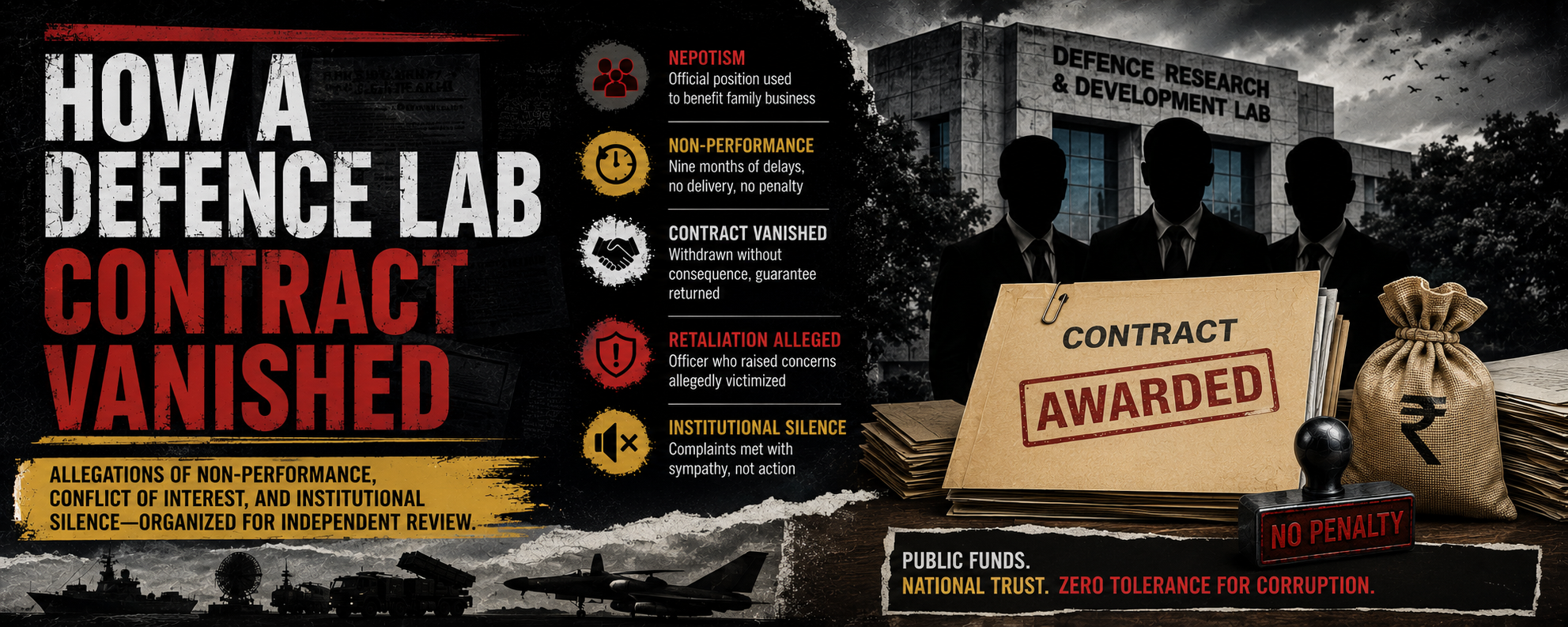
A defence contract. A husband’s company. Nine months of silence. A bank guarantee returned without penalty. And the officer who raised the alarm — allegedly punished on his own promotion board by the same person he complained about.

That’s the shape of the case being made against Ms. Suma Varughese, former DG (MED & CoS) and, as of 15 June 2026, a sitting DRDO chair-holder — now proposed for a panel role in the Centre of Excellence appointment process.  her inclusion should be paused, not because of one bad contract, but because of an alleged pattern: official position, family company, and institutional pressure, repeating across postings.

NameAlleged RoleAlleged Leverage Point
Suma VarugheseDG, MED & CoS (former); current DRDO chairAlleged to have directed procurement toward her husband’s firm and used board positions against a complaining officer
Thomas VarugheseHer husband; director, ComAVIA / Comavia System Technologies Pvt Ltd + two other firmsAlleged beneficiary of contracts said to trace back to her office
Ex-Purchase OfficerTransferred, CABS → CAIRAlleged to have swapped in a settlement clause ill-suited to the case
Current CAGOTransferred, CABS → CAIRAlleged to have fast-tracked the file under pressure
Mr. ChristopherEx-DRDO Chairman, now at IIT ChennaiAlleged to have shielded the pattern when it was first reported, years earlier at CABS
Mr. MangalDG, TMAlleged to have endorsed the current appointment “under pressure”

The paper trail starts with Contract Agreement/Supply Order No. CAIR/21AT0044/G1S/LP/197, dated 5 February 2021, awarded to Comavia System Technologies Pvt Ltd — the firm run by Ms. Varughese’s husband.

What allegedly happened next reads like a playbook:

A CAIR contractor’s bill — Exhibit A — corroborates part of this trail: a claim of ₹6,34,868 (Claim No. CL-9748169273988883) against this exact contract number, billed 29 November 2023 under the head “Vivad Se Vishwas-I.” That’s real paperwork, not just narrative. What it doesn’t prove on its own is the 9-month delay or the absence of penalty — those live in the contract’s liquidated-damages clause and the closure file, which haven’t been produced yet.

One flag worth resolving: the swapped clause “Vivad se Samvad.” The bill says “Vivad Se Vishwas.” Same family of settlement scheme, not necessarily the same clause — this needs to be pinned down before it goes anywhere official, or it hands a critic an easy way to poke a hole in an otherwise strong document.

The allegation doesn’t stop at procurement. In a separate DRDO HQ review, Ms. Varughese — as chairperson — allegedly leaned on the Project Director to finish an unrelated project faster, while expanding its scope. Then, sitting on his promotion board, she is alleged to have used that position to fail him.

Project Director complained. With evidence. To the highest authorities.

The response: sympathy. No action. Its because DRDO having helpless chairmen.

That’s the line keeps returning to — not that nobody knew, but that everybody who could act, didn’t.

 Where This Corruption Actually Began

Forget the single contract for a second. The real charge isn’t about one file — it’s about where the habit was learned.

Years before CAIR, before the ₹6.34 lakh guarantee, before the promotion-board retaliation — Suma Varughese was posted at CABS, and Mr. Christopher was running it as Director. That’s the alleged origin point. Not a coincidence of timing — a partnership of convenience, according to the complaint: her authority to place orders, his authority to make sure nobody looked too hard.

And the orders didn’t stop at one. multiple contracts, across multiple years, all flowing to the same address — Thomas Varughese’s company. Every one of them, allegedly reported. Every one of them, allegedly buried — not lost, not overlooked, managed. That word matters. It’s not “missed.” It’s not “an oversight.” The claim is that someone with the authority to stop it chose, repeatedly, not to.

Here’s the part that should stop anyone reading this cold: this didn’t end when Mr. Christopher moved on, and it didn’t end when Suma Varughese left CABS.  The same channel kept running — through DARE, through CAIR — and that the combined value of contracts steered this way, over the years, runs into crores of rupees. Not lakhs. Not one bad quarter. Crores — of taxpayer money, moving in one direction, for one family, over one long career.

That’s not a procurement irregularity. That’s a standing arrangement. A ₹6.34 lakh bank guarantee released without penalty isn’t the crime — it’s the residue. It’s what’s left visible above the waterline of something much bigger, much older, and allegedly still running.

One thing has to be said plainly: every figure in this section — “several orders,” “crores of rupees,” “till date” — is an allegation, not yet a filed number. It’s the single most serious claim in this whole account, and it deserves the single highest bar of proof: pull the CABS-era contract register, cross-reference every award to Thomas Varughese’s firms across CABS, DARE, CAIR and other various DRDO Labs, total it. If the number is real, it will show up in black and white. If it’s real, no one should need to take the word for it — the ledger will say it.

This isn’t presented as an isolated file. It’s alleged this pattern started at CABS, under Mr. Christopher’s watch, and never actually stopped — it just changed addresses, moving through DARE and CAIR and other DRDO Labs while the same two names stayed at the center of it. Mr. Mangal’s endorsement of the current appointment is alleged to have come under similar pressure — one more instance, of the same machine finding one more hand to turn the crank.

It’s requested by  the Core taxpayers of india to IISc, please check the IB reports before consideration of MS.  Suma Varughese for the Center of Excellence Appointment.

A strong story isn’t the same as a provable one. To make this stick:

An official allegedly steered work to her husband’s company, let it fail without cost, then sat in judgment over the man who objected. Strip the drama and it’s still a serious claim — which is exactly why it needs evidence, not adjectives, to carry it forward.

This is an initiative to protect the nation from anti-national networks that treat public defence funds as private income. Every rupee lost to a rigged contract or an unpunished withdrawal is a rupee taken from the taxpayer who funded it in good faith. Institutions built to defend the country cannot be allowed to double as private revenue streams for the well-connected. Accountability isn’t optional when national security budgets are on the line — it’s the minimum the country is owed.

Bangalore: DRDO bleeds as scientists desert organisation in droves

Monday, 24 February 2014 – 7:32pm IST | Place: Bangalore | Agency: DNA

DNA Correspondent

Young scientists are leaving India’s premier defence research agency in large numbers.

Defence Research Development Organisation (Drdo), responsible for developing indigenous defence systems, has not been able to retain its young scientists over the last seven years or so.

Close to 1,000 scientists have resigned from Drdo since 2007, but it is the exit of young scientists (Scientist ‘B’ and Scientist ‘C’ grades) that is a cause of concern.

The scientists in these grades are critical for research and development of a number of indigenous defence projects in areas such as aeronautics, armaments, combat vehicles, electronics and missiles.

Between 2007 and 2009, around 285 scientists in ‘B’ grade and 162 in ‘C’ resigned. Over the next four years, between 2010 and 2013, there was a small drop as 162 in grade ‘B’ and 77 in ‘C’ resigned.

The flight of the younger scientists is in complete contrast to the resignation to the senior scientists in ‘D’, ‘E’, ‘F’ ‘G’ ‘Outstanding’ ‘Distinguished’ categories, as between 2007 and 2013 only 86 resigned.

Following the high attrition rate in 2012, mainly due to availability better opportunities and incentives in the private sector, the ministry of defence (MoD) announced a few incentives and corrective measures to retain scientists.

The measures included two additional increments on promotion to each Grade, up to six variable increments on promotion granted on fast track, professional update allowance to all scientists, fast track promotions through assessments, opportunity to acquire higher qualifications at reputed institutes viz. IIT`s / IISc, etc. as Drdo sponsored candidate, young Scientists, Scientist of the Year and other Drdo awards in recognition to their contributions and creation of excellent infrastructure facilities at work places and residential complexes.

The incentives, however, have not been able to stop the exodus. Defence minister AK Antony said in Parliament recently that ‘personal and for pursuing higher studies’ as the reason for the scientists leaving the organisation.

Drdo has a sanctioned strength of 7,500 and is currently short of a few hundred scientists.

Nearly 700 scientists quit DRDO in six years, says Govt

NEW DELHI, December 5, 2012 – THE HINDU

Scientists install a DRDO-developed bio-toilet in the icy vastness of Siachen. File photo: DRDO

Nearly 700 scientists have resigned from India’s premier military research body DRDO in little less than six years from 2007, Defence Minister A K Antony said on Wednesday.

In a written reply to a question in the Rajya Sabha on resignation of scientists from Defence Research and Development Organisation(DRDO), Mr. Antony said a total of 637 scientists resigned during 2007-2011 and 50 scientists up to October 31 this year.

Scientists who had resigned have either cited personal or domestic reasons for leaving DRDO, Mr. Antony said.

However, it is assumed that increased opportunities or incentives available in other organisations and industries are the main reason of such resignation, he added.

On incentives taken as corrective measures to restrict resignation of scientists from DRDO, Mr. Antony said excellent infrastructure facilities have been created at work places and residential complexes and two additional increments have been given on promotion to each grade.

To another question, Mr. Antony said DRDO is a subordinate organisation under Defence Ministry and does not enjoy any special powers or autonomy because of its strategic nature of work.

Asked whether DRDO enjoys a huge amount of autonomy because of its strategic nature of work, he said, “DRDO is a subordinate organisation under the Department of Defence( R&D) in Defence Ministry and is governed by central government rules and regulations.

“Therefore, DRDO as an organisation does not enjoy any special powers or autonomy because of its strategic nature of work.”

Revised delegation of financial powers of Director General of DRDO was carried out in 2010 to address a long standing requirement and was done after due process and deliberation, he said.

“The process of exercise of these powers has been further rationalised and a corrigendum has been issued by Department of Defence (R&D) on November 21, 2012 as a partial modification to the earlier financial powers,” the minister added.

____________________________________________________________

Question and Answer in  RAJYA SABHA

GOVERNMENT OF INDIA
MINISTRY OF DEFENCE
RAJYA SABHA

QUESTION NO 1295
ANSWERED ON 05.12.2012

Resignation of scientists from DRDO

1295 SHRI DILIPBHAI PANDYA

Will the Minister of DEFENCE be pleased to satate :-

(a) whether it is a fact that about 650 scientists have resigned from their posts in Defence Research and Development Organisation (DRDO) during the last five years;

(b) if so, the year-wise and post-wise details thereof;

(c) whether low emoluments in DRDO are the reasons for their resignation; and

(d) if so, what corrective steps are taken / proposed to be taken by Government to persuade the scientists not to resign?

ANSWER

MINISTER OF DEFENCE
(SHRI A.K. ANTONY)

(a) A total of 637 scientists have resigned during 2007-2011 and 50 scientists upto 31st October 2012.

(b) Year-wise and post-wise details are given below:-

Post Year
2007 2008 2009 2010 2011 2012
(as on 31st October 2012)
Scientist ‘B’ 166 78 41 38 58 35
Scientist ‘C’ 86 58 18 18 21 12
Scientist ‘D’ 13 8 2 2 5 3
Scientist ‘E’ 2 5 1 3 1 –
Scientist ‘F’ 6 1 3 2 1 –
Total 273 150 65 63 86 50

No Scientist ‘G’, Scientists ‘H’ and Distinguished Scientist have resigned during 2007-2012.

(c) Scientists who had resigned have indicated their personal / domestic grounds as the reasons for leaving DRDO. However, it is assumed that increased opportunities / incentives available in other organizations / industries is the main reason of such resignation.

(d) The following incentives have been granted as corrective measures to restrict resignation of scientists from DRDO:-

• Two additional increments on promotion to each Grade.
• Up to six variable increments on promotion granted on fast track.
• Professional update allowance to all scientists.
• Fast track promotions through assessments.
•Opportunity to acquire higher qualifications at reputed institutes viz. IIT’s / IISc, etc. as DRDO sponsored candidate.
•Young Scientists, Scientist of the Year and other DRDO Awards in recognition to their contributions, etc.
• Excellent infrastructure facilities have been created at work places and residential complexes.

Government is making all efforts to grant Performance Related Incentive Scheme (PRIS) to DRDO scientists at par with scientists of Department of Atomic Energy (DAE) and Indian Space Research Organisation (ISRO).