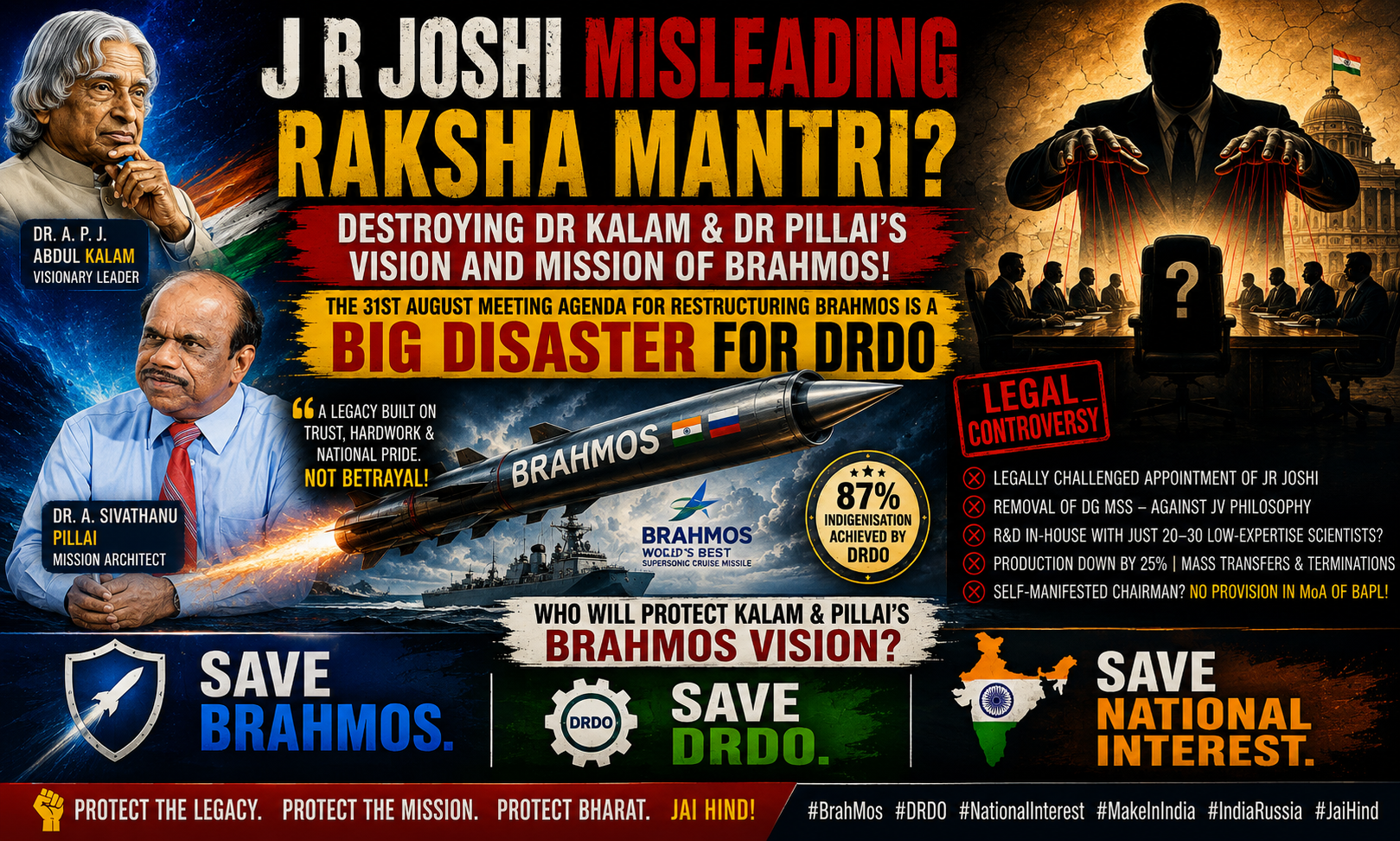
The agenda proposed for the 31st August meeting on the restructuring of BrahMos raises serious questions and, if approved in its present form, could prove to be a major setback for DRDO and the institutional architecture that has supported BrahMos since its inception.
How?
The whole world knows that on 12th February 1998, under the visionary leadership of Dr. A. P. J. Abdul Kalam, a Joint Venture was formed as a partnership between India’s DRDO and Russia’s Military Industrial Corporation, NPO Mashinostroyenia (NPOM).
The first successful flight of BrahMos was launched on 12th June 2001. Since then, BrahMos Aerospace Pvt. Ltd. has developed and produced multiple variants and has also entered the international defence-export arena.
There is numerous success stories associated with BrahMos, including its outstanding operational performance and the significant role attributed to the system during Operation Sindoor.
Unfortunately, according to the concerns and allegations raised in this matter, a former Chairman of DRDO made a controversial decision amid what has been described as an influential internal lobby and selected J. R. Joshi as DG BrahMos.
Most significantly, it has been alleged that J. R. Joshi was the junior-most among 7 eligible candidates. The selection was challenged before the CAT, and the Tribunal reportedly rejected the justification offered for the selection, including the explanation that the decision had been made on the basis of alphabetical order. Such an explanation has understandably raised serious questions, particularly when it concerns a premier national defence institution. The appointment was consequently quashed by the Hon’ble CAT.
Here, one important allegation requires serious examination: it has been claimed that information regarding the proposed appointment of J. R. Joshi was communicated to a particular individual one day before the selection interview and that this matter was duly brought to the attention of the Chairman, DRDO.
If established, such a sequence of events would raise serious questions regarding the transparency and credibility of the selection process and the confidence of the internal network involved. It is further understood that a stay was obtained from the Telangana High Court. Following extensive arguments, including submissions involving the ASG, the matter reportedly remains pending, with the verdict reserved since 8th July 2026.
The central question now is: what happens to the institutional ecosystem that has developed under J. R. Joshi if the High Court ultimately vacates the stay?
There are also serious concerns being raised regarding BrahMos production, with claims that production has already declined to approximately 25%. already because of continues inductions of non-skilled/low-skilled scientists with great profile could be Eco Intel from IB will justify.
Similar concerns have also been raised regarding continuing transfers and terminations involving individuals who are allegedly not aligned with the existing internal influential lobby. These allegations deserve transparent examination rather than being dismissed without inquiry.
Now comes the most consequential point. The proposed agenda appears to have been placed for approval through the present DRDO leadership. The concern is whether the complete institutional, technical and governance history of the BrahMos Joint Venture has been adequately considered.
Why should the DG MSS be removed from the Board?
Why has the DG MSS historically been associated with the Board/directorship structure of the Joint Venture?
The reason is fundamental: the DG MSS ecosystem is responsible for major missile R&D capabilities. The achievements of India’s missile programmes have been built upon the collective contribution of multiple missile-complex laboratories and their associated R&D infrastructure.
Now the agenda puts which shows that approve by RM through temporary DG DRDO, who don’t know the complete JV MoU, removal of DG MSS from the Board why DG MSS heading board directorship of JV because responsible for R&D and because of this India achieved 87% indignation of various and all missile complex labs under DG MSS have the credit.
Now our genius JR Joshi, current CEO ad MD BrahMos wants that BrahMos R&D will be in house at BAPL with just 20-30 low expertise scientists as you know what expertise are them.
However, the same indignation by DRDO since 2001 to till date Under DG MSS achieved 87% has contribution of more than 300 scientists in last 26 years of the history of BrahMos.
what will Joshi achieve with these small chunks and without R&D infrastructure, the help of DRDO missile complex laboratories and DGMSS Who is the Director General all missile complex laboratory cluster in Hydrabad. Can our dear Defence Secretary know this points basically they ignoring the vision of Dr. Kalam and misleading the RM.
Against this background, the proposal that BrahMos R&D should effectively be brought in-house with a limited team of approximately 20–30 scientists raises a fundamental technical question: can such a small group replicate the depth, infrastructure, laboratories, specialist manpower and institutional knowledge available across the established missile R&D ecosystem?
This is the point that must be examined carefully. From 2001 to the present, the established missile R&D structure under DG MSS and associated laboratories has contributed substantially to India’s missile-development achievements. What additional capability would be created by fragmenting this established ecosystem and attempting to recreate R&D capacity inside BrahMos with a comparatively small scientific team?
Can our Defence Secretary and the Raksha Mantri be fully apprised of these technical and institutional implications before any restructuring decision is taken? If not, there is a real risk that the original vision of Dr. Kalam and the founding leadership of BrahMos could be diluted through administrative restructuring rather than strengthened through scientific and technological integration.
As the agenda reportedly indicates that the Russian side’s responsibilities remain unchanged, a fundamental question arises: what is the compelling strategic necessity for such a significant change on the Indian side?
Russian Board:
• Dr. A. A. Dergachev – Chairman, Board of Directors, JV BrahMos
• Mr. Aleksander Maksichev – JMD
Indian Side – Board of Directors
Earlier:
• CEO, MD & DG BrahMos – currently J. R. Joshi, whose position is the subject of ongoing legal controversy.
• DG MSS – J Nayak (who voluntary withdrawing to support J R Joshi without considering the organization and national interest because of he is fascinating with JR Joshi dictatorship appearance and dreaming DRDO chairmanship with help of JR Joshi influential lobby support. He got this DG MSS post also the same lobby support because he is not a missile field man.
The proposed restructuring reportedly seeks to establish J. R. Joshi as the Chairman for the Indian side of BrahMos. This raises an important governance question: does the existing MoU of BAPL expressly provide for such a self-created or separately designated Indian-side Chairmanship?
If no such provision exists in the governing framework, the proposal requires careful legal, contractual and governance scrutiny before implementation.
Indian corporate-governance history would find it highly unusual if one Joint Venture were to operate with two separate Chairmen without a clear contractual and statutory basis.
Practically, a Board can only have one presiding Chairman at a time. In this point BAPL CS Mr. Nanda not agreed and resigned.
One Chairman and one Vice-Chairman may be a conventional governance structure, but any alternative arrangement must be clearly supported by the MoU, Articles of Association and applicable corporate law. The decision should therefore be based on institutional logic, legal provisions and national interest—not on individual aspirations or expectations regarding future appointments or extensions.
Now comes the proposed new MD position. Sources have told that the post may be offered to Mr. Arvind, Director, CFEES Delhi and CEO will be given to Sambhashiv Prasad, his old colleague, friend and Deputy CEO post will proposed to Mr. Parveen Pathak who is currently director market promotion and exports who started his career in BrahMos as Russian translator. All three individuals required proper IB clearance with Eco Intel.
If this is indeed the proposal, the country deserves to know the objective criteria, technical expertise, leadership credentials and selection process that justify such an appointment.
Now country can assume what type of qualities JR Joshi has.
It’s humbly requested to RM, please thoroughly considered the above points and This JV is between two countries Indo-Russia and international impact will be there so Kindly root through PMO and NSA for final restructuring of BrahMos Aerospace Pvt. Ltd.
Rest: Please see the 115th BM agenda sheet reportedly placed for approval before the Raksha Mantri.
Defence Secretary, RM should go thoroughly all 105pages line by line So they can assess the manipulation of J R Joshi and his influential lobby.
JAI HIND
