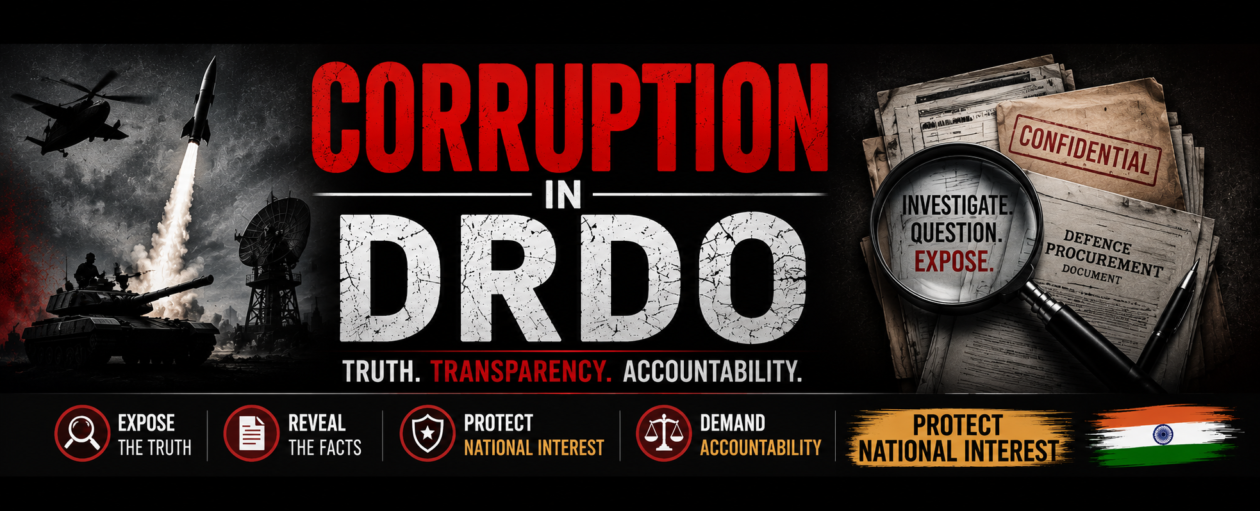
To, Hon’ble Defense Minister; Govt.of India, New Delhi,
Sub:– DRDO have no reply – taken shelter from RTI section 24(1) in corruption related cases ?
Respected Sir,
Major irregularities in the purchase of 59,000 bullet –proof jackets for security forces, the Home Ministry findings of the testing conducted by a tainted official at DRDO Chandigarh laboratory. The ministry requested the DRDO for initiating disciplinary proceedings against its scientist R.K.Verma, the joint director at the Terminal Ballistics Research Laboratory in Chandigarh.
My RTI related to know the disciplinary proceeding against R.K.Verma. But DRDO have no reply – taken shelter from RTI section 24(1) in corruption related cases?
However major irregularities find out by the ministry of home, but DRDO disciplinary proceedings result is unknown. May possible to promote Mr. R.K.Verma instead of major punishment with the pecuniary arrangement of the Top corrupt officers / scientist?
I request you to take necessary action as per the Home Ministry with those top scientists responsible to provide shelter during disciplinary proceedings.
With high regards,
Your, Sincerely.
(Rajiv Chauhan)
COPY TO THE :
1- Hon’ble President of India for kind consideration and necessary action.
2- Hon’ble Prime minister of India for kind consideration and necessary action.
To, Hon’ble Defense Minister; Govt.of India, New Delhi,
Subject – DRDO Scientist recommendation with false information to grant extension of service for a period of two years beyond the age of 60 years; .
Respected Sir,
This is not a single example which is put up before you that how the recommendations with false information to grant extension of service for a period of two years beyond the age of 60 years; given by the DRDO HQ. Is it a misuse of office for misuse of powers or a pecuniary arrangement with involvement of corruption?
Dr.Rao A Subhananda ; Distinguished Scientist, particulars recommended by the DRDO HQ with false information that ‘NO’ any VIGILANCE proceedings are pending or contemplated against the officer, However in a RTI reply it found that a Vigilance proceeding is pending against the scientist. I hereby enclose that annexure with DRDO HQ false information and related RTI information. Both information is contradictory. Which is a right information, Information given by CVC or given by the DRDO HQ?
I request you to take a suitable and necessary action against the responsible officer, who sent the recommendation with false information to the Govt. of India.
With high regards,
Your’s, Sincerely.
(Rajiv Chauhan)
COPY TO THE :
1- Hon’ble President of India for kind consideration and necessary action.
2- Hon’ble Prime minister of India for kind consideration and necessary action.
To, Hon’ble Defence Minister; Govt.of India, New Delhi,
Subject : Misuse of the financial powers by the DRDO officers / Scientist. Can you fix accountability & responsibility for recovery?
Respected Sir,
CAG reports clearly is showing the financial losses by the DRDO officers / Scientists in different projects as attached for your perusal. Head of the department of the DRDO failed to fix the accountability & responsibility for these losses. Can you fix it for recovery?
I am unable to understand that why Head of the DRDO fail to fix the accountability & responsibility for these Billions losses which is clearly indication of the misuse of DRDO office and financial powers. A high level corruption after pecuniary arrangement is possible.
I will be highly obliged for your kind consideration and necessary action to fix the accountability & responsibility for recovery.
With high regards,
Your, Sincerely.
ACA(Rajiv Chauhan)
COPY TO THE : 1- Hon’ble President of India for kind consideration and necessary action.
2- Hon’ble Prime minister of India for kind consideration and necessary action.
3- Director, CBI, New Delhi for kind consideration and necessary action.
(Rajiv Chauhan)
CAG Report on DRDO
No.12 of 2010-11 (Defence Services)
CHAPTER VI :
DEFENCE RESEARCH AND DEVELOPMENT ORGANISATION
6.1 Injudicious creation of assets
An expenditure of Rs 8.92 crore incurred by Defence Research and Development Organisation (DRDO) for creation of assets to draw power from a power supply corporation became infructuous due to DRDO’s failure to assess the corporation’s ability to supply stable and uninterrupted power required for operation of highly sensitive equipment and machines.
DRDO imported various sensitive equipment and machines for creation of technical facilities for a programme of strategic importance at a station. These facilities required uninterrupted and high quality stable power supply. Based on the recommendations of a Board of Officers, Ministry of Defence accorded sanction in March 2000, as amended in December 2001, for provision of external electrification at the station at a total cost of Rs 9.54 crore, to be executed by a Chief Construction Engineer, Research and Development (CCE R&D). The CCE R&D completed the works for power
supply receiving and distribution to each of the sites within the station, under the supervision of the State Power Supply Corporation, in November 2001 at a cost of Rs 9.15 crore including expenditure of Rs 0.23 crore for power distribution to living accommodation. The corporation had agreed to supply 4500 KVA of power, in a phased manner, as sought by DRDO. However, before creating the assets for drawing power from the corporation, DRDO did not get firm assurance from the Power Corporation for supply of the quality of power required by DRDO for operation of the sensitive
equipment/machines of the programme. Due to excessive variations in voltage/ frequency/current in the power supplied by the corporation, the imported equipment procured under the programme did not function properly. This along with frequent interruption in power supply forced DRDO to procure DG Sets, separately at a cost of Rs 3.57 crore for the facility. Only the living/ administrative accommodation which required meager quantity of power could use the power received from the corporation. The contract demand was therefore reduced from 4500 KVA to 600 KVA by September
2004 for the day to day operation of the site and other technical facilities including the living/administrative accommodation. Further, a sum of Rs 1.80 crore was spent during 2002-09 for maintenance of the 66 KV line and associated facilities to avoid deterioration. Thus the expenditure incurred on establishing a sub station to support the 66 KV line was rendered infructuous. The Ministry admitted in September 2009 that DRDO had relied upon the State owned power corporation to adhere strictly to the quality specifications as laid down in the Indian Electricity Rules 1956, which they didn’t do.
TheMinistry also stated that such a complex technical facility, which is of strategic importance to nation’s security, was being established for the first time in the country and DRDO could learn its complex requirements from this experience and argued that the expenditure should not be treated as wasteful as the experience learned from this project was utilized in the next project where they did not seek the provision of electricity from state Electricity Board and had commissioned required DG sets directly. The Ministry added in February 2010 that a new Radar system planned for Air Force requirement would be assembled at the station in a period of two to three years and there would
therefore be higher usage of the substation in the future. The Ministry’s statement about the likely utilization of the assets when the planned radar system for the Air Force comes up in the next two-three years does not validate the creation of the assets in the year 2001 and keeping them idle for over a decade. Thus, the failure of DRDO to assess the ability of state power corporation to supply to the required specifications for operation of sensitive equipmentresulted in an infructuous expenditure of Rs 8.92 crore, besides burdeningitself with a recurring liability of maintaining the redundant assets
6.2 Loss due to damage to imported equipment DRDO suffered a loss of Rs 6.91 crore as an imported equipment was damaged due to mishandling by the Air Consolidation Agent.
The Director of a Defence R&D Laboratory placed purchase order on a UK based firm in October 2006 for a machine required for a project at a cost of Rs 18.46 crore. As per terms of the purchase order, 70 per cent payment (Rs 12.23 crore) was made to the firm on shipment of the machine. Remaining 20 per cent of the amount was to be paid after installation and 10 per cent after the end of the warranty period. The machine was to be delivered by end of July 2007 at the laboratory premises through an Air Consolidation Agent (ACA)17 having Air Consolidation Contract with the Defence Research and Development Organisation (DRDO). As per terms and conditions of the contract, the ACA was responsible for all losses or damages to the equipment due to any cause whatsoever from the time they receive the shipment till delivery at consignee’s end. It was also stipulated in the contract that in case of losses to stores occasioned on account of Agent’s negligence, the amount spent on account of ACAs negligence will be recovered from the Agent’s pending bills. The machine arrived at Delhi Airport on 8 August 2007 and was locally transported by the ACA on 9 August 2007. One package consisting of the main equipment of heavy weight and size was damaged as it fell down while unloading at the laboratory premises due to mishandling for which the ACA was responsible. 17 M/s Balmer Lawrie and Company Limited: responsible for Air Consolidation Services, custom clearance and carrying of machine/stores being imported by DRDO Laboratories.
The Court of Inquiry (COI) constituted by the Director of the laboratory, to assess the loss and circumstances leading to damage found that the damage to the equipment was caused by the ACA while unloading. It was also revealed that the machinery and tools used by ACA while unloading were insufficient. The COI further recommended that pending settlement of the claim for liability of loss, the damaged component be got replaced from the supplying firm. Accordingly, the Director of the laboratory placed order on the same firm in January 2009 for supply of a new equipment for replacing the damaged one at a cost of Euro 960,000 (Rs 6.21 crore) excluding customs duty of Rs 0.70 crore which was to be paid by the Laboratory separately. The equipment was to be delivered by October 2009. Audit observed that despite contractual obligations, the laboratory did not raise any claim for the loss against the ACA though on behalf of the laboratory the ACA had lodged a claim of Rs 9.04 crore in February 2008 with the Insurance Company. The Insurance claim had however, not been finalized by the Insurance Company as of October 2009. The case reveals that DRDO has not only lost time but also suffered a loss of Rs 6.91 crore on account of damage to the equipment due to mishandling by ACA, which was yet to be made good as of October 2009 for which even the
claim has not raised against the transporting agency. In their reply of October 2009, the Ministry stated that they were making best efforts to recover the money to make good the loss.
6.3 Avoidable expenditure due to poor planning of a work service Poor planning of a work service by the Programme Director and Chief Construction Engineer, led to an additional expenditure of Rs 1.39 crore towards payment of compensation to the contractor.
In January 2006, Chief Construction Engineer (CCE) Research & Development (R&D) Secunderabad entered into a contract with a firm for construction of accommodation for System and Test Integration RIG (STIR) at the cost of Rs 18.78 crore, to be completed by July 2007. A Board of Officers had earlier assembled in May 2005 to consider the requirement of work services for STIR of a Defence Research and Development Programme at Bangalore and recommended construction of the facility on top priority and also that the work relating to the shifting of 66 KV power (HT) line running right through the middle of the selected site, be taken up and executed separately to facilitate the construction. The Programme Director (PD), STIR was to make the site available to the contractor within four weeks of conclusion of the contract. However, action was not taken by the PD to get the HT line shifted. In March 2006, the PD and CCE decided that the work for shifting the line would be executed through the CCE. As clear work front was not made available to the contractor for eight months after the award of work in January 2006 the contractor could not proceed with the work. The CCE concluded a separate contract in June 2006 with the same contractor for shifting the line and got it completed in October 2006. The CCE granted extension of time for completion of work from July 2007 to March 2008. Against a compensation of Rs 3.67 crore claimed by the contractor to offset the expenditure incurred on idle machinery/manpower and increase in cost of material/labour due to the delay in commencement of work, DRDO had to pay an extra-contractual amount of Rs 1.39 crore. On being pointed out, the CCE informed Audit in November 2007 that it was initially planned that the programme authorities would shift the HT line and make the site available for construction. The task was later transferred to CCE only in June 2006. After transferring the responsibility, the CCE concluded the contract in June 2006 without further loss of time for shifting the HT line. These statements of CCE were not totally correct as in March 2006 itself, the
PD and the CCE had decided that the shifting of HT line would be undertaken by the CCE. However, the CCE took another three months to award the contract for shifting the HT line. Thus due to poor planning of the work services by the PD and the CCE and their failure to ensure shifting of HT line before award of the contract for the work services resulted in an avoidable payment of Rs 1.39 crore to the contractor, besides delaying execution of the work. The case needs to be investigated so as to fix responsibility for the lapse. The Ministry stated in January 2010 that partially clear site was made
available to the contractor and the work on piling was commenced on date in the areas/locations other than 66 KV HT line shadow. It was further stated that delay of eight months was beyond the control of DRDO. The facts, however, remain that the contractor could not progress with the work for eight months due to non-shifting of HT line for which additional payment of Rs 1.39 crore had to be made to the contractor, which could have been avoided had the HT line been shifted in advance.
6.4 Loss due to lack of coordination in procurement of a life saving item An expenditure of Rs 93.09 lakh incurred on procurement of drugs proved infructuous as the drugs could not be issued to users within their shelf life. Although the life saving item was accepted in September 2004 for use in the Army, it remained undistributed for nearly five years predominantly due to the lack of coordination between the developer and the user.
The Autoject Injector (AJI) set consisting of two individual autoject injectors, one containing Atropine Sulphate and the other containing PAM Chloride was developed by Defence Research and Development Establishment, Gwalior (DRDE) of Defence Research and Development Organisation (DRDO) to treat and counteract nerve agents poisoning. On exposure to nerve agents, these are to be used by individuals for immediate treatment by self administered injection. Based on the requirement projected by Army HQ, the Ministry of Defence (MOD) issued sanction in September 2004 for production and supply of Autoject Injectors along with equal number of Atropine Sulphate and PAM
Chloride drug through DRDO. The sanction stipulated that the terms of supply of equipment would be determined and monitored by Army HQ/MOD in consultation with DRDO. DRDE procured from private sector firms 32,400 AJI for injecting Atropine Sulphate and 32,400 AJI for PAM Chloride along with 33,000 each of Atropine Sulphate drug cartridges and PAM Chloride drug cartridges at a cost of Rs. 2.80 crore, of which Rs 93.09 lakh was for the drug cartridges. Shelf life of AJIs was five years, that of Atropine Sulphate drug was two years, and it was only one year for PAM Chloride drug. The AJI and drug Cartridges were received during May/December 2005 and September 2005/January 2006 respectively. However, Army HQ did not intimate the consignee details to DRDE. In response to a request by DRDE, Army HQ (Additional Director General Weapons and Equipment) advised them in February 2006 to obtain consignee details from Dy. Director General Perspective Planning (Nuclear Biological and Chemical Warfare) and to deliver the consignments only after the items were duly inspected and certified fit in all respects by the representatives of the users. In the Joint Inspection, which was not attended by the user’s representative, held in April 2006 it was found that 25700 AJIs of Atropine Sulphate and 27,689 AJIs of PAM Chloride were acceptable. The remaining were defective and therefore rejected. The date of expiry of the drug PAM Chloride varied from June 2006 to October 2006 and that of the Atropine Sulphate varied from May 2007 to October 2007. In view of the early expiry of the drugs, the Joint inspection team recommended that process be initiated to replenish the drug cartridges. DRDE informed Army HQ in April 2006 about the acceptance in inspection of AJIs and sought consignee details. In July 2006, Army HQ asked DRDO HQ to send these to the Central Ordnance Depot Kandivli. Army HQ simultaneously informed DRDO HQ that the drug cartridges of PAM Chloride with balance shelf life of less than 75 per cent and Atropine Sulphate with shelf life expiring before 01 October 2007 should be replaced. In July 2006, DRDE issued 25,000 AJIs along with drug cartridges to Armed Forces Medical Store Depot Mumbai as later advised by Army HQ. However, the supplied stores could not be used due to non-availability of adequate shelf life of drug cartridges. DRDE placed supply orders for 8000 each of for AJI (Atropine Sulphate and PAM Chloride) and drug Cartridge 33000 each at a cost of Rs 0.12 crore and at a cost of Rs 1.35 crore respectively. Joint inspection was carried out for Atropine Sulphate and PAM Chloride drug cartridge received between July and September 2008. However, these were rejected by DGQA in October 2008 due to detection of butyl fragments in the injected content of drug, less injection of drug than the stipulated therapeutic dose making it ineffective and weak plastic bodies of reusable injectors. Army HQ in June 2009 formed a study group to analyse the complex issue in its totality. Based on the recommendations of the Study Group suggestions of Director General Armed Forces Medical Services and reassurance of DRDO about the efficacy of the drugs, Army HQ agreed to accept the AJIs and the drugs in their present condition for use during emergencies only, with the condition that DRDE would develop improved version at the earliest. The overriding consideration for the acceptance of the AJI/drug was that the advantage of the AJI outweighed the potential risks associated with the deficiencies pointed out by DGQA in October 2008. The Ministry of Defence stated in November 2009 that there was no loss since the Army had accepted the AJIs and drugs. The fact remains that the procurement of drug cartridges at a cost of Rs 93.09 lakh during 2005-06 was clearly a loss since their shelf life expired before the AJIs were accepted for use by the Army. Although the sanction issued by the Ministry in September 2004 stipulated that the terms of supply of equipment would be determined and monitored by Army HQ/MOD in consultation with DRDO, the above events are symptoms of lack of coordination and understanding among DRDO HQ, Army HQ and DRDE. Resultantly, the AJIs and their drugs developed for use in emergencies as life saving items remained without any use for nearly five years with associated financial repercussions such as loss on account of expiry of their shelf life. The case points to the need for a better coordination and communication between the associated agencies
to accomplish value for money and the Research and Development efforts.
No. 24 of 2011-12 (Defence Services)
6.1 Blockage of public money due to take over of unusable land Imprudent decision to acquire forest land by DRDO at a cost of ` 73.26 crore which could not be used for other than forest purpose not only delayed the completion of project but also blocked Government money
as land was not used for the project.
The Ministry of Defence in June 2003 sanctioned a project for ‘Development of Vehicle Mounted energy System’ by Defence Research and Development Organisation (DRDO) at a cost of ` 97.40 crore. The project was to be completed by June 2010. An ‘Integration and Test Facility’ was to be created under the project in a vast area of approximately 700 acres of land for testing purpose.DRDO initiated action in February 2004 for acquisition of 700 acres of land at Faridabad for the facility. The requirement was increased to 1100 acres in August 2005. The identified land belonging to Faridabad Municipal Corporation was covered under the Forest Conservation Act, 1980 and notifiedas such by Haryana Government in August 1992 under Section 4 of Punjab Land Preservation Act, 1900 (PLPA) which prohibited erection of buildings on the land. DRDO enquired from the Conservator of Forests, Haryana regarding the formalities to be completed for diversion of forest land for nonforest use and compensatory afforestation charges to be paid under Forest Conservation Act, 1980. Conservator of Forests, Haryana informed in November 2005 that out of the total 1104 acre of proposed land, 1091 acres of land was forest land. He also informed that Hon’ble Supreme Court in its order dated 18.3.2004 clarified that land notified under Section 4 & 5 of PLPA 1900 would be treated as forest and diversion of this land for non-forestry use would invoke Forest Conservation Act, 1980 under which this land cannot be put to use for nonforestry purpose without obtaining permission from the Government of India. Despite this, the Haryana Government in August 2006 on reconsideration offered 1100 acres of Forest land at Faridabad to the DRDO at the rate of ` 18 lakh per acre. DRDO in May 2007 reduced their requirement to 407 acres of land. In July 2007, the Commissioner, Faridabad Municipal Corporation informed DRDO that the Haryana Government had approved the proposal for allotment of 407 acres land at the rate of ` 18 lakh per acre to DRDO on the condition that DRDO will take necessary action for de-notification of land from the purview of PLPA 1900 from the Forest Department. Pending clearance of Forest Department, DRDO paid ` 73.26 crore in three instalments from October 2007 to April 2008 to State Government and took possession of land in April 2008. In June 2008 the Forest Department, Haryana informed DRDO to seek prior permission of Central Empowered Committee (CEC) for use of land. On an application filed by M/s R.D. Consultants on behalf of DRDO for seeking permission for non-forestry use of 407 acres of land allotted to the DRDO, the CEC filed a report in August 2009 in Hon’ble Supreme Court in pursuant to the Hon’ble Court order. The CEC recommended that the permission for use of land for setting up of the Centre by the DRDO may not be accepted. CEC also recommended that an alternative site jointly identified by the DRDO with Haryana Government may be used by DRDO and State Government should take immediate steps for acquiring the alternative identified land. However DRDO is yet to get the alternative land. Meanwhile, the Apex Review Board for the Project in December 2008 directed to use Terminal Ballistics Research Laboratory (TBRL) Ramgarh range by creating infrastructure at a cost of ` 38 crore, as Faridabad test range was not ready. The PDC of the main project was extended from June 2010 to June 2013. DRDO HQ stated that the test range to test the system was planned at Faridabad but the acquired land could not be utilized in view of non-clearance by CEC. TBRL Ramgarh has been identified as alternative site and development cost on this land for carrying out permanent facility for testing would be around ` 38 crore for which sanction was under process as of April 2010. The fact that subject land was under Punjab Land Preservation Act, and also that Supreme Court judgement prohibited use of forest land for non-forest purpose was well known. Hence decision of DRDO to acquire the subject land from State Government which could not be used for creating facility as CEC refused permission to use the land for other than forest purpose was imprudent and resulted in blockage of Government money to the tune of ` 73.26 crore. The Ministry stated in December 2010 that with the past experience, DRDO was confident and sure to get forest clearance for carrying out construction on the said land. But case for diversion for non-forest use was not accepted by the CEC as the area falls in the catchment area of two lakes posing serious environmental impact on ground water and flow of water to lake and Aravalli range. The case for refund of ` 73.26 crore had already been recommended by CEC and forwarded to Hon’ble Supreme Court of India on 22 September 2010. The fact, however, is that an amount of ` 73.26 crore paid from Defence Grants during October 2007 – April 2008 remained blocked with the State Government and this could have been avoided had the DRDO examined the likely legal implications beforehand.
6.2 Procurement/receipt of equipments after the closure or at the fag end of a project Defence Materials and Stores Research & Development Establishment (DMSRDE) procured equipments worth ` 1.52 crore after technical completion of the project or at the fag end of a project. The project was completed with the facilities available in DMSRDE and other Labs implying that the procurement was avoidable.
Ministry of Defence in February 2005 sanctioned a project on “Development of New Generation Polymers” (DRM 546) at an estimated cost of ` 8.50 crore for completion by February 2010. The project was technically completed in December 2009 and closure report was submitted in February 2010 with completion cost of ` 6.13 crore which included procurement of machinery and equipments worth ` 2.83 crore. Audit scrutiny indicated that the DMSRDE procured/received equipments worth ` 1.15 crore after technical completion of the project, i.e. December 2009 and equipment worth ` 0.37 crore at the fag end of the project. This was in contravention of DRDO Headquarters instructions to DMSRDE Kanpur in October 2004 to procure equipments at least six months before probable date of completion of the project to utilise these for production of some data or results which was expected from them. The time taken in procurement of five equipment i.e. from user demand to supply order ranged from 72 weeks to 142 weeks against the prescribed time of 26 weeks stipulated in Defence Procurement Manual 2005. In response to the audit query DMSRDE clarified that the facilities available in the Lab (DMSRDE), IIT Kanpur and other R&D Labs were used for the project and hence the project could be completed without the equipments. The said equipments procured under the project were being utilised even after the completion of the project for other ongoing projects and are essential for future projects. The Ministry in reply stated that most of the procurement delay in these specific cases were circumstantial, viz couple of cases were refloated twice, cases converting to resultant single tenders etc. These are the basic equipments having life span of around 15 years required for regular research work and were being utilised even after completion of the project. The value for money was partially achieved during the project. In order to overcome delays in procurement, a new schedule of delegation of financial power was issued in
July 2010 which had bestowed higher power for procurement for the project Directors/Lab Directors. The fact that equipments can be used for regular R&D activities being basic equipment is no justification to procure them for this project after it was completed. It could be procured from build up grant when required. It would appear that the cost estimates for the project was highly exaggerated as the project could be completed even without equipments worth `1.52 crore. Toovercome abnormal delay in procurement, inherent weakness in the system of procurement also needs to be looked into.
6.3 Development of a Modular Bridge below requisite specification Non execution of Project for Modular Bridge on specification recommended in statement of case based on which sanction was accorded resulted in wastage of assets created for ` 21.46 crore as users did not accept the bridge.
A feasibility study on Modular Bridge was carried out by Defence Research and Development Establishment (Engineers) (R&DE) (E) in August 2002. The study was based on the requirement projected by Army in General Staff Policy Statement (GSPS) of 1993. The salient feature of the bridge was single span up to 46 metre with Military Load Class 70 (MLC 70). Based on the recommendations given in statement of case for Modular Bridge 46 metre with MLC 70, the Ministry of Defence accorded sanction in October 2002 for execution of the project at a total cost ` 24.25 crore. The work was to be completed by R&DE(E) within 4 years from the date of allotment of project i.e. by October 2006. In May 2006, R&DE (E) sought extension of probable date of completion (PDC) of the project by two years, i.e. up to October 2008 due to technical difficulty in execution. Ministry accorded sanction for extension up to October 2008. In October 2007, the R&DE(E), against the 46 metre span and MLC 70 bridge, submitted Trial Report to Defence Research & Development Organisation Headquarters (DRDO) for 20 metre bridge with 40 MLC, which was not acceptable to the users and as such in March 2008 E-in-C Branch requested Directorate of Interaction with Services for Business (DISB) of DRDO HQ to accept proposal of 10 Modular Bridge ‘Buy Global’ at a cost of ` 600 crore to fill the operational voids as R&DE(E) had not developed requisite specification Bridge. Again the PDC of the project was revised in two spells upto December 2009.During this time the R&DE (E) developed 40 metre MLC 70 Modular Bridgenand technical trials were held from January 2008 to December 2009 and the bridge was found ready for traffic but the user requirement of 46 metre MLC 70 was not fulfilled. R&DE (E) confirmed that know how developed for Modular Bridge would be useful in future development. In March 2010 R&DE(E) submitted Closure Report of the project to DRDO HQ and closed the project after having incurred an expenditure of ` 21.46 crore with the proposal to develop a 46 metre MLC 70 bridge to meet the requirement of General Staff Qualitative Requirement (GSQR) issued in September 2007. Hence, another project was sanctioned in January 2010 at a cost of ` 13.25 crore to develop 46 metre MLC 70 Bridge which is to be completed by July 2012. Thus, instead of adhering to the specification given in the feasibility study for Modular Bridge upto 46 metre MLC 70, R&DE (E) Pune developed Modular Bridge of 40 metre MLC 70 which was not required by users. The end result of development of Modular Bridge at 40 metre MLC 70 was that after incurring expenditure of ` 17.89 crore excluding cost of five carrier vehicles being used in next project, the requirement of the user could not be served. In February 2011 Ministry stated that as per feasibility study report the modular bridge was projected for MLC-70. But later on it was changed to MLC-40 on user requirement during quarterly interaction meeting held in August 2002 and clarification made by user in December 2002. The bridge can also take MLC-70 loads upto 40 M. Since the system was to be developed on an in-service high mobility vehicle which was tatra 8×8 at that time, only MLC-40 was possible due to counter weight problems during launching. While the development of MLC-40 was at an advanced stage the requirement of 46 M MLC 70 was projected in the final GSQR issued in June 2007. In the meantime tatra 10×10 vehicle got introduced in the services and DRDO is confident to develop 46 M MLC 70 system on tatra 10×10. After seeking clarification on this issue from user (E-in-C) it was stated that their requirement stands for 46 M MLC 70 but load class of bridge for spans of 46M to be MLC-40 and MLC- 70 upto span of 38 M may be possible because of technology limitation. Ministry’s reply and user clarification, both expressed limitation of technology for development of bridge 46M MLC-70. The details of the case, Ministry’s reply and clarification given by users reveal the fact that both the user and DRDO were aware that the bridge was being built for 40 M MLC 70 /46M MLC 40. Further DRDO had its limitations for construction of bridge 46 M MLC-70. Even though both the user and the designer were aware of the limitations of the project, neither of them took the initiative to foreclose the project. As a result even after incurring government expenditure of ` 17.89 crore, excluding cost of carrier vehicles to be used in next project, the users requirement of modular bridge after lapse of nine years remains unfulfilled.
I would like to inform you about the ,DRDO Employees ,chandipur ,These are job in central govt. sector ,But they do not work properly are also job in private sector likely ,some are insurance agent ,Travel agent ,you know also very well and curruption is not limit in their.,some person who is involve and I want to give the name one is Mr. N.C.Mahapatra and another is Mr. Anjay Singh , both are DRDO Employees ,chandipur ,Balasore ,ODISHA (PXE),pls veryfication all these employees .
Therefore ,I want to request to you take the necssary action of these employees.
Subject – Chairman; Recruitment and Assessment of DRDO; Ministry of Defense letter violating the DRDO service rule for Promotion from scientist ‘F’ to Senior scientist ‘G’ – Can create corruption in DRDO ?
Respected Sir,
NO Assessment interview requirement for Promotion from scientist ‘F’ to Senior scientist ‘G’ as per the DRDO service rule-1979-Rule-8(2)(e) ; but Chairman, Recruitment and Assessment of DRDO forward name before promotion committee after “ INTERACTION ’’ .
What is the meaning of interaction and what is its need against the rule ? Nothing except the violation of law for corruption. UPSC conducted examinations for thousands participant for few seats then how RAC chairman want to stop the limited scientists opportunities to appear before the committee directly. Intension of Chairman is very clear.
I hereby enclosed the Chairman, Dr. P. S. Goel letter RAC/01/Assessment/PSG,dt-22-3-11 and DRDO service rules as an evidence of the violation of rules for corruption.
I will be highly obliged for your kind consideration and necessary action to prevent the corruption tactics in DRDO.
With high regards,
Your, Sincerely.
(Rajiv Chauhan)
COPY TO THE :
1- Hon’ble President of India for kind consideration and necessary action.
2- Hon’ble Prime minister of India for kind consideration and necessary action.
To, Hon’ble Home Minister of India Govt.of India, New Delhi,
Subject : DRDO; Ministry of Defense, Classified information’s available on web pages can harm to National Security – A clear cut violation of the Official Secrets Act-1923 .
Respected Sir,
Investigation agencies of India are unable to take suitable investigating decisions on a very important issue on my information’s to the Hon’ble Prime-Minister of India related with DRDO; Ministry of Defense, Classified information’s availability on web pages can harm to National Security.
Every year heavy Govt of India revenue is invested on the DRDO, defense related research for national security, but surprisingly classified information’s reached on web pages after the violation of the official secret act.
My information was forwarded for investigation to Special Cell and now it is forwarded to the Ministry of Defense by special cell. However investigation is a jurisdiction of the police then why they are unable to reach on investigation result that who is responsible / accountable?
I hereby enclose my information and its action before you to take a suitable and necessary action to decide the responsibility and accountability as per the law of official secret act.
I will be highly obliged.
To,Hon’ble President of India,Govt.of India, New Delhi
Subject – Corrupt Top Scientists of India making undue pressure on complainants of the corruption in DRDO; Ministry of Defense.
Respected Madam,
A planning by the Corrupt TOP scientist against the complainants of the corruption in DRDO; want to falsely implicate the charges against the complainants; come out from the RTI reply. A high power inquiry committee was formed with a planning to make a pressure to stop the corruption complaints against DRDO. Mr Prabhu regularly pointed the corruption points in DRDO through www.corruptionindrdo.com The Chairman of the High Power Committee was the Husband of a Scientist presently working under the TOP scientist of DRDO. This RTI reply is sufficient example to show that how DRDO, TOP corrupt scientists make undue influence on the complainants of the corruption in DRDO. I hereby enclose my RTI application and its reply before you to take a suitable action to prevent such type of undue influence on the complainants. I will be highly obliged.
With high regards,
Your, Sincerely.
(Rajiv Chauhan)
RTI Request from Cyber Law Group Formulations & Enforcement Division, GOIRTI Reply by Department of Information TechnologyRTI reply from Department of Technology
To, Mr. Pradeep Kumar, Central Vigilance Commissioner, New Delhi;
Subject : CVO / Director (Intelligence & vigilance) / Add. Director (Intelligence & vigilance) O/o the DRDO; Ministry of Defense involved in corruption to give shelter to corrupt senior scientist
Dear Sir,
I can give you my affidavit whenever you require to put my strong complaint related with the CVO / Director / Add. Director (Intelligence & vigilance); O/o –DRDO that they are working for providing the shelter to the corrupt officers and scientist in DRDO. After having strong evidences they ignored and give the clean chit to the corrupt officers / scientist. This clean chit is used by the corrupt officers and scientist to show their integrity. A lot of honest departmental senior officers and scientist put up complaints against the corrupt DRDO scientist but this Directorate of Intelligence and vigilance give the shelter to corrupt persons and recommended the action against the honest officers and scientist. This is a very good joke in your corruption preventive department. Can you scrutinize the complaints investigated by this CVO / directorate (Intelligence & vigilance) of DRDO? If yes than a lot of honest officers / scientists / NGO’s and individuals will give you strong evidences related high level corruption in DRDO, Ministry of Defense.
Secondly , however RTI is not your jurisdiction but a lot of the RTI file before CPIO, o/o DRDO to take the corruption related information’s, but CPIO never give the corruption related information to the RTI activist and get sheltered from 24(1) of the RTI act. If you can take the notice on RT I applications related with corruption than definitely you can get evidences against the corruption.
Thirdly, a lot of the scientist are involving in spy the researches and leak the classified information’s. This Directorate (intelligence and vigilance) O/o – DRDO is fully aware about these things but after that they are given the shelter to the corrupts.
Fourthly, I put up more than 100 complaints scrutinized by the (intelligence and vigilance) O/o – DRDO and give shelter to the corrupt offices / scientists—-
1- Scientist ’F’ O/o-DRDO; Neelam Bhalla complaint for recruitment of Swati Srivastava Scientist D/o-Mr Arun Kumar, Director O/o- DRDO HQ.
2- Senior Administrative Officer, O/o- DRDO Mr Prakash Singh , more than 40 corruption related complaints.
3- My corruption related more than 20 complaints against RAC OF DRDO.& others.
4- Spy of the research related complaints by the honest DRDO Scientists.
5- More than 50 corruption related complaints through www.drdocorruption.com
TOP senior scientists of the DRDO directly related with corruption, so that CVO / Directorate (intelligence and vigilance) O/o – DRDO give the shelter to his senior involved in corruption.
I request you to re-investigate the all corruption related cases of the DRDO investigated by the CVO / Directorate (Intelligence & vigilance) of DRDO through another investigating agency or directly by the CVC. I assure you that you will find out the heavy corruption in DRDO. I will be highly obliged for your kind consideration and necessary action.
Regards,
Rajiv Chauhan
COPY TO THE :
1- Hon’ble President of India for kind consideration and necessary action.
2- Hon’ble Prime minister of India for kind consideration and necessary action.
3- Hon’ble Home minister of India for kind consideration and necessary action.
4- Hon’ble Defense Minister of India for kind consideration and necessary action.
5- Hon’ble CIC of India for kind consideration and necessary action.
6- Director, Central Bureau of Investigation, for kind consideration and necessary action.
7-Director, Intelligence Bureau, for kind consideration and necessary action.,
Indo-Asian News Service | Updated: December 28, 2010 18:47 IST
Agra: India’s first indigenously-developed balloon-mounted radar that will greatly enhance the surveillance capabilities of the armed forces has been successfully launched.
The aerostat radar was launched from a military compound and will remain at a height of about one kilometre for the next two or three days. All its systems are working satisfactorily, Sudhir Gupta, the project director said.
The helium-filled aerostat has night vision cameras and sound recorders, weighs around 300 kg, and can be reused.
Gupta said the aerostat can survey areas upto 20 km away and with advanced cameras, its range can go beyond 100 km.
At the initiative of the Defence Research and Development Organisation (DRDO), the Agra based Aerial Delivery Research Development Establishment designed and fabricated the high-tech platform.
The aerostat will be used for communication and surveillance. The platform integrates high-end technology, aerodynamics, balloon techniques, hydraulics and high-pressure cylinder technology, according to the scientists involved in the project.
The Indian army and air force hitherto rely on Israeli aerostats that are deployed along the country’s western borders but the Indian version would be a cheaper option. They supplement the efforts of the air force’s airborne warning and control systems (AWACS) that fly at a much greater height.
January 23, 2009: India is buying two more Israeli EL/M-2083 Aerostat radars. Both India and Pakistan are using radar aerostats (blimps) to fill in the many gaps in the radar coverage of their mutual border. India already has two EL/M-2083s. The United States is providing aerostats to Pakistan. India bought its first EL/M-2083s three years ago, and is planning to deploy a total of six. India needs a total of 13 to cover all its borders. Pakistan is getting six L-88 Aerostat Systems. India’s decision to move ahead on its aerostat system is, in part, motivated by the recent success of LTTE rebels in Sri Lanka, using single engine commercial aircraft to bomb military targets (without much success, but the potential of such low flying aircraft was demonstrated.) Last year’s terror attacks in Mumbai is another motivator, along with the demand that the northwest coast, near Pakistan, be more closely monitored.
Aerostat systems use a 100-250 foot long, helium filled, unmanned blimp equipped with radar and other sensors. The larger of these blimps are more than twice the size of the more familiar advertising blimps. An aerostat is designed to always turn into the wind and stay in the same place. An aerostat is unpowered, and secured by a cable that can keep the aerostat in position at its maximum altitude of 15,000 feet. At that altitude, a large aerostat can carry a two ton payload. The cable also supplies power, which means the blimp can stay up for about 30 days at a time before it has to be brought down for maintenance on its radars. Often, two radars are carried. One is a surveillance radar, the other is a precision track and illumination radar (PTIR). The surveillance radar provides long-range coverage (about 500 kilometers for the EL/M-2083), while the PTIR, which is a steerable system capable of tracking multiple targets, can focus in on items of interest.
Aerostat systems cost varies from $5 million, to over $100 million each, depending on the size of the aerostat and the capabilities of the radar and other sensors. Aerostats work. Kuwait had one in 1990, and the ground radar spotted the Iraqis as soon as they crossed the border. The U.S. uses dozens of aerostat systems in Iraq and Afghanistan, to guard bases. The EL/M-2083 costs about $20 million each. Israel itself is using two of them, and has four more on order.
Appeal to clean DRDO of corrupt and anti-national officials