Tag Archives: remove

Here’s a novel idea to provide stench-free rides in trains

ANIL KUMAR SASTRY – MANGALURU, May 11, 2015 – The Hindu
the hindu 11 may 2015A senior Railway official has come out with a novel idea that could rid the Indian Railways of the ‘World’s largest open toilet’ tag.

His idea of self-contained toilet coaches (SCTC) within every train rake will not only make tracks stench-free, but also reduce financial burden on the Railways, which is introducing expensive bio-toilets in all coaches.

In his paper posted on the Indian Railway Traffic Service (IRTS) Association (www.irts.org.in), senior IRTS officer and Director with the Railway Board, Anwar Hussain Shaik, has given a simple solution — remove toilets in every passenger coach and design exclusive toilet coaches that can be attached to every rake. The SCTC will have a collection tank beneath and a water tank atop. The waste will be disposed of directly to the underground drainage system at designated stations, thereby completely eliminating manual intervention. Depending upon the number of coaches of each rake, three or four toilet coaches could be marshalled in between the rake in such a way that passengers need not cross more than three coaches to reach the toilet, Mr. Shaik said.

Introduction of SCTC for all 1,600 rakes of the Railways would cost around Rs. 1,000 crore at the rate of Rs. 63 lakh per rake. However, the bio-toilets would cost more than Rs. 8,000 crore. He, however, admitted that the big problem would be changing the mindset of passengers, who are used to toilets in every coach.

K R RAVINDRANATHAN,SC F RCMA Hyderabad Clarification on TA/DA Bill

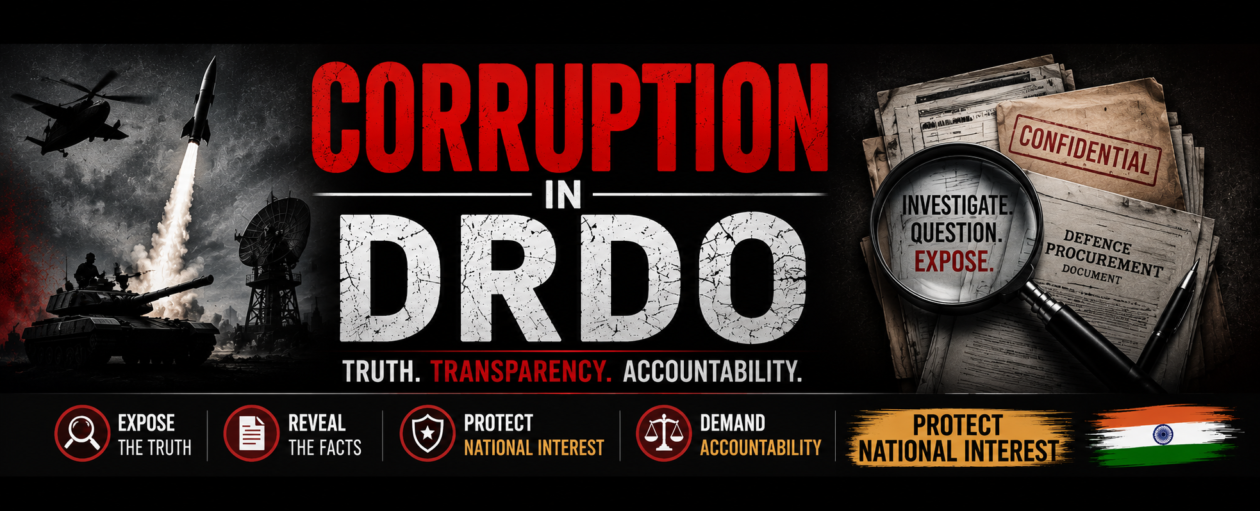
Following Mails I have received from Sh KR RAVINDRANATHAN, Sc F, RCMA. Dear friends I am against the corrupt practices in DRDO not against any individual, the matter has to decide by competent authorities.

regards
prabhu dandriyal


Ravindranathan K.R. <ravikr99@yahoo.com>
reply-to: “Ravindranathan K.R.” <ravikr99@yahoo.com>
to: “prabhudoon@gmail.com” <prabhudoon@gmail.com>
date: Mon, Aug 18, 2014 at 11:43 AM
subject: prabhudoon@gmail.com

Respected Sir
This is with reference to the news item regarding my TD claim to SAMEER Chennai
IT is clarified that it was a typographhical error while totaling I forgot to half the value
and there is no intention to make the false claims etc as alleged in your website, I my self very much upset y the oversight and rectified the claims immedialy for inadvertent error I have also halved the train fare claimed in question but forgot to do so before submitting due to urgent works.
SO Please understand this situation and the oversight happened inadvertently. I have never ever made such mistake till date.
SO please remove that allegations as the matter has been clarified to the authorities concerned sir.
Once again I request you to understand my pain and anguish due to bad publicity.
Requesting you to do the needful.
KR RAVINDRANATHAN

Kelakote Ravindranathan <ravikr99@gmail.com>
to: prabhudoon@gmail.com
date: Mon, Aug 18, 2014 at 12:24 PM
subject: REGARDING TA/DA CLAIM

DEAR SIR
AS EXPLAINED NO SUCH CLAIM HAS BEEN PREFERRED IT WAS AN INADVERTENT ERROR OCCUR DUE TO OVERSIGHT AND FAILING TO HALF THE AMOUNT LIKE I DID IN THE TRAIN FARE SO KINDLY UNDERSTAND MY SITUATION
BILL HAS NOT BEEN CLAIMED IT HAS BEEN ALREADY RECTIFIED AND SUBMITTED
SO NO FALSE CLAIMS AS PROJECTED REQUEST TO CORRECT THE POSITION IMMEDIATELY SIR \
RAVINDRANATHAN KR

Kelakote Ravindranathan <ravikr99@gmail.com>
to: Prabhu Dandriyal <prabhudoon@gmail.com>
date: Mon, Aug 18, 2014 at 1:29 PM
subject: TA DA Claims

This is with respect to the half and twisted information sent to you regarding a TA DA claims of Myself as already expalined there has been a genuine clerical mistake and this has been immediately rectified by me please see the attached file
So once again I request you not to blow the issue out of proportion and cause undue harm to my reputation and career it would be very very unfair sir.
Matter has been accepted and cloased by department long back and bills have been resubmitted after correction.
RAVINDRANATHAN KR

From Confidential
K R RAVINDRANATHAN
SC F RCMA Hyderabad

To
REGIONAL DIRECTOR
RCMA Hyderabad
Hyderabad
25/7/2014
Sub : TA /DA Adjustment Bill—Clarification regarding

Respected Sir,
Reference is made your letter no RCMA(Hyd)/602/ADMIN dated 15/07/2014.
With reference to the TA/DA Adjustment it is admitted that a clerical mistake has occurred in not reducing the Air FARE value by half (as applicable) due to fact I had forgotten to half the value while taking the print although I had kept in mind to do so. There is no intend whatsoever for excess claim as i had cut the train fares also. The passenger (spouse) could not travel due to sudden development of chicken pox of my son and had to stay back and as I did not have time to re-issue the ticket used the same old ticket. While claiming i wanted to remove one name and cut the AMOUNT by half i.e. Rs. 3850 but forgot to do the second action inadvertently due to technical activities and other family tensions at that point in time resulting in the error.
Kindly excuse for my genuine memory lapse and permit me to re-submit the revised/rectified bill as the bill has not yet cleared for settlement.
Error in the bills happened inadvertently and inconveniences if any, is regretted.
Thanking you,
Sd \{ K R RAVINDRANATHAN SC F }

Kargil Vijay Diwas: What DRDO have learnt 15 years after the Kargil war?

What about SDR after DEAL’s Director Sh RC Agarwal’s second extension , Aditya after second PDC extension, not even static target fire achieved, in last 15 years corruption in DRDO increased 15 fold ?????????

Couldn’t get key radars before Kargil due to DRDO, says Malik

New Delhi, September 6 The Tribune, Chandigarh
Former Army chief VP Malik, who led the army during the 1999 Kargil war, has said casualties in the conflict could have been reduced had DRDO “not come in the way” in the acquisition of weapon-locating radars.

“We had one or two incidents particularly on the weapon-locating radar. If the DRDO had not come in the way we would have got them before the Kargil war and that would have definitely reduced our casualties,” he told Karan Thapar on Devil’s Advocate programme on CNN-IBN.

Asked whether DRDO was “slight boastful” in claims over developing weapons, Malik said, “Well that has been our (armed forces’) experience over the development of weapons and equipment the DRDO has delivered or not delivered.”

On whether APJ Abdul Kalam, during his stint as the Director-General of the DRDO, overestimated the country’s capacity and ability, Malik merely said. “I do not want to go more into that.”

Amid claims by some scientists that Pokhran-II in 1998 was not a complete success, Malik says armed forces were “affected” by doubts over its efficacy and need to be “reassured” by the nuclear establishment on the exact yield of the atomic tests. Malik also said the statement by former president APJ Abdul Kalam, the DRDO chief when India exploded the bombs in 1998, rubbishing the claims of his colleague and defence scientist Dr K Santhanam, was “unconvincing.”

Santhanam said the tests were a fizzle, which were rejected by Kalam, who said Pokhran-II was a complete success. “They (armed forces) need to be reassured about the weapon system they use and about the planning of what kind of the yield they have when they hit the target,” said Malik. He dubbed as shocking the recent comments of Santhanam, questioning the yield of the thermonuclear device tested on May 11, 1998. “Yes, it affects the armed forces. Particularly, because, when they plan the task given to them then they have to know what kind of yield that each nuclear weapon has,” he said, stressing that it was important to remove doubts.

“Let us not forget that Dr Santhanam was part of his (Kalam’s) team. And it came as quite a shock with Dr Santhanam himself mentioning that it was a fizzle. Of course, again he was referring to the thermonuclear weapon. So, Dr Kalam’s statement was not quite convincing,” he said. Malik said the team of scientists led by then chairman of the Atomic Energy commission R Chidambaram should reassure the armed forces on the yield of the weapons. — PTI

‘Death Of The Internet As We Know It’ – Outlook BY SUNDEEP DOUGAL ON DEC 15, 2011 AT 22:55 IST

http://blogs.outlookindia.com/default.aspx?ddm=10&pid=2673

SUNDEEP DOUGAL

‘Death Of The Internet As We Know It’

In their various pronouncements since the censorship controversy broke, Mr Kapil Sibal and Mr Sachin Pilot, the minister and minister of state respectively in the ministry of communications and information technology, have been vocally insisting that the government does not want to resort to censorship and believes in the constitutional right of free speech.

These pieties were once again repeated today by the two ministers after meeting representatives of social media companies, including Google, Facebook and Twitter, for what is now being spun as an “open dialogue to empower individuals and citizens” while reliable sources also reveal that their ministry “is mulling forming an inter-ministerial group to work out a mechanism to monitor and avoid uploading of any defamatory material on Internet.”

At the Centre for Internet and Society (CIS) blog, Pranesh Prakash points to the government’s patent insincerity because this sudden talk of ‘transparency’ and ‘dialogue’ came only after it was exposed in the press that the Department of Information Technology was holding secret talks with Internet companies.

He also underlines the clandestine manner in which the government wants Internet companies to ‘self-regulate’ user-uploaded content. One of the reasons for this arm-twisting is to prevent the sort of embarrassment caused by the Google Transparency Report which had demolished the government claims of wanting to curb “hate speech” or that affecting “religious sensitivities” as it tabulated that out that as many as 255 (71%) of the 358 complaints made to Google in the last six months, were about ‘government criticism’ and only 8, or 2.23% were about “hate speech”.

With self-censorship, there would be no need for these requests for removal in the first place, nor will sites have to be blocked officially using the IT Act.

In the article we carried yesterday, Who Plays Judge, Nikhil Pahwa of Medianama provided a reasonable hypothesis about Mr Kapil Sibal’s recent actions:

one of my fears is that something as draconian as pre-censorship may actually be used to make the IT Rules look justifiable, like something of a rollback. People will be furious about suggestions to pre-censor the web, but in comparison, perhaps be willing to accept arbitrary and opaque post-censorship, which is what the the IT Rules allow. The IT Rules need to be amended as well.

The CIS blog by Pranesh Prakash once again underlines what is wrong with these rules:

These rules, which were made by the Department of Information Technology and not by the Parliament, require that all intermediaries remove content that is ‘disparaging’, ‘relating to… gambling’, ‘harm minors in any way’, to which the user ‘does not have rights’.  When was the last time you checked wither you had ‘rights’ to a joke before forwarding it?  Did you share a Twitter message containing the term “#IdiotKapilSibal”, as thousands of people did a few days ago?  Well, that is ‘disparaging’, and Twitter is required by the new law to block all such content.  The government of Sikkim can run advertisements for its PlayWin lottery in newspapers, but under the new law it cannot do so online.  As you can see, through these ridiculous examples, the Intermediary Guidelines are very badly thought-out and their drafting is even worse.  Worst of all, they are unconstitutional, as they put limits on freedom of speech that contravene Article 19(1)(a) and 19(2) of the Constitution, and do so in a manner that lacks any semblance of due process and fairness.

CIs’s draft report on the Intermediary Liability in India: Chilling Effects on Free Expression on the Internet 2011 looks at these rules critically. For the purposes of this study, takedown notices were sent to a sample comprising of 7 intermediaries and their response to the notices was documented.

The results of the paper clearly demonstrate that the Rules indeed have a chilling effect on free expression. Specifically, the Rules create uncertainty in the criteria and procedure for administering the takedown thereby inducing the intermediary to err on the side of caution and over-comply with takedown notices to suppress legitimate expressions. Additionally, the Rules do not establish sufficient safeguards to prevent misuse and abuse of the takedown process to suppress legitimate expressions.

Of the 7 intermediaries to which takedown notices were sent, 6 intermediaries over-complied with the notices, despite the apparent flaws in them. From the responses to the takedown notices, it can be reasonably presumed that not all intermediaries have sufficient legal competence or resources to deliberate on the legality of an expression. Even if such intermediary has sufficient legal competence, it has a tendency to prioritise the allocation of legal resources according to its perceived importance of the expressions.

Further, if such subjective determination is required to be done in a limited timeframe and in the absence of adequate facts and circumstances, the intermediary mechanically complies (without application of mind) with the takedown notice.

The results also demonstrate that the Rules are procedurally flawed as they ignore all elements of natural justice. The third party provider of information whose expression is censored is not informed about the takedown, let alone given an opportunity to be heard before or after the takedown. There is no recourse for the third party provider of information to have the removed information restored or put back if it does come to his knowledge. The intermediary is under no obligation to provide a reasoned decision for rejecting or accepting a takedown notice. There is also no requirement for disclosure or transparency in the takedown process.

These Rules and all this recent talk of ‘self-regulation’ are of a piece with the government’s overall paranoia of the power of the internet and various whistleblower websites that are coming up (eg, consider the recent case involvingcorruptionindrdo.com). Because there are constitutional safe-guards against censorship, surreptitious measures are being adopted in a number of ways. As Prakash points out:

Mr. Sibal’s latest proposed amendment to the Copyright Act, which is before the Rajya Sabha right now, has a provision called section 52(1)(c) by which anyone can send a notice complaining about infringement of his copyright.  The Internet company will have to remove the content immediately without question, even if the notice is false or malicious.  The sender of false or malicious notices is not penalized. But the Internet company will be penalized if it doesn’t remove the content that has been complained about.  The complaint need not even be shown to be true before the content is removed.  Indeed, anyone can complain about any content, without even having to show that they own the rights to that content.  The government seems to be keen to have the power to remove content from the Internet without following any ‘due process’ or fair procedure.  Indeed, it not only wants to give itself this power, but it is keen on giving all individuals this power.

POSTED BY SUNDEEP ON DEC 15, 2011 AT 22:55 IST