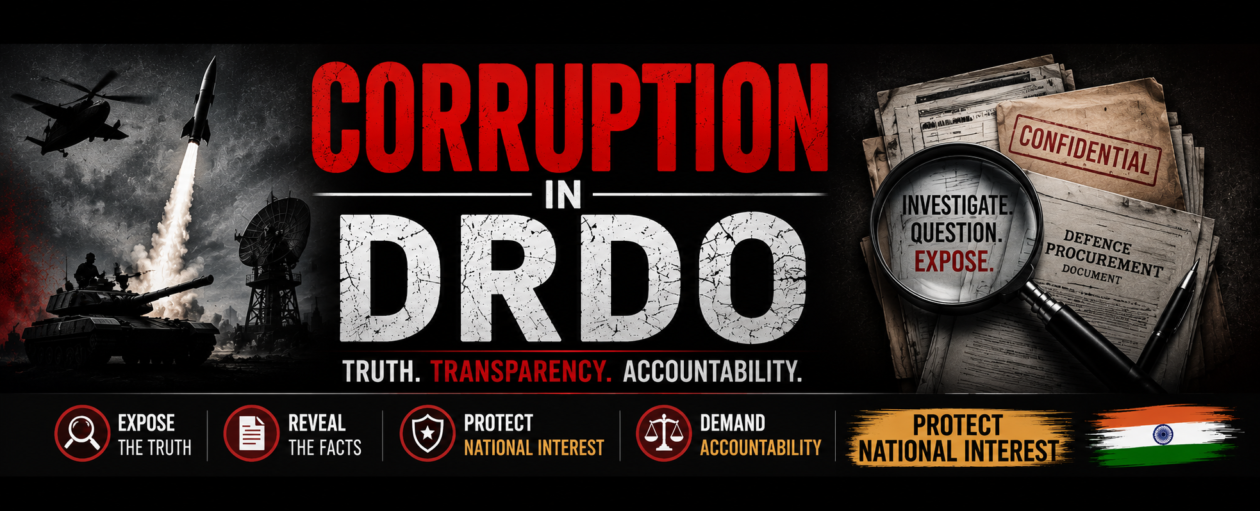
Tag Archives: CAG

Misuse of the financial powers by the DRDO officers / Scientist. Can you fix accountability & responsibility for recovery?

Dated : 12-06-12

From-                                                                                                                                             Rajiv Chauhan;                                                                                                            1053/3,Shastri nagar,Meerut(U.P)                                                                09412628314;09258045938;

To,                                                                                                                                             Hon’ble  Defence Minister;                                                                                                     Govt.of India,  New Delhi,


Subject :   Misuse of the financial powers by the DRDO officers / Scientist. Can you fix accountability & responsibility for recovery?

Respected Sir,

CAG reports clearly is showing the financial losses by the DRDO officers / Scientists in different projects as attached for your perusal. Head of the department of the DRDO failed to fix the accountability & responsibility for these losses. Can you fix it for recovery?

I am unable to understand that why Head of the DRDO fail to fix the accountability & responsibility for these Billions losses which is clearly indication of the misuse of DRDO office and financial powers. A high level corruption after pecuniary arrangement is possible.

I will be highly obliged for your kind consideration and necessary action to fix the accountability & responsibility for recovery.

With high regards,

Your,  Sincerely.


ACA(Rajiv Chauhan)

COPY TO THE :   1- Hon’ble President of India for kind consideration and necessary action.

2- Hon’ble Prime minister of India for kind consideration and necessary action.

3- Director, CBI, New Delhi  for kind consideration and necessary action.


(Rajiv Chauhan)


CAG Report on DRDO

No.12 of 2010-11 (Defence Services)


CHAPTER VI :

DEFENCE RESEARCH AND DEVELOPMENT ORGANISATION

6.1 Injudicious creation of assets

An expenditure of Rs 8.92 crore incurred by Defence Research and Development Organisation (DRDO) for creation of assets to draw power from a power supply corporation became infructuous due to DRDO’s failure to assess the corporation’s ability to supply stable and uninterrupted power required for operation of highly sensitive equipment and machines.

DRDO imported various sensitive equipment and machines for creation of technical facilities for a programme of strategic importance at a station. These facilities required uninterrupted and high quality stable power supply. Based on the recommendations of a Board of Officers, Ministry of Defence accorded sanction in March 2000, as amended in December 2001, for provision of external electrification at the station at a total cost of Rs 9.54 crore, to be executed by a Chief Construction Engineer, Research and Development (CCE R&D). The CCE R&D completed the works for power

supply receiving and distribution to each of the sites within the station, under the supervision of the State Power Supply Corporation, in November 2001 at a cost of Rs 9.15 crore including expenditure of Rs 0.23 crore for power distribution to living accommodation. The corporation had agreed to supply 4500 KVA of power, in a phased manner, as sought by DRDO. However, before creating the assets for drawing power from the corporation, DRDO did not get firm assurance from the Power Corporation for supply of the quality of power required by DRDO for operation of the sensitive

equipment/machines of the programme. Due to excessive variations in voltage/ frequency/current in the power supplied by the corporation, the imported equipment procured under the programme did not function properly. This along with frequent interruption in power supply forced DRDO to procure DG Sets, separately at a cost of Rs 3.57 crore for the facility. Only the living/ administrative accommodation which required meager quantity of power could use the power received from the corporation. The contract demand was therefore reduced from 4500 KVA to 600 KVA by September

2004 for the day to day operation of the site and other technical facilities including the living/administrative accommodation. Further, a sum of Rs 1.80 crore was spent during 2002-09 for maintenance of the 66 KV line and associated facilities to avoid deterioration. Thus the expenditure incurred on establishing a sub station to support the 66 KV line was rendered infructuous. The Ministry admitted in September 2009 that DRDO had relied upon the State owned power corporation to adhere strictly to the quality specifications as laid down in the Indian Electricity Rules 1956, which they didn’t do.                                                                                     

TheMinistry also stated that such a complex technical facility, which is of strategic importance to nation’s security, was being established for the first time in the country and DRDO could learn its complex requirements from this experience and argued that the expenditure should not be treated as wasteful as the experience learned from this project was utilized in the next project where they did not seek the provision of electricity from state Electricity Board and had commissioned required DG sets directly. The Ministry added in February 2010 that a new Radar system planned for Air Force requirement would be assembled at the station in a period of two to three years and there would

therefore be higher usage of the substation in the future. The Ministry’s statement about the likely utilization of the assets when the planned radar system for the Air Force comes up in the next two-three years does not validate the creation of the assets in the year 2001 and keeping them idle for over a decade. Thus, the failure of DRDO to assess the ability of state power corporation to supply to the required specifications for operation of sensitive equipmentresulted in an infructuous expenditure of Rs 8.92 crore, besides burdeningitself with a recurring liability of maintaining the redundant assets

6.2 Loss due to damage to imported equipment DRDO suffered a loss of Rs 6.91 crore as an imported equipment was damaged due to mishandling by the Air Consolidation Agent.

The Director of a Defence R&D Laboratory placed purchase order on a UK based firm in October 2006 for a machine required for a project at a cost of Rs 18.46 crore. As per terms of the purchase order, 70 per cent payment (Rs 12.23 crore) was made to the firm on shipment of the machine. Remaining 20 per cent of the amount was to be paid after installation and 10 per cent after the end of the warranty period. The machine was to be delivered by end of July 2007 at the laboratory premises through an Air Consolidation Agent (ACA)17 having Air Consolidation Contract with the Defence Research and Development Organisation (DRDO). As per terms and conditions of the contract, the ACA was responsible for all losses or damages to the equipment due to any cause whatsoever from the time they receive the shipment till delivery at consignee’s end. It was also stipulated in the contract that in case of losses to stores occasioned on account of Agent’s negligence, the amount spent on account of ACAs negligence will be recovered from the Agent’s pending bills. The machine arrived at Delhi Airport on 8 August 2007 and was locally transported by the ACA on 9 August 2007. One package consisting of the main equipment of heavy weight and size was damaged as it fell down while unloading at the laboratory premises due to mishandling for which the ACA was responsible. 17 M/s Balmer  Lawrie and Company Limited: responsible for Air Consolidation Services, custom clearance and carrying of machine/stores being imported by DRDO Laboratories.

The Court of Inquiry (COI) constituted by the Director of the laboratory, to assess the loss and circumstances leading to damage found that the damage to the equipment was caused by the ACA while unloading. It was also revealed that the machinery and tools used by ACA while unloading were insufficient. The COI further recommended that pending settlement of the claim for liability of loss, the damaged component be got replaced from the supplying firm. Accordingly, the Director of the laboratory placed order on the same firm in January 2009 for supply of a new equipment for replacing the damaged one at a cost of Euro 960,000 (Rs 6.21 crore) excluding customs duty of Rs 0.70 crore which was to be paid by the Laboratory separately. The equipment was to be delivered by October 2009. Audit observed that despite contractual obligations, the laboratory did not raise any claim for the loss against the ACA though on behalf of the laboratory the ACA had lodged a claim of Rs 9.04 crore in February 2008 with the Insurance Company. The Insurance claim had however, not been finalized by the Insurance Company as of October 2009. The case reveals that DRDO has not only lost time but also suffered a loss of Rs 6.91 crore on account of damage to the equipment due to mishandling by ACA, which was yet to be made good as of October 2009 for which even the

claim has not raised against the transporting agency. In their reply of October 2009, the Ministry stated that they were making best efforts to recover the money to make good the loss. 

6.3 Avoidable expenditure due to poor planning of a work service Poor planning of a work service by the Programme Director and Chief Construction Engineer, led to an additional expenditure of Rs 1.39 crore towards payment of compensation to the contractor.

In January 2006, Chief Construction Engineer (CCE) Research & Development (R&D) Secunderabad entered into a contract with a firm for construction of accommodation for System and Test Integration RIG (STIR) at the cost of Rs 18.78 crore, to be completed by July 2007. A Board of Officers had earlier assembled in May 2005 to consider the requirement of work services for STIR of a Defence Research and Development Programme at Bangalore and recommended construction of the facility on top priority and also that the work relating to the shifting of 66 KV power (HT) line running right through the middle of the selected site, be taken up and executed separately to facilitate the construction. The Programme Director (PD), STIR was to make the site available to the contractor within four weeks of conclusion of the contract. However, action was not taken by the PD to get the HT line shifted. In March 2006, the PD and CCE decided that the work for shifting the line would be executed through the CCE. As clear work front was not made available to the contractor for eight months after the award of work in January 2006 the contractor could not proceed with the work. The CCE concluded a separate contract in June 2006 with the same contractor for shifting the line and got it completed in October 2006. The CCE granted extension of time for completion of work from July 2007 to March 2008. Against a compensation of Rs 3.67 crore claimed by the contractor to offset the expenditure incurred on idle machinery/manpower and increase in cost of material/labour due to the delay in commencement of work, DRDO had to pay an extra-contractual amount of Rs 1.39 crore. On being pointed out, the CCE informed Audit in November 2007 that it was initially planned that the programme authorities would shift the HT line and make the site available for construction. The task was later transferred to CCE only in June 2006. After transferring the responsibility, the CCE concluded the contract in June 2006 without further loss of time for shifting the HT line. These statements of CCE were not totally correct as in March 2006 itself, the

PD and the CCE had decided that the shifting of HT line would be undertaken by the CCE. However, the CCE took another three months to award the contract for shifting the HT line. Thus due to poor planning of the work services by the PD and the CCE and their failure to ensure shifting of HT line before award of the contract for the work services resulted in an avoidable payment of Rs 1.39 crore to the contractor, besides delaying execution of the work. The case needs to be investigated so as to fix responsibility for the lapse. The Ministry stated in January 2010 that partially clear site was made

available to the contractor and the work on piling was commenced on date in the areas/locations other than 66 KV HT line shadow. It was further stated that delay of eight months was beyond the control of DRDO. The facts, however, remain that the contractor could not progress with the work for eight months due to non-shifting of HT line for which additional payment of Rs 1.39 crore had to be made to the contractor, which could have been avoided had the HT line been shifted in advance.

6.4 Loss due to lack of coordination in procurement of a life saving item An expenditure of Rs 93.09 lakh incurred on procurement of drugs proved infructuous as the drugs could not be issued to users within their shelf life. Although the life saving item was accepted in September 2004 for use in the Army, it remained undistributed for nearly five years predominantly due to the lack of coordination between the developer and the user.

The Autoject Injector (AJI) set consisting of two individual autoject injectors, one containing Atropine Sulphate and the other containing PAM Chloride was developed by Defence Research and Development Establishment, Gwalior (DRDE) of Defence Research and Development Organisation (DRDO) to treat and counteract nerve agents poisoning. On exposure to nerve agents, these are to be used by individuals for immediate treatment by self administered injection. Based on the requirement projected by Army HQ, the Ministry of Defence (MOD) issued sanction in September 2004 for production and supply of Autoject Injectors along with equal number of Atropine Sulphate and PAM

Chloride drug through DRDO. The sanction stipulated that the terms of supply of equipment would be determined and monitored by Army HQ/MOD in consultation with DRDO. DRDE procured from private sector firms 32,400 AJI for injecting Atropine Sulphate and 32,400 AJI for PAM Chloride along with 33,000 each of Atropine Sulphate drug cartridges and PAM Chloride drug cartridges at a cost of Rs. 2.80 crore, of which Rs 93.09 lakh was for the drug cartridges. Shelf life of AJIs was five years, that of Atropine Sulphate drug was two years, and it was only one year for PAM Chloride drug. The AJI and drug Cartridges were received during May/December 2005 and September 2005/January 2006 respectively. However, Army HQ did not intimate the consignee details to DRDE. In response to a request by DRDE, Army HQ (Additional Director General Weapons and Equipment) advised them in February 2006 to obtain consignee details from Dy. Director General Perspective Planning (Nuclear Biological and Chemical Warfare) and to deliver the consignments only after the items were duly inspected and certified fit in all respects by the representatives of the users. In the Joint Inspection, which was not attended by the user’s representative, held in April 2006 it was found that 25700 AJIs of Atropine Sulphate and 27,689 AJIs of PAM Chloride were acceptable. The remaining were defective and therefore rejected. The date of expiry of the drug PAM Chloride varied from June 2006 to October 2006 and that of the Atropine Sulphate varied from May 2007 to October 2007. In view of the early expiry of the drugs, the Joint inspection team recommended that process be initiated to replenish the drug cartridges. DRDE informed Army HQ in April 2006 about the acceptance in inspection of AJIs and sought consignee details. In July 2006, Army HQ asked DRDO HQ to send these to the Central Ordnance Depot Kandivli. Army HQ simultaneously informed DRDO HQ that the drug cartridges of PAM Chloride with balance shelf life of less than 75 per cent and Atropine Sulphate with shelf life expiring before 01 October 2007 should be replaced. In July 2006, DRDE issued 25,000 AJIs along with drug cartridges to Armed Forces Medical Store Depot Mumbai as later advised by Army HQ. However, the supplied stores could not be used due to non-availability of adequate shelf life of drug cartridges. DRDE placed supply orders for 8000 each of for AJI (Atropine Sulphate and PAM Chloride) and drug Cartridge 33000 each at a cost of Rs 0.12 crore and at a cost of Rs 1.35 crore respectively. Joint inspection was carried out for Atropine Sulphate and PAM Chloride drug cartridge received between July and September 2008. However, these were rejected by DGQA in October 2008 due to detection of butyl fragments in the injected content of drug, less injection of drug than the stipulated therapeutic dose making it ineffective and weak plastic bodies of reusable injectors. Army HQ in June 2009 formed a study group to analyse the complex issue in its totality. Based on the recommendations of the Study Group suggestions of Director General Armed Forces Medical Services and reassurance of DRDO about the efficacy of the drugs, Army HQ agreed to accept the AJIs and the drugs in their present condition for use during emergencies only, with the condition that DRDE would develop improved version at the earliest. The overriding consideration for the acceptance of the AJI/drug was that the advantage of the AJI outweighed the potential risks associated with the deficiencies pointed out by DGQA in October 2008. The Ministry of Defence stated in November 2009 that there was no loss since the Army had accepted the AJIs and drugs. The fact remains that the procurement of drug cartridges at a cost of Rs 93.09 lakh during 2005-06 was clearly a loss since their shelf life expired before the AJIs were accepted for use by the Army. Although the sanction issued by the Ministry in September 2004 stipulated that the terms of supply of equipment would be determined and monitored by Army HQ/MOD in consultation with DRDO, the above events are symptoms of lack of coordination and understanding among DRDO HQ, Army HQ and DRDE. Resultantly, the AJIs and their drugs developed for use in emergencies as life saving items remained without any use for nearly five years with associated financial repercussions such as loss on account of expiry of their shelf life. The case points to the need for a better coordination and communication between the associated agencies

to accomplish value for money and the Research and Development efforts. 

  No. 24 of 2011-12 (Defence Services)

6.1 Blockage of public money due to take over of unusable land Imprudent decision to acquire forest land by DRDO at a cost of ` 73.26 crore which could not be used for other than forest purpose not only delayed the completion of project but also blocked Government money

as land was not used for the project.

The Ministry of Defence in June 2003 sanctioned a project for ‘Development of Vehicle Mounted energy System’ by Defence Research and Development Organisation (DRDO) at a cost of ` 97.40 crore. The project was to be completed by June 2010. An ‘Integration and Test Facility’ was to be created under the project in a vast area of approximately 700 acres of land for testing purpose.DRDO initiated action in February 2004 for acquisition of 700 acres of land at Faridabad for the facility. The requirement was increased to 1100 acres in August 2005. The identified land belonging to Faridabad Municipal Corporation was covered under the Forest Conservation Act, 1980 and notifiedas such by Haryana Government in August 1992 under Section 4 of Punjab Land Preservation Act, 1900 (PLPA) which prohibited erection of buildings on the land. DRDO enquired from the Conservator of Forests, Haryana regarding the formalities to be completed for diversion of forest land for nonforest use and compensatory afforestation charges to be paid under Forest Conservation Act, 1980. Conservator of Forests, Haryana informed in November 2005 that out of the total 1104 acre of proposed land, 1091 acres of land was forest land. He also informed that Hon’ble Supreme Court in its order dated 18.3.2004 clarified that land notified under Section 4 & 5 of PLPA 1900 would be treated as forest and diversion of this land for non-forestry use would invoke Forest Conservation Act, 1980 under which this land cannot be put to use for nonforestry purpose without obtaining permission from the Government of India. Despite this, the Haryana Government in August 2006 on reconsideration offered 1100 acres of Forest land at Faridabad to the DRDO at the rate of ` 18 lakh per acre. DRDO in May 2007 reduced their requirement to 407 acres of land. In July 2007, the Commissioner, Faridabad Municipal Corporation informed DRDO that the Haryana Government had approved the proposal for allotment of 407 acres land at the rate of ` 18 lakh per acre to DRDO on the condition that DRDO will take necessary action for de-notification of land from the purview of PLPA 1900 from the Forest Department. Pending clearance of Forest Department, DRDO paid ` 73.26 crore in three instalments from October 2007 to April 2008 to State Government and took possession of land in April 2008. In June 2008 the Forest Department, Haryana informed DRDO to seek prior permission of Central Empowered Committee (CEC) for use of land. On an application filed by M/s R.D. Consultants on behalf of DRDO for seeking permission for non-forestry use of 407 acres of land allotted to the DRDO, the CEC filed a report in August 2009 in Hon’ble Supreme Court in pursuant to the Hon’ble Court order. The CEC recommended that the permission for use of land for setting up of the Centre by the DRDO may not be accepted. CEC also recommended that an alternative site jointly identified by the DRDO with Haryana Government may be used by DRDO and State Government should take immediate steps for acquiring the alternative identified land. However DRDO is yet to get the alternative land. Meanwhile, the Apex Review Board for the Project in December 2008 directed to use Terminal Ballistics Research Laboratory (TBRL) Ramgarh range by creating infrastructure at a cost of ` 38 crore, as Faridabad test range was not ready. The PDC of the main project was extended from June 2010 to June 2013. DRDO HQ stated that the test range to test the system was planned at Faridabad but the acquired land could not be utilized in view of non-clearance by CEC. TBRL Ramgarh has been identified as alternative site and development cost on this land for carrying out permanent facility for testing would be around ` 38 crore for which sanction was under process as of April 2010. The fact that subject land was under Punjab Land Preservation Act, and also that Supreme Court judgement prohibited use of forest land for non-forest purpose was well known. Hence decision of DRDO to acquire the subject land from State Government which could not be used for creating facility as CEC refused permission to use the land for other than forest purpose was imprudent and resulted in blockage of Government money to the tune of ` 73.26 crore. The Ministry stated in December 2010 that with the past experience, DRDO was confident and sure to get forest clearance for carrying out construction on the said land. But case for diversion for non-forest use was not accepted by the CEC as the area falls in the catchment area of two lakes posing serious environmental impact on ground water and flow of water to lake and Aravalli range. The case for refund of ` 73.26 crore had already been recommended by CEC and forwarded to Hon’ble Supreme Court of India on 22 September 2010. The fact, however, is that an amount of ` 73.26 crore paid from Defence Grants during October 2007 – April 2008 remained blocked with the State Government and this could have been avoided had the DRDO examined the likely legal implications beforehand.

6.2 Procurement/receipt of equipments after the closure or at the fag end of a project Defence Materials and Stores Research & Development Establishment (DMSRDE) procured equipments worth ` 1.52 crore after technical completion of the project or at the fag end of a project. The project was completed with the facilities available in DMSRDE and other Labs implying that the procurement was avoidable.

Ministry of Defence in February 2005 sanctioned a project on “Development of New Generation Polymers” (DRM 546) at an estimated cost of ` 8.50 crore for completion by February 2010. The project was technically completed in December 2009 and closure report was submitted in February 2010 with completion cost of ` 6.13 crore which included procurement of machinery and equipments worth ` 2.83 crore. Audit scrutiny indicated that the DMSRDE procured/received equipments worth ` 1.15 crore after technical completion of the project, i.e. December 2009 and equipment worth ` 0.37 crore at the fag end of the project. This was in contravention of DRDO Headquarters instructions to DMSRDE Kanpur in October 2004 to procure equipments at least six months before probable date of completion of the project to utilise these for production of some data or results which was expected from them. The time taken in procurement of five equipment i.e. from user demand to supply order ranged from 72 weeks to 142 weeks against the prescribed time of 26 weeks stipulated in Defence Procurement Manual 2005. In response to the audit query DMSRDE clarified that the facilities available in the Lab (DMSRDE), IIT Kanpur and other R&D Labs were used for the project and hence the project could be completed without the equipments. The said equipments procured under the project were being utilised even after the completion of the project for other ongoing projects and are essential for future projects. The Ministry in reply stated that most of the procurement delay in these specific cases were circumstantial, viz couple of cases were refloated twice, cases converting to resultant single tenders etc. These are the basic equipments having life span of around 15 years required for regular research work and were being utilised even after completion of the project. The value for money was partially achieved during the project. In order to overcome delays in procurement, a new schedule of delegation of financial power was issued in

July 2010 which had bestowed higher power for procurement for the project Directors/Lab Directors. The fact that equipments can be used for regular R&D activities being basic equipment is no justification to procure them for this project after it was completed. It could be procured from build up grant when required. It would appear that the cost estimates for the project was highly exaggerated as the project could be completed even without equipments worth `1.52 crore. Toovercome abnormal delay in procurement, inherent weakness in the system of procurement also needs to be looked into. 

6.3 Development of a Modular Bridge below requisite specification Non execution of Project for Modular Bridge on specification recommended in statement of case based on which sanction was accorded resulted in wastage of assets created for ` 21.46 crore as users did not accept the bridge.

A feasibility study on Modular Bridge was carried out by Defence Research and Development Establishment (Engineers) (R&DE) (E) in August 2002. The study was based on the requirement projected by Army in General Staff Policy Statement (GSPS) of 1993. The salient feature of the bridge was single span up to 46 metre with Military Load Class 70 (MLC 70). Based on the recommendations given in statement of case for Modular Bridge 46 metre with MLC 70, the Ministry of Defence accorded sanction in October 2002 for execution of the project at a total cost ` 24.25 crore. The work was to be completed by R&DE(E) within 4 years from the date of allotment of project i.e. by October 2006. In May 2006, R&DE (E) sought extension of probable date of completion (PDC) of the project by two years, i.e. up to October 2008 due to technical difficulty in execution. Ministry accorded sanction for extension up to October 2008. In October 2007, the R&DE(E), against the 46 metre span and MLC 70 bridge, submitted Trial Report to Defence Research & Development Organisation Headquarters (DRDO) for 20 metre bridge with 40 MLC, which was not acceptable to the users and as such in March 2008 E-in-C Branch requested Directorate of Interaction with Services for Business (DISB) of DRDO HQ to accept proposal of 10 Modular Bridge ‘Buy Global’ at a cost of ` 600 crore to fill the operational voids as R&DE(E) had not developed requisite specification Bridge. Again the PDC of the project was revised in two spells upto December 2009.During this time the R&DE (E) developed 40 metre MLC 70 Modular Bridgenand technical trials were held from January 2008 to December 2009 and the bridge was found ready for traffic but the user requirement of 46 metre MLC 70 was not fulfilled. R&DE (E) confirmed that know how developed for Modular Bridge would be useful in future development. In March 2010 R&DE(E) submitted Closure Report of the project to DRDO HQ and closed the project after having incurred an expenditure of ` 21.46 crore with the proposal to develop a 46 metre MLC 70 bridge to meet the requirement of General Staff Qualitative Requirement (GSQR) issued in September 2007. Hence, another project was sanctioned in January 2010 at a cost of ` 13.25 crore to develop 46 metre MLC 70 Bridge which is to be completed by July 2012. Thus, instead of adhering to the specification given in the feasibility study for Modular Bridge upto 46 metre MLC 70, R&DE (E) Pune developed Modular Bridge of 40 metre MLC 70 which was not required by users. The end result of development of Modular Bridge at 40 metre MLC 70 was that after incurring expenditure of ` 17.89 crore excluding cost of five carrier vehicles being used in next project, the requirement of the user could not be served. In February 2011 Ministry stated that as per feasibility study report the modular bridge was projected for MLC-70. But later on it was changed to MLC-40 on user requirement during quarterly interaction meeting held in August 2002 and clarification made by user in December 2002. The bridge can also take MLC-70 loads upto 40 M. Since the system was to be developed on an in-service high mobility vehicle which was tatra 8×8 at that time, only MLC-40 was possible due to counter weight problems during launching. While the development of MLC-40 was at an advanced stage the requirement of 46 M MLC 70 was projected in the final GSQR issued in June 2007. In the meantime tatra 10×10 vehicle got introduced in the services and DRDO is confident to develop 46 M MLC 70 system on tatra 10×10. After seeking clarification on this issue from user (E-in-C) it was stated that their requirement stands for 46 M MLC 70 but load class of bridge for spans of 46M to be MLC-40 and MLC- 70 upto span of 38 M may be possible because of technology limitation. Ministry’s reply and user clarification, both expressed limitation of technology for development of bridge 46M MLC-70. The details of the case, Ministry’s reply and clarification given by users reveal the fact that both the user and DRDO were aware that the bridge was being built for 40 M MLC 70 /46M MLC 40. Further DRDO had its limitations for construction of bridge 46 M MLC-70. Even though both the user and the designer were aware of the limitations of the project, neither of them took the initiative to foreclose the project. As a result even after incurring government expenditure of ` 17.89 crore, excluding cost of carrier vehicles to be used in next project, the users requirement of modular bridge after lapse of nine years remains unfulfilled.


The Missile that Cannot Fire – Long delays, cost escalation damage DRDO’s reputation

Amarnath K, Menon and  Gaurav C. Sawant – April 13, 2012 – India Today 

The Defence Research and Development Organisation (DRDO) was set up in 1958 with a vision to “provide our defence services a decisive edge by equipping them with internationally competitive systems and solutions”. The DRDO has clearly failed in its mission.

There is no bigger indictment of India‘s premier organisation for research and development in military hardware than the fact that 54 years after its establishment, India still imports 70 per cent of its equipment requirements. In 1997, India best known defence bureaucrat and the then scientific adviser to defence minister, APJ Abdul Kalam, had said that India should bring the hare of imports in defence equipment purchases down to 30 per cent by 2005. No progress has been made. The percentage is still 70-30 in favour of imports.

DRDO`s list of successes is short-primarily the Agni and Prithvi missiles. Its list of failures is much longer.The Light Combat Aircraft (LCA) project, which was commissioned in 2001, is running late by four years. The costs have gone up from an original estimate of around Rs 3,300 crore to over Rs 5,780 crore. The Kaveri Engine for LCA is running late by 16 years and the cost has escalated by around 800 per cent.
In 2011, the Comptroller and Auditor General (CAG) put a serious question mark on drdo’s capabilities. “The organisation, which has a history of its projects suffering endemic time and cost overruns, needs to sanction projects and decide on a probable date of completion on the basis of a conservative assessment of technology available and a realistic costing system,” its report stated.

The CAG report also revealed that not all technologies developed by DRDO were suitable for use by the armed forces. The three services have rejected 70 per cent of the products developed at the Armament Research and Development Establishment (ARDE), Pune, in the last 15 years costing Rs 320 crore because the products did not meet their standard and requirement, The CAG report stated that in order to form a fair and balanced view of the success of the projects undertaken by drdo, 46 completed and nine ongoing projects worth Rs 387.35 crore were scrutinised in February 2011. Of the 46 completed and closed projects, only 13 closed projects, wrapped up at a cost of Rs 68 crore, underwent production. “Without close synergy between the users and the technology development agency, much of the development efforts would go in vain, as the success rate of projects in ARDE amply demonstrates,” the report said.

The army is not impressed by DRDO`s performance either. Says Major-General S.V. Thapliyal, a former deputy director-general for perspective planning at army headquarters in Delhi, “DRDO promises to manufacture. It nixes our plans to acquire from abroad; It does not meet the deadline. Worse, it does not maintain quality either. The soldier, the end user, is the worst sufferer.”

General V.P. Malik, who was chief of army staff during the Kargil War, has an interesting incident to narrate in his book Kargil From Surprise to Victory. In 1997, the army finalized plans to acquire the AN/TPQ-37 Fire finder radars from the US. Prices were negotiated and just before purchase, drdo offered to manufacture them at half the price and within two years. The government shot down the army’s plans to buy these radars. In 1999, during the Kargil War, the radars were desperately needed. Neither had DRDO manufactured them nor could they be procured from the US (post-1998 Pokhran tests there was an arms embargo). Several lives were lost in Pakistani shelling. Wlien Indo-US relations improved, India did buy these radars in 2003, but at almost twice the initial price. “The problem with drdo is that it is big on promise and small on delivery. There is no accountability in the system,” says Malik.

DRDO continues to mislead. On April 4, it claimed it had achieved a major milestone on an “indigenous” programme to develop a sophisticated radar to monitor the Indian airspace. The aircraft on which the radar is mounted—a modified Embraer EMB 1451-is imported from Brazil. drdo had to resort to the Embraer aircraft because its own efforts at producing an indigenous carrier had ended in disaster. Project Guardian Airawat was stalled in 1999 when its HS-748 turboprop aircraft crashed, killing eight crew members-engineers, scientists and Indian Air Force (IAF) officers-on board.
Under a Rs 1,050 crore agreement, Brazil’s Embraer will now act as the pverall systems integrator for the “indigenous” project, supplying the three jets, mounting the radar and electronics onto the plane’s fuselage and ensuring that the altered jets retain acceptable flight performance.

According to its original 2004 timeline, this project was to be completed by 2011. Now the delivery of the remaining two modified Embraer aircraft is only expected by mid-2013. The project will not be complete until 2014. Even then there are serious flaws in the project. IAF has pointed out that the Embraer EMB 1451 cannot fly above 4 0,000 ft and therefore is only of limited use in surveillance. “DRDO has a history of claiming foreign designs as its own, like the Arjun tank which is a derivative of the German Leopard,” says a source in the agency. ~
The technology development agency is also largely responsible for the fact highlighted by General V.K. Singh that 97 per cent of the army’s air defence is obsolete. The CAG report lists seven requirements of the army for air defence guns and the project status report. CAG notes the end result: “Even though three R&D projects and one staff project were undertaken, the air defence gun system could not be developed by DRDO to satisfy the frequently revised requirement of the user.”

Army air defence sources say DRDO is tinkering with World War II equipment instead of working on cutting-edge technology. “The chief downplayed the state of affairs. It is in dire straits,” says a top-ranking air defence officer.

“The air defence is in a very-sorry condition,” says Air Marshal A.K. Singh, former air officer commanding-in-chief, Western Air Command. “DRDO is not able to service the equipment. Even if systems are acquired from abroad and DRDO or Hindustan Aeronautics Limited is meant to service it, it fails.This leaves critical gaps in national defence,” he says.

The Government had constituted a committee for the first-ever external review of the agency in February 2007. The committee chaired by P. Rama Rao, ex‘secreta1y, Department of Science and Technology and former director, Defence Metallurgical Research Laboratory, Hyderabad, suggested that DRDO be restructured to make it a leaner organisation. It also recommended the setting up of a commercial arm of the organisation to make it a profitable entity, besides cutting back on delays in completing projects. “Delivery delayed is delivery denied,” said
Defence Minister A.K. Antony on delays in DRDO projects. But little progress has been made in the last five years on implementing the committee’s suggestions.

DRDO chief V.K. Saraswat is eager to put his house in order. He has called for the setting up of a Defence Technology DRDO chief V.K. Saraswat is eager to put his house in order. He has called for the setting up of a Defence Technology Commission as well as a bigger role for DRDO in picking production partners for products developed by the agency. Instead of the current practice of the Ministry of Defence arbitrarily nominating a defence public sector undertaking or an ordnance factory to build the product, usually when development is almost complete, DRDO would be able to select a capable partner company from the outset, from the private sector if necessary.

The defence organisation, which has an annual budget of over Rs 10,000 crore, now has no choice but to reinvent itself. The agency‘s research has drifted away from its core competence in recent times. It has been accused of “wasting time and precious resources” being engaged in research and development of technique for detection of pesticides in fruits, technology for dengue control, dental implants, foldable stretchers and berry juice.
The moribund agency is also suffering from employee attrition. Over the past five years, while the report of the Rama Rao Committee has languished, around 1,700 of its 7,900 engineers and scientists have left for better opportunities in private companies. The depletion of talent will be the last stage in what cynical insiders say is the process of converting DRDO into a dodo.

Blunders, bungling in NTRO, says SC

Indian Express

Krishnadas Rajagopal : New Delhi, Tue Apr 17 2012, 00:50 hrs

The Supreme Court used terms like “blunders committed” and “bungling up” to describe the goings-on in the the National Technical Research Organisation (NTRO), the government’s ultra-secretive technical intelligence wing under the court’s scanner following allegations of corruption and financial irregularities.
A Bench of Justices H L Dattu and C K Prasad said in ab open court on Monday that the government has filed its third and latest status report. The hearing was based on a PIL filed by V K Mittal, a scientist who had pioneered the formation of the NTRO but later pulled out after being “disgusted” by the agency’s functioning.

Referring to the status report filed in a sealed cover by Additional Solicitor General Harin Raval, the SC informed Mittal’s lawyer, Jayant Bhushan, that “some progress has been made and they are seriously considering some inquiries and even termination of some officers after consulting the Prime Minister’s Office”.

“So far three reports have been filed. These reports go into the affairs of the NTRO… they have pointed blunders committed by these people and where they have committed the blunders. Steps are being taken, they say, and amounts lost should be adjusted,” the Bench observed.

“We will give them time till July 30. If by that time they don’t comply, we will make them comply. On July 30, we will give the matter a final look. Further hearing is not required. There has been bungling,” the court said.

The court had decided to keep an eye on the NTRO after the Comptroller and Auditor General (CAG) exposed the alleged irregularities involving top NTRO bosses in a special audit report tagged “top secret”.

The apex court had issued notices to the Union of India through the Prime Minister’s Office, Central Vigilance Commission, NTRO through its chairman, and the CAG in August 2011.

Created in 2004 under the Prime Minister’s Office, the NTRO essentially deals with missile monitoring, satellite and airborne imagery, cyber patrolling and security, cyber offensive operations, communication support systems, as well as cryptology.

Mittal had approached the SC after the Delhi High Court on April 16, 2011 refused to take any action, leaving it to the CAG “to proceed in accordance with law”. In his petition, Mittal submitted that mere disciplinary proceedings against the errant officers of NTRO was not enough as the “misdeeds of those officers warrant initiation of criminal proceedings”.

PMO, NSA shielding CAG-indicted NTRO – The Pioneer

SUNDAY, 18 MARCH 2012 00:27 J GOPIKRISHNAN | NEW DELHI

While the Prime Minister’s Office and the National Security Advisor are trying to hush up the wrongdoings by powerful technical intelligence agency, NTRO, by not tabling the CAG report in Parliament, the CAG response to an RTI query confirms blatant violations in purchase and recruitments in the sensitive organisation.

The CAG submitted its report to the President in mid-February 2011. As per tradition, this should have been tabled in Parliament in the next session. But the Government has not mustered the courage to table it even after more than a year.

The Government may attract breach of privilege notices from parliamentarians as it is going to submit the report to the Supreme Court on March 19. All the CAG reports are first placed in Parliament, which makes it public.

This will be the first time the Government will bypass Parliament and submit a CAG report to the Supreme Court. The SC had ordered for production of the controversial CAG report in a sealed cover on a petition filed by former joint secretary of National Technical Research Organisation VK Mittal.

“We have noticed lack of transparency and non-compliance of rules and procedures in procurement of systems/stores/equipment and deficient procurement management resulting in cases of excess payment/wasteful expenditure/loss to exchequer,” said the CAG’s office in the RTI reply sought by whistleblower VK Mittal.

“We have noticed cases of appointment of ineligible candidates and lack of transparency in recruitment of regular employees also in NTRO…. We have noticed lack of transparency in appointment of contractual employees… We have noticed instances of misuse of official position,” added CAG’s office.

CAG decision to audit on NTRO affairs in December 2009 was vehemently objected by then National Security Advisor MK Naryanan and later overruled by Prime Minister Manmohan Singh. NTRO, which was formed after the Kargil war, works under NSA who reports to the Prime Minister.

The CAG submitted its performance audit on the NTRO, the first such audit report on an intelligence organisation in mid-February 2011. The report, according to sources, exposed the style of functioning and rampant corruption in secret service organisation, nepotism and siphoning money in the name of national security. The findings of the CAG were pointing directly towards the “arbitrary decisions” of then NSA and higher officials in the PMO, said sources.

Among the major findings, the blatant violation of UAV (Unmanned Aerial Vehicle) purchases by manipulating the decisions of Cabinet Committee on Security (CCS). The CAG report, a copy of which is also with National Security Advisor Shiv Shankar Menon over the past one year, has indicted former NTRO Chairman KVSS Prasad Rao and its Advisor MS Vijayaraghavan for misdeeds in several purchases.

The CAG’s Special Audit on Performance and Finance of NTRO has revealed that the agency, in a bid to favour the Israeli vendors, never informed the CCS on adding extra cost of Rs 150 crore. The CCS sanctioned Rs 300 crore for purchase and NTRO manipulated the accounting procedures and hiked the purchase amount to Rs 450 crore.

More over CAG found that the entire such purchase to favour the Israeli vendor lead to inferior quality and the entire UAVs are still non-operational.

The CAG in its report on the functioning of NTRO found that as many as 143 posts in the sensitive organisation were filled not according the procedures and observed severe nepotism in such postings. The CAG decided to audit when Mittal, who quit from the organisation and complained on illegalities.

After Government hushed up the CAG report by not tabling before Parliament, he approached Supreme Court through noted lawyer Prashant Bhushan. In a recent hearing, Justices HL Dattu and CK Prasad directed Solicitor General Rohinton Nariman to submit the controversial CAG report on March 19 in a sealed cover. Several legal experts point out that non-tabling of CAG report before Parliament and presenting it in a sealed cover before court may invite breach of privilege by Parliamentarians.

Centre submits action taken report on NTRO scam to SC

Centre submits action taken report on NTRO scam to SC

TNN Mar 20, 2012, 02.41AM IST

NEW DELHI: The Union government on Monday submitted in sealed cover to the Supreme Court an action taken report (ATR) on the Comptroller and Auditor General’s (CAG) findings about alleged irregularities in purchase of intelligence equipment by the National Technical Research Organization (NTRO).

Additional solicitor general Harin Raval submitted the ATR. Adjourning the matter to April 9, a bench of Justices H L Dattu and C K Prasad said, “If we are convinced (after perusing the report) there is some positive steps taken, we will not go ahead with hearing of the case. But if we feel it is merely eyewash, we will then call upon those responsible.”

PIL petitioner V K Mittal had alleged that a major portion of the Rs 450-crore NTRO scam pertained to purchase of unmanned aerial vehicles (UAVs) from an Israeli firm allegedly at a very high price without the mandatory approval of the Cabinet Committee on Security (CCS).

NTRO, which was set up in 2004 and functions under the Prime Minister’s Office, has been entrusted with the task of missile monitoring, satellite and airborne imagery, cyber patrolling and security, cyber offensive operations and communication support systems, including cryptology.

It was on the complaint of Mittal, a former joint director who had also served in NTRO, that the PMO had ordered a probe into the scam. Later, the CAG was asked to look into the organization’s accounts. The government had alleged that Mittal wanted to head the NTRO and filed the PIL when he did not succeed.

Mittal’s petition stated that the independent body answerable only to the national security adviser was allotted about Rs 8,000 crore since 2005, but no book of accounts were maintained for the expenses.

Serious lapses in NTRO equipment buying: CAG

Serious lapses in NTRO equipment buying: CAG

by Danish Raza Mar 12, 2012 First Post

New Delhi: While the Comptroller and Auditor General’s  (CAG) special audit report of National Technical Research Organisation (NTRO)remains a top secret, the auditing authority has officially admitted it found serious lapses in recruitment of regular employees and procurement of equipment by NTRO.

“We have noticed cases of appointment of ineligible candidates and lack of transparency in recruitment of regular employees in NTRO,” the office of the Directorate General of Audit (central expenditure), an arm of CAG, said in response to RTI application filed by V.K. Mittal

The findings of NTRO audit have not been made public.The report has not been placed before the Parliament. The agency is a highly specialised technical intelligence gathering agency.

Responding to a query on the types of irregularities which were detected in procurement of systems/ equipment, the auditing body said, “We have noticed lack of transparency and non- compliance of rules in procurement of systems/ equipment and deficient procurement management resulting in cases of excess payment/ wasteful expenditure to exchequer.”

According to the RTI reply dated February 29, 2012, a copy of which is with Firstpost, CAG has also noticed instances of misuse of official position. CAG has also informed Mittal that neither NTRO nor the National Security Advisor (NSA) has filed any action taken report based on special audit report- a first for any intelligence agency in India.

In other words, NSA received the audit report but took no action based on its findings.

“The fact that the CAG has detected bungling in NTRO but nothing was to curb it, calls for greater accountability in NTRO and other similar bodies,” said Mittal.

The NTRO, created in 2004, is a technical intelligence wing of the government of India. It reports directly to the NSA.

Mittal, a former scientist with NTRO and one of the founding members of the organization, exposed a series of irregularities in the purchase of defence equipment in NTRO. He wrote to the NSA and the Prime Minister’s Office about lack of transparency in procuring of equipment, including unmanned aerial vehicles, by the NTRO.

Last year, Mittal filed a petition in Delhi High Court on the issue. The High Court refused to interfere in the matter directing the CAG to proceed in accordance with law.

Mittal then moved Supreme Court which, in August last year, issued notices to the PMO, Central Vigilance Commission, NTRO and CAG.

In the next hearing on March 19, the government has to submit the auditor’s report in the Supreme Court before the bench of justice H L Dattu and C K Prasad.

DNA Exclusive: CAG nails NTRO; NSA sits on report

DNA Exclusive: CAG nails NTRO; NSA sits on report

Published: Monday, Mar 5, 2012, 9:15 IST
By Saikat Datta | Place: New Delhi | Agency: DNA

An aggressive audit of the country’s premier technical spying agency, the National Technical Research Organisation (NTRO), by the CAG — the first time an intelligence agency has been audited — has revealed large-scale irregularities, corruption and several instances of official position/s being misused.

The report is unlikely to be made public or even placed before Parliament, but is bound to raise questions on National Security Adviser (NSA) Shiv Shankar Menon’s role as he has not taken any action on the report for months. The NTRO does not come under any ministry and it reports directly to the NSA.

India is one of the few democracies where Parliament has no supervisory control over intelligence agencies. The report comes at a time when there is tremendous churning within the intelligence community with calls for greater accountability and transparency.

The CAG summarised its findings while replying to former NTRO joint secretary VK Mittal’s query under RTI seeking details of the audit. It says the CAG has “noticed cases of appointment of ineligible candidates” confirming fears that the agency has been flouting rules while recruiting senior people.

A source told DNA that this has resulted in people being recruited based on their “connections” rather than merit. In fact, IPS officer Jaijeet Singh (Maharashtra cadre) who joined the NTRO last year is probing such cases. So far, five people — either of the rank of joint secretary or director — are under the scanner. The “illegal recruits” include Commander Manoj Modi from the navy, LtCol Sachin Burman, part of the cyber-espionage team, Pramod Prasad, Ruchichandra Srivastava and HS Dhillon.

The CAG found that contractual appointments of senior officers were not transparent. Financial rules were flouted while recruiting Brigadier Anil Malhotra on contract. Malhotra dealt with counter-intelligence and internal security.

The report also talks of several senior officers “misusing” their positions. Chief among them is MS Vijaraghavan, currently the second-in-command in the NTRO.

The fact that he used a prime property in New Delhi’s posh Hauz Khas enclave as his personal residence — rent bills ran into lakhs — left the organisation embarrassed. The CAG recorded several instances of “misuse of official power”, many being committed by Vijayraghavan. Despite all this, he still holds a sensitive post because the government has chosen to ignore the charges against him.

PV Kumar, the present NTRO chairman, too investigated the mess and sent his report to the NSA, Menon. But he has been sitting on both reports for months. And the picture is unlikely to change because neither report would be tabled in Parliament. The reason: the reports are confidential.

The CAG said in an earlier reply, November 28, 2011, under RTI that neither the NTRO nor the NSA has sent any “action-taken” report. DNA has learnt that the CAG has found at least 143 instances of illegal recruitments. It has also found “non-compliance of rules” in procurement of systems and equipment. This means kickbacks could have been part of the several purchases made by NTRO.

The NTRO was set up after the Kargil war to coordinate all technical intelligence efforts. But the organisation has failed to take off because of nepotism and corruption. Even Union home minister P Chidamabaram refused to include the agency in his daily intelligence briefings. The home ministry recently denied it the status of a notified agency that could legally intercept phones and emails of the people of the country.

Defence lab wasted money on bridge Army couldn’t use: CAG

THE INDIAN EXPRESS

Defence lab wasted money on bridge Army couldn’t use: CAG

Pranav Kulkarni : Pune, Sun Dec 25 2011, 02:47 hrs

The Comptroller and Auditor General (CAG) of India has now targeted city-based Defence Research & Development Organisation (DRDO) lab Research and Development Engineers (R&DE). A CAG report has revealed that the non-execution of a project to build a modular bridge by the R&DE resulted in wastage of assets created at a cost of Rs 21.46 crore as the users, in this case, the Army, found the bridge unusable. The report, however, mentions that the DRDO and the Army were aware of the project limitations but no attempt was made by either of them to resolve the matter beforehand.

The report says the Ministry of Defence (MoD) had, in October 2002, sanctioned a project to build a 46-metre single-span bridge of Military Load Class 70 (MLC 70). R&DE was supposed to complete the work by October 2006 at a cost of Rs 24.25 crore. In May 2006, it sought an extension of the Probable Date of Completion (PDC) up to October 2008. In October 2007, the R&DE, against specifications, submitted a trial report to the DRDO headquarters for a 20-metre bridge and MLC 40 standard, which was not acceptable to the Army. Also, the PDC of the project was again extended to December 2009.

During this time, the R&DE developed a 40-metre, MLC 70 bridge, which was usable after trials but was not what the users had specified (46 m). The report said in March 2010, the R&DE closed the project after having spending Rs 21.46 crore and proposed to develop a new project worth Rs 13.25 crore with original specifications, which was to be completed by July 2012.

“Thus instead of adhering to specifications, R&DE, Pune, developed a bridge which was not required by the users. The end result was — after an expenditure of Rs 17.89 crore, excluding the cost of five carrier vehicles being used in next project, the requirements of the user could not be served,” the report says.

“The details of the case, MoD’s reply and the clarification given by the users reveal that both the user and DRDO were aware that the bridge being built was 40 metres and MLC 70. Further, the DRDO had its limitations for construction of the bridge with original specifications. Though both the user and the designer were aware of the limitations of the project, neither of them took the initiative to foreclose the project,” it says.

Manish Bharadwaj, scientist and spokesperson, DRDO said, “We will have to speak to DRDO authorities before commenting.”

SC asks for a copy of CAG report on NTRO scam

SC asks for a copy of CAG report on NTRO scam

TNN | Jan 17, 2012, 12.47AM IST

NEW DELHI: The Supreme Court on Monday asked for a copy of the Comptroller and Auditor General’s report pointing out alleged irregularities in the purchase of intelligence equipment byNational Technical Research Organisation(NTRO), which was set up in 2004 to provide critical data relating to threats to the nation.

Solicitor general R F Nariman assured a bench of Justices H L Dattu and C K Prasad that the government had already initiated action against erring officials on the basis of the CAG report but petitioner V K Mittal’s counsel Jayant Bhushan wondered why the Centre was shy of bringing the alleged irregularities into the open by placing the report in Parliament.

The bench asked Nariman to produce the CAG report on NTRO scam in a sealed cover by March 19. This is the second time within a year that the apex court has asked for a CAG report, the first being on the irregularities in the allotment of 2G spectrum and licences during A Raja’s tenure as telecom minister.

Nariman was belligerent in trashing Mittal’s PIL, not only accusing the latter of attempting to serve a personal interest but also alleging that his correspondence with the authorities revealing top secret projects with their location could help countries inimical to India.

Bhushan countered Nariman by alleging that the government was deliberately keeping the matter under wraps in the name of security to shield the culprits. But the bench said, “It is not a case where the government has put the issue in cold storage but promised that it was being looked into. We will not pass an order but request the SG to produce the CAG report in a sealed cover on March 19.”

Mittal had alleged that a major portion of the Rs 450 crore NTRO scam pertained to purchase of unmanned aerial vehicles (UAVs) from an Israeli firm allegedly at a very high price without the mandatory approval of the Cabinet Committee on Security (CCS).

NTRO, which functions under the Prime Minister’s Office, has been entrusted with the task of missile monitoring, satellite and airborne imagery, cyber patrolling and security, cyber offensive operations and communication support systems including cryptology.

It was on the complaint of Mittal, a former joint director in the government of India who had also served in NTRO, that the PMO had ordered a probe into the scam and later, CAG was asked to look into the organisation’s accounts. Nariman alleged that Mittal wanted to head the NTRO and filed the PIL when he did not succeed.

During the last hearing, Bhushan had alleged that Delhi High Court had dismissed Mittal’s writ petition on April 6, 2011 after the Centre filed a probe status report in sealed cover assuring prompt action against the guilty officials. However, no action was taken till date, he claimed.

Mittal’s petition stated that the independent body answerable only to the national security adviser was allotted approximately Rs 8,000 crore since 2005, but there was no accounting of the spending.

Appeal to All Retired/Serving Officials of DRDO – Please Provide Inputs & Suggestion for PIL’s

Dear friends

To save our premier organization from clutches of corrupt official it is time to submit PIL’s in honorable Supreme Court/ High Court. The people who retired or serving in DRDO are very well know that how much neck deep corruption, nepotism, favoritism and misuse of funds prevailing in DRDO.

So far DRDO has escaped from the attentions of the various agencies like CAG, CVC, CBI, Income Tax, Custom and Sales Tax etc.  The www.corrutionindrdo.com received lot of information which can attract the above all agencies and in few cases the information also about how DRDO fooling or misleading these agencies.

We have to tell the honorable Court that DRDO senior management is as corrupt as Sh P J Thamos, Ex- CVC, or as Justice Soumitra Sen (first judge impeached by Rajyashabha) and some corrupt as Sh Andimuthu Raja (2G scam fame minister) as Smt Kanimozhi Karunanidhi (2G scam fame member of Parliament) as Sh Suresh Kalmadi ( CWG scam fame member of Parliament)  are now in Tihar Jail.

DRDO established in the year 1958 with a humble beginning to technical support to the defence forces, as an integral part Ministry of Defence along with defence production units. The successive war fought by India such as 1962 with China, 1956 & 1971 with Pakistan and 1999 Kargil war it has been proved that DRDO has not played significant role and exhausted billion of billion  poor tax payers money.

The promised were like bring moon on Earth as programs like IGMDP (Missile Program), MBT (Arjun), SAMYUKTA(Electronic Warfare), LCA(Tejas Aircraft), RADARS, SHIPS, SUBMARINE, Bread, Butter, Jam etc.

Until 1980 DRDO spread from Kanyakumari to Leh and Gujrat to North East. The huge Infrastructure were built (1 Lakh Crores) and high technical man power recruited                 ( 30000) by passing UPSC and aim was to develop import substitute but with the passage of time:-

  1. DRDO forgot all the commitments to the defence forces and instead of strengthen the forces it played role of obstacles for procurement latest technology.
  2. DRDO directors, Hqrs justify their successive failures but consumed 7-8 % of defence budget annually.
  3. The total failures were reviewed by ministry of defence and 439 projects was short closed/ aborted(before time)
  4. Programs which were initiated by 1990 with the promise of deliverable products were failed measurably the poor tax payer’s money which were supposed to play a positive role in country’s defence were mere wasted.
  5. Today we are importing the import substitute latest example like SDR and befooled the countryman.
  6. In the name of SECRECY article’s of 1927 & 1965 seals the corrupt DRDO top brasses and they are siphoning the precious money in the broad day light to their son’s, daughter’s, spouse, relatives and friends bank accounts.
  7. Orders are placed with foreign firms through open / limited tenders but the case is negotiated with these private pocket firms which are related to them. As a result huge DRDO money goes to massage parlour, Cocktails Party’s  and dowry with Mercedes Benz ( Ex Director DIITM, DRDO Hqrs was generously to give Mercedes Benz to his Son In Law)
  8. Fighting against corruption prevailing in DRDO since 2001 have collected enough information and ready to file PIL .  Through website www.corruptionindrdo.com many many honest, patriotic and nationalist people join their hands and supplied lot information about corruption, nepotism to save our DRDO.

I appeal to my brothers and sisters of serving and retired DRDO officials to join hands in support the PIL’s for cleaning the DRDO from corrupt officials and make DRDO a perfect productive organization so our future talented boys and girls not quit from DRDO due to unethical environment.

The proposed PIL will be submitted through Sh Vinay Kumar Mittal, Ex Scientist ‘G’, DRDO and whistle blower of NTRO. The PIL’s will be presented by Sh Prashant Bhushan the noted advocated   Sh Anna’s right hand.

  1. Extension / contracts/ consultancy of corrupt DRDO officials beyond the 60 years of service
  2. Recruitment/ Assessment tool used to encourage corruption/ nepotism/favoritism and kick backs in recruitment and assessments( DRDO RAC activities and the role of RAC chairman)
  3. To fix the accountability. So far nobody is answerable to anybody in DRDO. It has inculcated a culture to encourage bluff and give benefit to bluff masters.
  4. To expose all DRDO serving/ retire top officials having companies which are involving in unethical business directly or indirectly and siphoning the poor tax payer’s money.

Sh Vinay Kumar Mittal, Ex Scientist ‘G’, DRDO has kindly agreed and offered his services to submit PIL’s who already brought the NTRO corruption in the notice of honorable Supreme Court as well as in the notice of common people of India.

Thanking you

Regards
Prabhu Dayal Dandriyal
21-Sunderwala, Raipur, Dehradun-248008
Phone – 2787750, Mobile- 9411114879,

E-mail id prabhudoon@gmail.comprabhu@dandriyal.com                                          Website –  www.corruptionindrdo.com

From   Vinay Kumar Mittal vkm021055@gmail.com
To       prabhu@dandriyal.com
Date    Fri, Aug 19, 2011 at 6:48 AM

Subject  Request for information for filing PIL in Delhi High Court against DRDO

Dear Prabhu,

i am an avid reader of your site about what is happening in DRDO.

DRDO of today is not the DRDO of yesteryear’s . There no doubt that there is massive corruption , favoritism , nepotism , misuse of official position and funds in various laboratorieses of DRDO. DRDO Laboratory Director are ‘neo kings’ who are law unto themselves . I remember a Director’s conference in mid 900’s when Dr. Arunachalam was SA and T.N Sheshan was Defence Secretary . He very open  said that  ‘”when you visit a DRDO lab there will be  a long pathway –  you open one gate then second gate and finally a third gate to see the king (Director)  sitting and ruling over his empire. They consider themselves nothing less than kings – the Maharaja with lab staff and scientist as their praja”.

I have personally witnessed all this and deeply saddened

What went wrong with NTRO is this DRDO culture which was imported by DRDO crowd i.e. KVSS Prasad Rao and M.S.Vijayraghavan .This DRDO culture destroyed NTRO. Now Hon’ble Supreme Court taking a very very serious view of happenings in NTRO , things are expected to move in right direction. Based on  the evidence provided by me , I have reasons to believe that some very very senior functioneries will definately be arrested after Hon’ble Supreme Court goes throught CAG and CVC report on NTRO.

I am now filing four more PILs in Supreme Court throught Sh. Prashant Bhushan  to the issue of corruption in NTRO with all the evidnece . This became essentail since there were many issues which could not be covered in my earlier PIL/SLP in the matter related to NTRO.

I have a request to make . Kindly provide me with evidence ( RTI responses, copies of documents if any and details of cases ) about corruption, misuse of official position , favoritism , nepotism in DRDO and I will file PIL in Delhi High Court against DRDO. This is essential since many of you are already working in DRDO and give3n the poor moral character of officials of DRDO , you may not like to take up the issue with you bosses. As far as as I am concerned , i have nothing to loose and worry about – iIhave faced enough threats of liquidation , arrest etc and I have taken this in my stride . When you challenge this corrupt system , this is bound to happen.

Unfortunately DRDO has escaped attention of the agencies/ institutions  because of  general impression that ‘ they are poor scientists only and not Income Tax , Sales Tax or other public dealing departments”. We have to tell the world that DRDO senior management is as corrupt as any other department.

Please do not worry about the cost . This can be worked out separately in an transparent manner.

Please put this appeal on your web site. The documents can be provided either through you or directly to me at following address

Vinay Kumar Mittal
605, Satpura Apartment
Kaushambi,
Ghaziabad 201010
email-vkm021055@gmail.com 
Mobile – +919811333195
Res- 0102-2776171