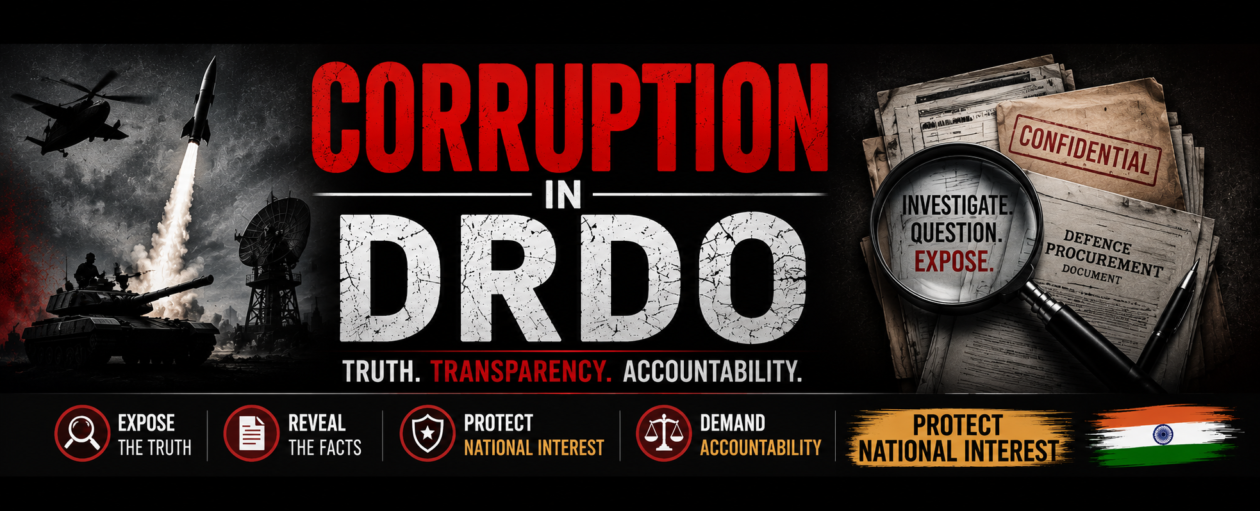
Tag Archives: Avinash Chander

Def Minister’s inquiry in DRDO’s TOT could open can of worms

Prateek Goyal- Friday, May 4, 2018 – Sakal Times

“Many old TOTs by DRDO given to industries will be under the scanner.”

The inquiry was ordered after a news report about the repetitions of TOT by DRDO at the Defence Expo held at Chennai in April.

Similiarly, in year 2013, one of the TOTs in question of an explosive device kit prepared by High Enegy Material Laboratory (HEMRL) Pune received a lot of media attention after the signing of MoU with a US-based company.

Sakal Times has found out that a propaganda of TOT was promoted in order to boost the image of DRDO after the corruption and nepostism in it was exposed by the audit report of Comptroller General of Defence Accounts (CGDA) in 2012.In order to Boost the image of DRDO Avinash Chander,the then director of DRDO in year 2013 served the old wine in new bottle and created a propoganda for reverse technology transfer to USA by forged TOT of explosive device kit prepared at HEMRL, Pune.

According to documents with Sakal Times, the patent for EDK was falsified and a memorandum of understanding (MOU) was signed with one South Carolina-based company – which was actually a car accessories’ company with only two employees.

Murky background
HEMRL developed the EDK technology and applied to patent it in March 1996. In February 2010, the EDK was patented in the name of its inventors – Rabindra Kumar Sinha, Jaman Singh Gharia, Usha Devi Ramchandran Nair and Hira Lal Yadav.

Despite this, HEMRL falsely credited the innovation on the name of another scientist who was not the inventor – Reny M Roy – and was sent to America. The letter from HEMRL stated that she is the team leader and her presence in USA for the demonstration is necessary.

Roy claims this is wrong information. “The team had not completed their work, it was us who made it operational. Nothing is on anybody’s name, please don’t do such things as DRDO is doing good work,” she said.

Sinha, one of the inventors of EDK, said, “We completed the project and we don’t know why our name has not come and it doesn’t affect us.”

The DRDO director in 2013, when the MOU was signed, Avinash Chander, is currently based in Hyderabad and defended his actions saying, “I am not responsible for this, I was not the head of HEMRL lab. You should ask the concerned director.”

Propaganda and repeated MOU of TOT

  • 2011: HEMRL signed the first MOU with Crowe and Company, a Summerville,South Carolina-based car accessory and consulting services company with annual revenue of USD 1 lakh and has two employees. The MOU was signed between the then HEMRL director Shubhanand Rao and Fay Crow, who was the president of Crowe and company. It is significant to note that before signing the MOU with Crowe and company, DRDO signed a licensing agreement for EDK with a NOIDA based company by the name of Vantage Integrated Security Solutions-which used to deal in the assembling of CCTV Cameras
  • 2012: Controller General of Defence Accounts audit reveals large scale corruption in DRDO projects and VK Saraswat, the then Director General was relieved from his services. The new Director Avinash Chander again signed an MOU with Crowe and Company in Washington DC.
  • 2013:The new Director Avinash Chander again signed an MOU with Crowe and Company in Washington DC. A big function was organized by the DRDO at US Chamber of Commerce building. A dinner party was also hosted by the then Indian Ambassador to Amercia Nirupama Roy for DRDO official and family members of Fay Crowe. A delegation of a dozen scientist including Chander, Roy and Satish Naik, a Technical officer took part in the event.
  • 2015: Chander was sacked by the then Defence Minister, Manohar Parrikar. DRDO team comprised Chander, Reny Roy and Satish Naik, technical officer in addition to nine officials

DRDO’s explanation

  • Though DRDO claims that no explanation was demanded from them, Directorate of Public Interface (DPI) of DRDO has sent an explanatory letter to Defence Minister dated April 23.
  • The letter stated that TOT’s were not repeated during the Defence Expo 2018, and that earlier the technology was demonstrated to clients and later a proposal for TOT was sent to them.
  • DRDO spokesperson Manish Bhardwaj told Sakal Times, “No such inquiry has been ordered by Honourable Raksha Mantri on this matter. The news report refereed by you is factually incorrect. A rebuttal was already sent to the concerned media by the Directorate of Public Relations (DPR), Ministry of Defence.”

————————————————————————————————————————————————————

www.cooruptionindrdo.com inputs on above article

DRDO News letter of May 2011 – EDK ToT news 

DRDO News letter of September 2013 –   EDK ToT in US with same company news 

Avinash Chander launching EDK ToT with Fay Crowe, Crowe & Company, US 

Dinner party was also hosted by the then Indian Ambassador to Amercia Nirupama Roy for DRDO official and family members of Fay Crowe.


With DRDO chief S Christopher’s posting, govt signals end of extension era

By Manu Pubby, ET Bureau | 30 May, 2015, 05.44AM IST

NEW DELHI: The government has sent a firm signal against the rampant culture of service extensions at Defence Research and Development Organisation (DRDO) with the appointment of its new head, S Christopher, who has superseded the top four scientists who are all on their second extension at the country’s premier research body.

While questions are now being raised about the future of the four scientists – who are designated as director generals of different branches at DRDO headquarters and are several years senior in service to Christopher – the government has made its preference for promoting younger scientists clear

When DRDO chief Avinash Chander was removed from his post in January, Defence Minister Manohar Parrikar had said that one of the reasons for the change was that the government wanted younger scientists to come up. Going by this principle, the government considered only Christopher and AM Datar for the post, with Christopher making the cut on the basis of seniority, officials said.
While Chander was removed from the job with a terse message from the cabinet secretariat, the future of the four scientists on second extension – which allows them to serve till the age of 64 against the retirement age of 60 – may not be too bright.

The second top appointment at DRDO is also being watched with much interest. The choice of GS Reddy, a missile scientist, to the newly created separate post of Scientific Advisor to the Raksha Mantri, is believed to be part of a new deep selection approach to groom talent. patern et 30 may 2015

S Christopher is new Director General of DRDO; GS Reddy appointed scientific advisor to Defence Minister

By ET Bureau | 28 May, 2015, 09.30PM IST

s-christopher-is-new-director-general-of-drdo-gs-reddy-appointed-scientific-advisor-to-defence-minister
After a gap of several months, DRDO has finally got a new leadership with Defence Minister Manohar Parrikar pushing through a new concept to divide the top post into two parts.

After a gap of several months, DRDO has finally got a new leadership with Defence Minister Manohar Parrikar pushing through a new concept to divide the top post into two parts.

The government on Thursday appointed S Christopher who heads the centre for airborne systems as the new Director General of DRDO with the rank of a secretary.
Splitting the top post, the government also appointed the younger GS Reddy – a missile scientist – as the scientific advisor to the defence minister. Reddy will directly report to Parrikar and will be the pointsman for the minister for defence research projects.

Both top officials have got a term for 2 years, though Reddy is expected to continue after that and would be a contender for top job of DG DRDO.
The new appointments come after DRDO chief Avinash Chander was removed from his post in January with Parrikar saying that the government wants to have a new, younger leadership for the organisation.

The splitting of the post ks first among a series of structural changes that are expected at DRDO in coming months.

It is still not clear how the responsibilities will be divided among the two as the ministry has not come out with a detailed notification.

Both officials are expected to be based in Delhi.

Another top DRDO scientist denied extension by Modi government

by Pranav Kulkarni | New Delhi | Published on:April 1, 2015 1:49 am – The Indian Express
Two months after it sacked Defence Research and Development Organisation (DRDO) chief Avinash Chander, the government has denied extension to a top DRDO scientist. Bikash Bhattacharya, who was on his first extension as the director of Pune-based High Energy Materials Research Laboratory (HEMRL), retired Tuesday. Besides him, the government in the past six months has denied extension to at least three top DRDO scientists.
While Chander was sacked unceremoniously citing the need for appointing younger scientists, the Modi government has on several platforms made public its intentions to streamline DRDO.
Sources in DRDO said the HEMRL director’s extension was recommended by Chander and was considered by the Appointments Committee of Cabinet (ACC). It was, however, rejected by the government “about 10 days ago”. Bhattacharya was formerly associated with ISRO.
Bhattacharya, 62, who took over as director, HEMRL on September 11, 2011 was already on one extension after he completed 60 years on March 23, 2013. As per DRDO’s existing promotion policy, two extensions are permitted for a tenure of two years after the scientist completes 60 years, the retirement age.
Bhattacharya is the fourth scientist to have been denied extension by the Modi government in the past six months. Others who were denied extension are directors of Defence Research & Development Establishment (DRDE), Defence Bioengineering and Electromedical Laboratory (DEBEL) and Electronics & Radar Development Establishment (LRDE) — M P Kaushik, V C Padaki and Venkatnarayana Raju, respectively.
The denial of extensions by the Modi government has reversed the trend of the UPA government which was criticised for making extensions a “norm” instead of an “exception”. In 2012 for instance, 11 top scientists were on extension at various laboratories across the country.

I smell malicious intention by DRDO officials, claims former Agni V programme director RK Gupta

Pranay Upadhyay, CNN-IBN Feb 06, 2015 at 12:35pm IST
New Delhi: A day after the project director of nuclear-capable Agni 5 missile programme at DRDO RK Gupta was removed, a letter has surfaced in which he has claimed that he was targeted by former DRDO chief Avinash Chander.
“I feel dishonoured the way I was treated. I smell malicious intention. My whole family is undergoing mental agony. In case of any untoward incident or accident, I fix responsibility on Dr Avinash Chander and Dr VG Sekaran,” Gupta writes in his letter.
Gupta was removed as director of Agni V programme a day after a successful test. While DRDO sources termed the transfer as “routine”, the officer alleged that he was singled out by two senior officials within the organisation including former chief Avinash Chander, who demitted his office on January 31.

 While DRDO sources termed the transfer as "routine", the officer alleged that he was singled out by two senior officials within the organisation including former chief Avinash Chander, who demitted his office on January 31.
While DRDO sources termed the transfer as “routine”, the officer alleged that he was singled out by two senior officials within the organisation including former chief Avinash Chander, who demitted his office on January 31.

Gupta has complained to the Defence Ministry that he received the letter, dated January 9, only on February 2 when he reached his office after the successful launch.
“With all humility and respect, I wish to bring to your notice that on February 2, I was relinquished from the post of project director Agni-V. I am shocked that such bad treatment is meted out to such a senior scientist with an excellent track record throughout service tenure,” he said in his letter to Defence Secretary RK Mathur, who is also holding the additional charge of DRDO.
Incidentally, Gupta’s name had come up in connection with the sudden termination of Chander’s contract by the government, 15 months ahead of his tenure.
It was then rumoured that one of the reasons for Chander’s removal was three complaints filed by individuals including by Gupta who has denied any such move.

Perform or perish

by Harsh Pant Wednesday, 4 February 2015 dna

The Modi government has done the right thing by jolting an ossified bureaucracy

India’s ossified bureaucracy is being shuffled like never before. The most recent development in this realm has been the rather dramatic sacking of Sujatha Singh from the post of the Foreign Secretary and the appointment of S Jaishankar to that position. The rumours about this development were floating around for quite some time. Still, when the decision actually came to replace Singh about seven months before the end of her tenure, it ended up sending shock waves through the complacent Indian foreign policy establishment.

No one seems to be contesting that Jaishankar is a great choice. Yet the critics of the decision have largely focused on bureaucratic niceties by suggesting Jaishankar’s appointment not only curtailed Singh’s career but also ended up blocking the career prospects of some senior Indian Foreign Service (IFS) officers. The reaction of the Congress Party has been rather strange with former information and broadcasting minister Manish Tewari trying to link the action to the Khobragade episode involving an IFS officer who was jailed in the US two years ago for allegedly mistreating her maid. He tweeted: “Is sacking of Foreign Secretary late retribution for her stand on Devyani Khobragade affair? Removal after a Presidential visit ‘coincidental’?”

Such criticisms of the government’s decision are missing the key point. This decision should be viewed as part of a larger, and much needed, bureaucratic shake-up that the Prime Minister is engendering. Just two weeks ago, the government had also terminated the appointment of the Defence Research and Development Organisation (DRDO) chief Avinash Chander, 15 months before his contract was to end.

Prime Ministers till now have devoted, at best, occasional interest in nuclear and strategic policy issues, mainly preferring to delegate substantial levels of policy making discretion to organisations like the Department of Atomic Energy (DAE) and the Defence Research and Development Organisation (DRDO). The conduct of the DRDO has been largely driven by an effort to protect its direct communicative link to the Prime Minister, secure recurrent generous funding, and maintain a high level of autonomy. Given its significant budgetary resources in the context of a developing nation, DRDO has repeatedly failed in delivering quality output. Major projects of the DRDO including the Light Combat Aircraft Tejas, Nag missile, Long-range Surface-to-Air missile project and the Airborne Early Warning and Control System have either not been completed on time or have resulted in huge cost overruns. It took the agency almost a decade and a half to operationalise the Agni-I.

The inattention or inability of the Prime Minister’s office so far to take concrete steps to improve the DRDO’s performance and compel it to cooperate with other defence bureaucratic stakeholders has permitted it a remarkable degree of self-governance in budgetary prioritisation, project design and delivery time-scale planning, and setting operational policy through regular statements outlining the doctrinal meaning of DRDO products. Prime Minister Modi had criticised the DRDO for its chalta hai attitude during an address in Kargil in August last year when he had said, “If a project was conceived in 1992, it should not be the case in 2014 we are still saying it will take some more time.” And in December last year, India’s Parliamentary Standing Committee on Defence had censured the DRDO, accusing it of shoddy research, chronic inefficiency, inordinate delays, corruption and its penchant for reverse engineering. The government seems to have taken the bull by the horns and removed Chander to ensure some semblance of accountability in the organisation.

The appointment of Jaishankar as foreign secretary is also along the same lines that merit would be rewarded. The Indian Foreign Service (IFS) needs to recognise that business as usual is no longer enough. At a time when India’s global imprint is expanding rapidly, a risk-averse foreign policy bureaucracy will not be able to meet the aspirations of the nation. The idea that seniority should determine who should be the nation’s top diplomat is an idea whose time has long gone. But bureaucratic resistance has prevented any substantive reforms in the service. There are hardly any incentives to perform and hardly any penalties for underperformance.

As a result, nearly everyone in the diplomatic service manages to rise to the upper echelons. Despite the fact that the best and the brightest are no longer attracted to the IFS, there have been few attempts to cultivate outside expertise, with hardly any opportunities for lateral entry or temporary rotations. In fact, it was Manmohan Singh who had wanted to introduce lateral entry in the Indian bureaucracy in his first term but the idea was quietly killed by the bureaucracy (who else?). Personnel are scarce and demands are growing on the IFS but Indian diplomats have not managed to transform the service and change its character to suit the needs of the time. Is it any wonder then that ad hocism pervades Indian foreign policy thinking?

Bureaucracies, if not competently led and directed, tend to morph into interest groups with a focus on preserving their own institutional privileges. In democracies, effective political control and guidance is absolutely critical if the role of bureaucracies is not to become corrosive on policymaking. It is in the nature of bureaucracies to be risk-averse. Leave them alone and they will muddle along the path of least resistance, trying to increase their power by resisting change. The Modi government is right in shaking things up and making Indian bureaucracies more accountable and effective. But much more remains to be done!

The author teaches at King’s College, London

‘Sacking Not a Good Word to Hear After 42 Years’, India’s Agni Man Says

http://www.ndtv.com/video/player/news/sacking-not-a-good-word-to-hear-after-42-years-india-s-agni-man-says/355104

Top scientist Avinash Chander, who was recently ousted as chief of the Defence Research and Development Organisation or DRDO has said the termination of his contract was “totally unexpected” and that he was taken by “surprise” by the swift move of the government. “Sacking is not a good word to hear after 42 years of service,” Mr Chander told NDTV, also saying that Defence Minister Manohar Parrikar was well within his rights to choose his team. The minister had said the government wanted younger scientists on the team.


Real reasons behind DRDO chief Avinash Chander’s sacking

Thursday, 15 January 2015 – 7:05am IST | Place: New Delhi | Agency: dna
Jyotika Sood, Iftikhar Gilani

Avinash Chander (left) has been terminated from the post of DRDO Chief File Photo dna Research & Archives

Three major complaints against Defence Research and Development Organisation (DRDO) chief Avinash Chander, including two anonymous ones, were pending before the Prime Minister’s Office in November 2014, when he was given a contract of 16 months on his retirement. It is reliably learnt that investigations into the complaints went against him and thus he was summarily sacked two months after the extension in service.

What were the complaints about?
According to RTI by Uttarakhand-based Prabhu Dandriyal in December 2014, and accessed by dna, PMO had stated that it had received three complaints against Avinash Chander. The details of the two complaints could not be ascertained. The third complaint was filed by R K Gupta of Advance System Laboratory, Hyderabad. According to PMO sources, Gupta had made an allegation against DRDO chief Avinash Chander for favouring his junior. Gupta was apparently superseded by his junior scientist by bending the rules, sources added.

Why was the PM peeved?
Chander had to face PM’s ire also because of the mess in the DRDO. As per the PMO estimates losses worth around Rs 29,000 crore were accrued due to time and cost overruns in acquisitions/developmental projects. For example, the indigenous Aircraft Carrier will now cost Rs 19,341 crore from its original cost of Rs 3,241 crore. Similarly, in case of the Stealth Guided Missile Destroyer, the cost has been revised from Rs 3,850 crore to Rs 11,662 crore and timelines have been revised from 2010-11 to 2015-16.

What did dna report highlight?
In December, dna had exposed how Parliament Standing Committee on defence had rapped up DRDO for its shoddy research, inordinate delays, corruption and its fancy for reverse engineering.

What’s Parrikar’s justification for sacking Chander?
On Wednesday, defence minister Manohar Parrikar said, “It was my recommendation that the DRDO chief’s post should be held by a young person and not by someone on contract.”

Interestingly, the government has taken action against Chander, but there are many more scientists in DRDO working under extension rules even after their retirement. As on September 1, 2014, around ten scientists in category of distinguished scientists i.e. special secretary level and over a dozen scientists on grade H — outstanding scientists i.e. additional secretary level – are still working in DRDO. But no termination orders have come against them.

The government’s reason seems to be also ironical as it has recently appointed Vijay Kumar Saraswat, former DRDO chief, as full-time member of newly formed Niti Aayog. Saraswat had worked as DRDO director general post 60 years. He had got an extension of two + two years and finally retired on May 31, 2013. Saraswat is Chander’s predecessor and according to a senior scientist in DRDO, “both have ideological differences which was known to scientific fraternity.”

What are Chander’s credentials?
Avinash Chander is an IIT Delhi graduate and joined DRDO in August 1972. He has won several awards, including DRDO medal for scientist of the year for AGNI I, and is called the chief architect of the long range ballistic missiles in India. He had retired on November 1, 2014 but was given an extension, on contractual basis, till May 2016.

DRDO chief sacked within 2 months of new contract

Indiatoday.in PTI New Delhi, January 13, 2015 | UPDATED 21:48 IST     The government on Tuesday removed Chief of top defence research organisation Avinash Chander, 15 months before his contract was to end.

The Appointments Committee of Cabinet headed by Prime Minister Narendra Modi “approved the termination” of the contract of Avinash Chander with effect from January 31, an official notification said.

Interestingly, Chander who was Secretary, Defence Research and Development cum Director General, DRDO and Scientific Advisor to the Defence Minister, had retired on November 30 last on attaining 64 years of age and he was given a contract for 18 months till May 31 next year.
The removal of Chander after being given a contract raises questions over the Government action.

Analysts believe that the action could have been taken against the backdrop of Prime Minister Narendra Modi’s comment that the ‘laid back’ attitude in the DRDO will not be tolerated during a visit last year.

Efforts to contact Chander did not fructify as he did not answer the calls made on his phone.

Chander joined DRDO in 1972 after completing graduation in Electrical Engineering from Indian Institute of Technology (IIT), Delhi.

Chander is the chief architect of Agni series of ballistic missile systems.

Development of Agni range of missiles under a highly-restrictive international control regimes was possible only out of his technology forecast, perspective planning and relentless efforts, DRDO officials said.

DRDO Chief Avinash Chander sacked 15 months ahead of his contract term

IBN Live – Jan 13, 2015 at 08:58pm IST
New Delhi: Government on Tuesday removed Chief of top defence research organisation Avinash Chander, 15 months before his contract was to end. The Appointments Committee of Cabinet headed by Prime Minister Narendra Modi “approved the termination” of the contract of Avinash Chander with effect from January 31, an official notification said.
Interestingly, Chander who was Secretary, Defence Research and Development cum Director General, DRDO and Scientific Advisor to the Defence Minister, had retired on November 30 last on attaining 64 years of age and he was given a contract for 18 months till May 31, 2016.
The removal of Chander after being given a contract raises questions over the Government action. Analysts believe that the action could have been taken against the backdrop of Prime Minister Narendra Modi’s comment that the ‘laid back’ attitude in the DRDO will not be tolerated during a visit last year.

avinashchander_630

Efforts to contact Chander did not fructify as he did not answer the calls made on his phone. Chander joined DRDO in 1972 after completing graduation in Electrical Engineering from Indian Institute of Technology (IIT), Delhi. Chander is the chief architect of Agni series of ballistic missile systems.
Development of Agni range of missiles under a highly- restrictive international control regimes was possible only out of his technology forecast, perspective planning and relentless efforts, DRDO officials said.